

1. Summary
The production of pesticide intermediates and dye precursors—involving critical reactions like chlorination, nitration, sulfonation, and amination—presents one of the most formidable challenges in industrial air pollution control. These processes do not simply release standard Volatile Organic Compounds (VOCs); they emit a toxic, corrosive cocktail of polyhalogenated organics (chlorobenzene, chloropropene), acid gases (HCl, SO2), and odorous sulfur/nitrogen compounds (H2S, mercaptans, amines). For manufacturers in Australian chemical hubs like Kwinana (WA), Altona (VIC), or Botany (NSW), dealing with these emissions is not just about environmental stewardship—it is a license-to-operate necessity.Standard thermal oxidizers often fail in these environments due to rapid corrosion from acid gases or insufficient residence time to fully destroy complex halogenated bonds, leading to the formation of dioxins. EVER-POWER has developed a specialized Corrosion-Resistant 5-Bed RTO System integrated with multi-stage scrubbing technology specifically for this sector. Unlike standard 3-bed systems, our 5-bed design provides the extended residence time and thermal stability required to break down refractory chlorinated compounds while ensuring >99% destruction efficiency (DRE). This robust solution effectively manages the “puff” emissions typical of batch reactor venting, ensuring your facility remains compliant with the strictest Australian and international standards.
2. Key Compliance Standards We Meet:
- EPA Victoria (Environment Protection Act 2017): We align with the “General Environmental Duty” (GED) by minimizing risks from Class 3 indicators (like Benzene and Vinyl Chloride) and ensuring strict odour control (<1 OU in residential buffers).
- NSW EPA (Protection of the Environment Operations Act 1997): Our systems are designed to meet Group 6 emission standards for solid particles and hazardous chemicals, specifically addressing the opacity and acid gas limits for chemical plants in the Botany Industrial Park area.
- National Pollutant Inventory (NPI): Our high DRE (>99%) significantly reduces the reportable threshold loads for key substances like toluene, xylenes, and particulate matter, simplifying your annual NPI reporting.
- Global Best Practices (EU BREF & US EPA): We adhere to the EU “Common Waste Water and Waste Gas Treatment/Management Systems in the Chemical Sector” (WGC BREF 2023) and US EPA NESHAP standards for pesticide active ingredients, ensuring your facility meets world-class safety benchmarks.
3. The 5-Bed RTO Advantage: Science Meets Durability
The core of our solution for pesticide and dye intermediates is the 5-Bed Regenerative Thermal Oxidizer. While 3-bed systems are common, 5-bed designs offer a critical advantage for halogenated waste streams: extended residence time and superior purging capabilities. The process begins with a multi-stage pre-treatment. High-concentration acid gases are first neutralized in a Caustic Scrubber. The gas then enters the RTO, where ceramic media preheats it to >800°C. In the combustion chamber, complex organic bonds are shattered. Crucially, the 5-bed design allows for a dedicated “purge” cycle that cleans the inlet bed of trapped VOCs before the flow reverses, preventing the momentary “puff” of untreated gas that plagues simpler systems.
Post-combustion, the exhaust—now containing HCl or SO2 from the oxidation of chlorinated/sulfurous compounds—is cooled via a Quench Tower and then passed through a final Polishing Scrubber. This ensures that no secondary pollution (acid rain precursors) is released. Our systems utilize High-Nickel Alloys (like Hastelloy) and specialized acid-resistant ceramic packing to withstand the extreme corrosive environment, ensuring a service life that outlasts standard carbon steel units by decades.
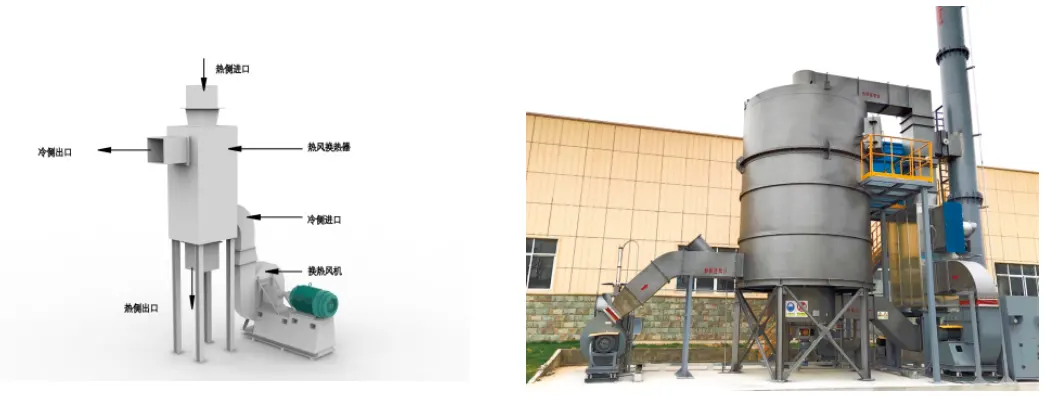

4. Ever Power RTO Technical Specifications
| Performance | 2-bed RTO | 3-bed RTO | Rotary Valve RTO | Notes |
|---|---|---|---|---|
| Technicality | First generation | Second generation | Third generation | |
| Number of chambers | 2 | 3 | 12 | Rotary valve operates continuously |
| Number of valves | 4 | 9 | / | |
| Reliability | Valve switching times per year: 350,000 | Valve switching times per year: 520,000 | / | |
| Piping pressure fluctuation | ±500pa | ±250pa | ±25pa | |
| Discharge compliance | Total purification efficiency: 95% | Total purification efficiency: 99% | Total purification efficiency: 99.5% | 99.5% |
| Maximum treating range | < 1g | < 5g | < 10g | 50mg/m³ discharge standard |
| Heat dissipation surface area | 100m² | 145m² | 95m² | |
| Energy saving | Thermal efficiency: 90% | Thermal efficiency: 95% | Thermal efficiency: 96% | 96% |
| Start-up heating time | 2.5h | 2.5h | 2h | Cold furnace start-up (Ethyl acetate) |
| Self-operation concentration | 2.5g/m³ | 2.2g/m³ | 1.8g/m³ | |
| Economy | Regenerative ceramic filling volume: 18m³ | Regenerative ceramic filling volume: 26m³ | Regenerative ceramic filling volume: 17m³ | 17m³ |
| Practicality | Occupation of land: L12×W7 | Occupation of land: L16×W7 | Occupation of land: L12×W7 | L12×W7 |
*Disclaimer: The other brand names mentioned above are provided solely for illustrative purposes. We do not offer original products or equipment bearing these brand names.
5. Market Trends: The Shift to Zero-Liquid Discharge & Energy Recovery
The Australian chemical manufacturing sector is undergoing a significant transformation driven by “Circular Economy” principles. A major trend is the move towards Energy-Neutral Compliance. Manufacturers are no longer satisfied with just destroying waste; they want to harvest the energy. Our modern RTOs act as thermal batteries, converting high-concentration solvent streams (common in pesticide synthesis) into heat energy that can be fed back into steam boilers or thermal oil heaters, offsetting natural gas consumption by up to 40%.
Another critical trend is Real-Time Digital Compliance Monitoring. With regulatory bodies like the NSW EPA utilizing remote sensing and community reporting apps, plants require automated, transparent emission data. EVER-POWER systems now come standard with IoT-enabled continuous emission monitoring systems (CEMS) that log HCl, VOC, and temperature data to the cloud, providing generated reports that satisfy audit requirements instantly and proactively flagging maintenance needs before a breach occurs.
6. Customer Success Story:
“We faced very complex emission problems at our chemical plant in Queensland, particularly with hydrogen chloride and nitrogen and sulfur compounds. Ever-Power’s 5-bed RTO system not only solved these harmful gas emissions but also handled the fluctuating emissions from our reactors, significantly improving our plant’s compliance and safety.”
“Our dye intermediate plant had experienced numerous fines due to non-compliance with chloride and sulfate emissions. Ever-Power’s customized RTO system brought about a real change for us, strictly complying with EPA Victoria requirements and significantly reducing energy consumption through heat recovery, saving us considerable costs.”
“Ever-Power’s RTO system truly solved all the pain points at our plant, especially its specialized ‘cleaning’ cycle design, which ensures that even during instantaneous releases from batch reactors, the system can promptly eliminate ‘instantaneous release’ pollutants, completely avoiding emission exceedances.”
“The traditional thermal oxidizers we used before always had problems when dealing with corrosive gases like sulfur and chlorides. Ever-Power’s 5-bed RTO system has a very robust design, utilizing acid-resistant ceramics and high-nickel alloys, ensuring long-term operation in extreme environments. Now we can confidently handle those challenging chemical waste gases.”
“For us, Ever-Power’s RTO system is more than just a compliance tool; it has become an integral part of our production process. Through waste gas heat recovery, we use the waste gas to power our steam boilers, reducing natural gas consumption by 40%, which has brought significant economic benefits to our production.”
“As a chemical plant located in the Botany industrial park, we have always faced strict emission limits. Ever-Power’s RTO system perfectly meets NSW EPA emission standards, handling a large volume of toxic gases and maintaining efficient operation with virtually no maintenance. Our compliance has been greatly improved.”
7. About us | EVER-POWER Manufacturing: Custom-Built for Corrosive Realities
Ever-Power specializes in bespoke RTO solutions for the unique challenges of Australian asphalt producers—from high-silica dust in outback quarries to coastal humidity in Queensland plants. Our engineering team conducts on-site exhaust profiling to size pre-filters, select corrosion-resistant alloys, and optimize heat recovery based on your utility needs. With service hubs in Sydney and Perth, we offer rapid spare parts delivery, operator training in English, and 24/7 remote diagnostics. Unlike generic suppliers, we deliver full turnkey projects including civil works coordination, commissioning, and compliance documentation aligned with NSW EPA or VIC DELWP requirements. Every system is factory-tested before shipment to ensure seamless startup.
9. Related Solutions


10. Frequently Asked Questions (FAQ)
Q1. Why is a 5-bed RTO better than a 3-bed design for chlorinated pesticide waste?
A1. Great question. While 3-bed systems are good, 5-bed designs offer superior management of “untreated puffs” during valve switching. For chlorinated waste, this is crucial to prevent unburnt precursors from reforming into dioxins or escaping as odour, ensuring you meet the strict >99% DRE required for toxic compounds.
Q2. How does your system handle the corrosive HCl gas produced during combustion?
A2. Corrosion is the enemy here. We tackle it two ways: first, the RTO internals are lined with specialized acid-resistant ceramic blocks and Hastelloy components. Second, we integrate a Quench tower and Caustic Scrubber immediately after the combustion chamber to neutralize the HCl gas before it enters the exhaust stack.
Q3. Can this RTO system handle the fluctuating flow rates from our batch reactors?
A3. Absolutely. Batch processing creates wild swings in flow and concentration. Our systems use variable frequency drives (VFDs) on the main fan and a sophisticated pressure control loop to maintain steady negative pressure in your reactor headers, regardless of whether you are running one vessel or five.
Q4. What is the estimated cost of an RTO for a medium-sized dye intermediate plant in Sydney?
A4. Costs vary based on airflow (Nm³/h) and material requirements (e.g., amount of Hastelloy needed). However, for a typical 15,000 Nm³/h system with scrubbing, the investment is significant but often recovered within 2-3 years through energy savings if you utilize our waste heat recovery options. Contact us for a precise quote.
Q5. Do you provide local maintenance support in Australia for these complex systems?
A5. Yes, we do. We understand that downtime isn’t an option. We partner with specialized Australian engineering firms in VIC, NSW, and WA to provide installation, commissioning, and 24/7 emergency support, ensuring your compliance monitors always stay in the green.
Q6. How do you prevent explosions when treating high-concentration solvent streams?
A6. Safety is paramount. Our systems include multiple layers of protection: LEL (Lower Explosive Limit) analyzers at the inlet, flame arrestors, and automated fresh air dilution valves. If concentrations exceed 25% LEL, the system automatically dilutes the stream or diverts it to a safety bypass to prevent any risk.
Q7. Can the heat from the RTO be used to power our solvent recovery distillation columns?
A7. Yes, this is a very popular configuration. We can install a waste heat boiler on the RTO exhaust to generate steam (e.g., 6-10 bar). This steam can be piped directly to the reboilers of your distillation columns, essentially using your waste solvents to power your production process.
Q8. Does your system comply with the new NPI reporting requirements for Australian industry?
A8. Definitely. Our digital control systems log all flow and temperature data needed for National Pollutant Inventory calculations. Furthermore, by destroying >99% of VOCs, you significantly lower your reportable emissions, which is great for your annual environmental reports.
Q9. How long does the ceramic packing last in a sulfonated gas environment?
A9. In standard RTOs, sulfur can cause glazing or plugging. We use structured ceramic packing with a specific chemical formulation resistant to sulfur attack and thermal shock. With proper maintenance and our recommended “bake-out” cycles, the media typically lasts 5+ years before needing partial top-up.
Q10. What is the lead time for delivery to the Port of Melbourne or Botany?
A10. For a custom 5-bed system involving exotic alloys, manufacturing typically takes 16-20 weeks. Shipping to Australian major ports adds about 3-4 weeks. We recommend engaging with us early in your project planning phase to align with your plant shutdown schedules.
Editor: PXY