

1. Summary
99.5% Destruction Efficiency | 97% Thermal Energy Recovery | Australian EPA Compliance
Transform your distillery’s environmental footprint with EVER-POWER’s Regenerative Thermal Oxidizer (RTO) technology. Specifically engineered for the volatile organic compound (VOC) profiles of DDGS drying and grain processing, our systems ensure your facility meets New South Wales (NSW) EPA and Victoria DELWP standards while slashing fuel consumption through advanced ceramic heat exchange.
2. Five Key Facts
As the Australian craft spirits and industrial ethanol sectors expand, the environmental scrutiny on “spent grain” processing has reached a tipping point. Drying Distillers Dried Grains with Solubles (DDGS) is an energy-intensive process that releases complex VOCs, including ethanol, organic acids, and odorous aldehydes. EVER-POWER provides the engineering bridge between production scaling and environmental stewardship.
- ✔ 99% VOC Destruction: Thermal oxidation at 850°C ensures complete breakdown of heavy grain vapors.
- ✔ Ultra-Low Fuel Consumption: Our 3-tower RTO designs maintain self-sustaining combustion at low LEL levels.
- ✔ Odor Neutralization: Total elimination of the “burnt grain” scent often cited in community complaints.
- ✔ 24/7 Monitoring: Integrated Siemens PLC systems for remote diagnostics across the Outback or coastal hubs.
- ✔ Rapid ROI: Heat bypass options allow for pre-heating dryer intake air, cutting boiler loads by up to 35%.


3. Ever Power RTO Technical Specifications
| Performance | 2-bed RTO | 3-bed RTO | Rotary Valve RTO | Notes |
|---|---|---|---|---|
| Technicality | First generation | Second generation | Third generation | |
| Number of chambers | 2 | 3 | 12 | Rotary valve operates continuously |
| Number of valves | 4 | 9 | / | |
| Reliability | Valve switching times per year: 350,000 | Valve switching times per year: 520,000 | / | |
| Piping pressure fluctuation | ±500pa | ±250pa | ±25pa | |
| Discharge compliance | Total purification efficiency: 95% | Total purification efficiency: 99% | Total purification efficiency: 99.5% | 99.5% |
| Maximum treating range | < 1g | < 5g | < 10g | 50mg/m³ discharge standard |
| Heat dissipation surface area | 100m² | 145m² | 95m² | |
| Energy saving | Thermal efficiency: 90% | Thermal efficiency: 95% | Thermal efficiency: 96% | 96% |
| Start-up heating time | 2.5h | 2.5h | 2h | Cold furnace start-up (Ethyl acetate) |
| Self-operation concentration | 2.5g/m³ | 2.2g/m³ | 1.8g/m³ | |
| Economy | Regenerative ceramic filling volume: 18m³ | Regenerative ceramic filling volume: 26m³ | Regenerative ceramic filling volume: 17m³ | 17m³ |
| Practicality | Occupation of land: L12×W7 | Occupation of land: L16×W7 | Occupation of land: L12×W7 | L12×W7 |
4. Strategic Comparison & Brand Compatibility
While the global market features several reputable thermal oxidation providers, EVER-POWER offers a localized engineering approach that prioritizes long-term maintenance simplicity in the Australian context.
Disclaimer: Mention of third-party brands such as Dürr™ or Anguil™ is for technical reference and industry comparison purposes only. EVER-POWER is an independent manufacturer of high-performance RTO systems and is not affiliated with, sponsored by, or endorsed by these trademark holders.
| Feature | Standard Industry Models | EVER-POWER RTO Advantage |
|---|---|---|
| Valve Actuation | Pneumatic Cylinders | High-Speed Electric Servo (Optional for precision) |
| Particulate Handling | External Baghouse required | Integrated Pre-filtration + Self-cleaning bake-out |
| Local Support | Fly-in Technicians from US/EU | Service hubs in Sydney & Perth; 24/7 Remote Login |
*Disclaimer: The other brand names mentioned above are provided solely for illustrative purposes. We do not offer original products or equipment bearing these brand names.
5. Regulatory Landscape: Navigating Global & Local Compliance
For an Australian distillery, compliance isn’t just about the Protection of the Environment Operations (POEO) Act in NSW or the Environmental Protection Act 1994 in Queensland. As the world moves toward unified ESG (Environmental, Social, and Governance) reporting, our RTOs are designed to meet the world’s most stringent standards, allowing our clients to export DDGS as “Carbon-Neutral Certified” or “Low-Emission Grain.”
Australian & Regional Neighbors
- Australia: National Environment Protection Measures (NEPM) for Air Quality.
- New Zealand: Resource Management Act (RMA) – Focus on Odor Control.
- Indonesia: P.20/MENLHK/SETJEN/KUM.1/6/2017 regarding emission standards for carbon sources.
- Vietnam: QCVN 19:2009/BTNMT on industrial emission of inorganic substances and dusts.
Global Tier-1 Markets (Top 30 Industry Players)
- USA: EPA Clean Air Act Title V Compliance.
- Germany: TA-Luft (Technischen Anleitung zur Reinhaltung der Luft).
- China: GB37822-2019 (Volatile Organic Compounds Fugitive Emission Control Standard).
- Brazil: CONAMA Resolution 436 for stationary source emissions.
6. Bespoke Solutions for the Australian Landscape
Ever-Power specializes in bespoke RTO solutions for the unique challenges of Australian asphalt producers—from high-silica dust in outback quarries to coastal humidity in Queensland plants. Our engineering team conducts on-site exhaust profiling to size pre-filters, select corrosion-resistant alloys, and optimize heat recovery based on your utility needs. With service hubs in Sydney and Perth, we offer rapid spare parts delivery, operator training in English, and 24/7 remote diagnostics. Unlike generic suppliers, we deliver full turnkey projects including civil works coordination, commissioning, and compliance documentation aligned with NSW EPA or VIC DELWP requirements. Every system is factory-tested before shipment to ensure seamless startup.

7. Installation Strategy: 8 Steps to Commissioning
- Site Survey & Gas Profiling: We measure your dryer’s peak VOC swings and particulate load.
- Foundation & Civil Prep: Coordinating concrete pad specs for high-tonnage RTO towers.
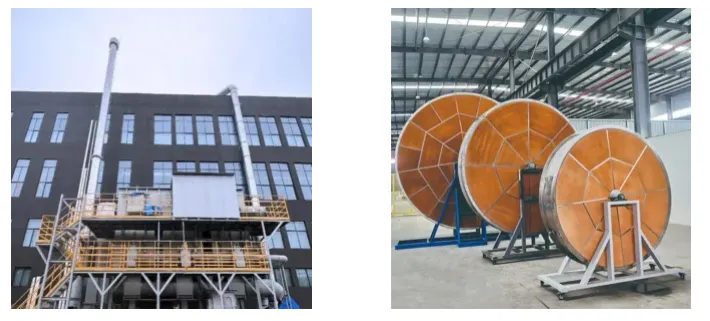
- Mechanical Assembly: Rigging of heat exchange chambers and combustion manifold.
- Ceramic Media Loading: Precision placement of honeycomb or random saddles to prevent channeling.
- Electrical & Controls Integration: Wiring to your local SCADA or factory management system.
- Gas Train Certification: Ensuring all piping meets AS 3814 gas safety standards.
- Cold/Hot Commissioning: Testing valve timing, burner ignition, and bypass logic.
- Compliance Testing: Third-party stack testing to certify 99%+ DRE for your operating permit.
8. Customer Success Case Study
“When we were drying DDGS (Distillers Dried Grains with Solubles), the biggest headache was the sweet, burnt grain smell, which led to significant community complaints. After Ever-Power’s RTO (Regenerative Thermal Oxidizer) system was installed, the odor was virtually eliminated, and we can now finally expand production with peace of mind.”
“To be honest, our biggest concern initially was the RTO’s gas costs. However, in actual operation, the system is self-sustaining for most of the time, and the boiler load has decreased significantly. Combined with waste heat recovery, our overall energy bill is considerably lower than before, and the ROI is very clear.”
“We had previously contacted several environmental equipment suppliers, but their proposed solutions were very generic. Ever-Power, however, clearly analyzed the ethanol, aldehydes, and grain VOCs in the early stages, and their design was entirely tailored to DDGS drying, rather than using a generic template. This gave us great confidence.”
“Now that everyone is talking about ESG and net-zero emissions, a key reason we chose Ever-Power is that their equipment supports hydrogen co-firing and future carbon capture from the outset. When policies become stricter, we won’t need to start from scratch; this is a long-term investment.“
“From initial exhaust gas analysis and equipment design to installation, commissioning, and subsequent maintenance, Ever-Power didn’t just sell us a piece of equipment and leave. They truly considered long-term operation and compliance issues from the factory’s perspective, which is quite rare in the Australian market.”
9. Knowledge Graph: The RTO Ecosystem
Understanding an RTO requires looking at it as a integrated heat-work system. Our designs incorporate:
1. Primary Recovery: Ceramic media capturing 95% of thermal energy.
2. Secondary Recovery: Hot air heat exchangers to pre-heat boiler feed water or dryer intake.
3. Tertiary Safety: Multi-sensor LEL monitors and explosion relief panels.
4. Parts & Consumables: We stock UV scanners, high-temp gaskets, and valve seats for immediate dispatch from our Australian warehouses.
10. Related Solutions



11. Frequently Asked Questions (FAQ) – Voice Search Optimized
Q1. How much does a new RTO system cost for a mid-sized Australian distillery?
A1. The price of an RTO system varies based on airflow (Nm³/h) and VOC concentration, typically ranging from $250,000 to $1.2M AUD. Factors like stainless steel requirements for corrosive vapors and secondary heat recovery options will influence the final quote. Contact our Sydney engineering team for a site-specific budgetary estimate.
Q2. What is the typical maintenance schedule for an RTO in a DDGS drying plant?
A2. We recommend a monthly inspection of valve seals and burner performance, followed by a semi-annual internal inspection of ceramic media for particulate build-up. Our automated “Bake-out” cycle handles most organic residues, but a physical clean-out may be needed every 24-36 months depending on your pre-filtration efficiency.
Q3. Where can I find a reliable RTO supplier with local support in Perth or Western Australia?
A3. EVER-POWER maintains service hubs and technical advisors across both the East and West coasts. Our Perth-based technicians are trained specifically for the Western Australian mining and food processing sectors, ensuring rapid response for regional distilleries and grain handlers.
Q4. Which environmental regulations govern VOC emissions for ethanol production in New South Wales?
A4. In NSW, the Protection of the Environment Operations (Clean Air) Regulation 2021 sets strict limits on VOC concentrations. Distilleries usually fall under “Scheduled Premises” requiring an Environment Protection License (EPL) that specifies exact destruction efficiencies, often achieved only through RTO technology.
Q5. How does a regenerative thermal oxidizer improve the ROI of my grain drying operations?
A5. By capturing up to 97% of the heat generated during oxidation, the RTO becomes nearly self-sustaining. This eliminates the massive fuel bills associated with traditional thermal afterburners. Additionally, we can integrate a secondary heat exchanger to use “waste” heat for your distillery boilers, further cutting utility costs.
Q6. What happens if the RTO shuts down during a production run of DDGS?
A6. Our systems include an automated fail-safe bypass damper. If the RTO detects a critical fault, the process air is diverted to a safe stack (depending on your local permit) to prevent pressure build-up in the dryer, while the PLC triggers an immediate alert to your operators via SMS or SCADA.
Q7. Are there government grants or EV/Renewable subsidies for RTO investment in Australia?
A7. Yes, many states offer energy efficiency grants or decarbonization incentives for industries moving away from high-carbon footprints. While not an EV subsidy, the “Modern Manufacturing Initiative” or regional “Regional Job Creation Funds” often cover up to 30% of environmental equipment costs for eligible facilities.
Q8. Can an RTO handle both ethanol vapors and grain dust simultaneously?
A8. Yes, but it requires a specialized design. EVER-POWER utilizes high-velocity ceramic media and cyclonic pre-separators to remove heavy dust before the air enters the RTO, preventing the honeycomb structure from clogging while still oxidizing 99% of the ethanol and organic odors.
Q9. How long is the service life of an EVER-POWER RTO system?
A9. With proper maintenance, the main shell and structure of our RTOs are designed for a 20-25 year lifespan. Ceramic media typically requires replacement every 7-10 years, and mechanical components like valve gaskets are replaced every 2-3 years as part of a proactive service plan.
Q10. Why should I choose a 3-tower RTO over a 2-tower model for odor control?
A10. A 3-tower RTO provides a “purge” cycle that prevents the small amount of untreated VOCs trapped in the inlet chamber from escaping during valve switches. For distilleries located near residential areas, this 0.5% difference in destruction is critical for preventing “smell complaints” and maintaining your social license to operate.
Customer Success Stories
Industry Trends & ROI: The Future of Distilling in Australia
The trend toward “Net Zero Spirits” is no longer optional. Leading Australian gin and whiskey brands are now utilizing their environmental compliance as a marketing tool. An RTO is not just a “cost center”; it is a vital part of a circular economy.
Financial Impact: For a facility processing 50,000 Nm³/h of dryer exhaust, switching from a direct-fired afterburner to an EVER-POWER RTO can save over $180,000 AUD annually in natural gas costs alone. When factoring in Carbon Credits (ACCUs) and the ability to sell “Green DDGS” to the livestock sector, the payback period is often less than 3.5 years.
Ready to Future-Proof Your Distillery?
Contact our Australian engineering team today for a free exhaust gas analysis and RTO sizing consultation.
Editor: PXY