

1. Summary
In the vast landscapes of Australia, where urban expansion meets environmental stewardship, managing landfill gas (LFG) has become a critical challenge. Landfill sites, from bustling Sydney suburbs to remote outback operations in Western Australia, generate methane-rich gases that pose risks to air quality and climate goals. Regenerative Thermal Oxidizers (RTOs) offer a robust solution for purifying these emissions, especially in auxiliary airflow systems that handle diluted or low-concentration streams. This article explores how RTO for landfill gas purification can transform waste management practices Down Under, drawing on local regulations, global trends, and tailored engineering from Ever-Power(Australia) Co., Ltd.
As a leading provider of industrial air pollution control systems, Ever-Power specializes in customizing RTO units to meet Australia’s unique environmental demands. Whether you’re operating a site in Melbourne’s industrial zones or Brisbane’s coastal areas, our systems ensure compliance while optimizing energy recovery. For more on our innovations, check out our company overview.
2. Understanding Landfill Gas and the Role of RTO in Purification
Landfill gas is a byproduct of organic waste decomposition, primarily consisting of methane (CH4) and carbon dioxide (CO2), with traces of volatile organic compounds (VOCs), hydrogen sulfide (H2S), and other odorous compounds. In auxiliary airflow scenarios—such as venting from leachate treatment ponds or gas collection headers—these streams are often diluted, making direct flaring inefficient and environmentally suboptimal.
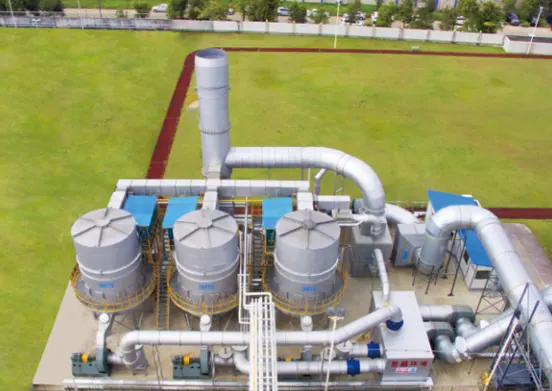
RTO technology steps in by using ceramic media beds to recover up to 95% of the heat from combustion, oxidizing harmful gases at temperatures around 800-1000°C. This process converts methane and VOCs into harmless water vapor and CO2, achieving destruction removal efficiencies (DRE) of over 99%. For Australian operators, this means handling variable gas flows from 5,000 to 50,000 Nm³/h with minimal fuel input, keeping operational costs low amid rising energy prices.
One unique viewpoint here is integrating RTO with carbon capture units. By capturing post-combustion CO2, operators can reduce their site’s carbon footprint by up to 40%, aligning with Australia’s push toward net-zero emissions by 2050. This isn’t just compliance—it’s a pathway to carbon credits under schemes like the Emissions Reduction Fund.
3. Global and Local Regulations Shaping RTO Adoption in Landfill Gas Management
Navigating regulations is key for any landfill operator investing in regenerative thermal oxidizer Australia. In Australia, the National Environment Protection (Ambient Air Quality) Measure sets strict limits on methane and VOC emissions, with states like New South Wales enforcing the Protection of the Environment Operations Act 1997, requiring DRE above 98% for auxiliary streams. Victoria’s Environment Protection Authority (EPA) mandates best practice techniques under the Environment Protection Regulations 2021, often favoring RTO over traditional flares due to lower NOx emissions.
Neighboring countries echo this rigor. New Zealand’s Resource Management Act 1991 and Air Quality Regulations demand VOC reductions in landfill vents, pushing RTO use in sites near Auckland. Indonesia, a key Pacific neighbor, enforces Minister of Environment Regulation No. 5/2021, limiting H2S to 0.02 mg/m³, making RTO essential for Java’s urban landfills. Papua New Guinea’s Environment Act 2000 focuses on odor control, aligning with RTO’s high-efficiency oxidation.
Globally, top landfill-intensive nations set benchmarks. The United States’ EPA New Source Performance Standards (NSPS) under 40 CFR Part 60 require 98% methane destruction for auxiliary flows, with states like California mandating RTO for low-BTU gases. China’s GB 16297-1996 and recent VOC Control Standards cap emissions at 120 mg/m³, favoring RTO in provinces like Guangdong. In the European Union, the Industrial Emissions Directive (2010/75/EU) and Best Available Techniques (BAT) Reference Document for Waste Treatment insist on thermal oxidation for odorous gases, influencing countries like Germany and France. Brazil’s CONAMA Resolution 430/2011 limits VOCs in Rio de Janeiro landfills, while India’s Central Pollution Control Board guidelines under the Air (Prevention and Control of Pollution) Act 1981 promote RTO for methane abatement in Delhi and Mumbai sites. South Korea’s Clean Air Conservation Act requires 95% efficiency, and Japan’s Air Pollution Control Act sets similar standards for Tokyo-area facilities.
4. Ever Power RTO Technical Specifications
| Performance | 2-bed RTO | 3-bed RTO | Rotary Valve RTO | Notes |
|---|---|---|---|---|
| Technicality | First generation | Second generation | Third generation | |
| Number of chambers | 2 | 3 | 12 | Rotary valve operates continuously |
| Number of valves | 4 | 9 | / | |
| Reliability | Valve switching times per year: 350,000 | Valve switching times per year: 520,000 | / | |
| Piping pressure fluctuation | ±500pa | ±250pa | ±25pa | |
| Discharge compliance | Total purification efficiency: 95% | Total purification efficiency: 99% | Total purification efficiency: 99.5% | 99.5% |
| Maximum treating range | < 1g | < 5g | < 10g | 50mg/m³ discharge standard |
| Heat dissipation surface area | 100m² | 145m² | 95m² | |
| Energy saving | Thermal efficiency: 90% | Thermal efficiency: 95% | Thermal efficiency: 96% | 96% |
| Start-up heating time | 2.5h | 2.5h | 2h | Cold furnace start-up (Ethyl acetate) |
| Self-operation concentration | 2.5g/m³ | 2.2g/m³ | 1.8g/m³ | |
| Economy | Regenerative ceramic filling volume: 18m³ | Regenerative ceramic filling volume: 26m³ | Regenerative ceramic filling volume: 17m³ | 17m³ |
| Practicality | Occupation of land: L12×W7 | Occupation of land: L16×W7 | Occupation of land: L12×W7 | L12×W7 |
5. Emerging Trends in RTO for Landfill Gas Purification
The landscape of landfill gas management is evolving rapidly, driven by sustainability imperatives. One trend is the shift toward hydrogen-fueled burners in RTO systems, reducing reliance on natural gas and slashing operational carbon emissions by 50-70%. In Australia, where hydrogen hubs are emerging in Queensland, this could integrate with green hydrogen supplies for zero-emission oxidation.
Another innovation is pairing RTO with zeolite wheel concentrators for ultra-low concentration auxiliary streams. This combo boosts inlet VOC levels 10-20 fold, enabling self-sustaining combustion and cutting energy costs by 30%. For sustainable analysis, consider a typical 20,000 Nm³/h Australian landfill RTO: It might oxidize 500 tons of methane annually, equivalent to avoiding 10,500 tons of CO2e emissions (using EPA’s global warming potential factor of 21 for methane). This not only meets Australia’s Safeguard Mechanism but positions operators as climate leaders.
Finally, a fresh perspective: RTOs are now incorporating AI-driven predictive maintenance, using sensors to forecast ceramic bed fouling from siloxanes in landfill gas, extending system life by 20% and minimizing downtime in remote sites like those in the Northern Territory.
6. Ever-Power’s Customized RTO Solutions for Australian Landfill Challenges
At Ever-Power(Australia) Co., Ltd., we go beyond off-the-shelf systems. Ever-Power specializes in bespoke RTO solutions for the unique challenges of Australian asphalt producers—from high-silica dust in outback quarries to coastal humidity in Queensland plants. Our engineering team conducts on-site exhaust profiling to size pre-filters, select corrosion-resistant alloys, and optimize heat recovery based on your utility needs. With service hubs in Sydney and Perth, we offer rapid spare parts delivery, operator training in English, and 24/7 remote diagnostics. Unlike generic suppliers, we deliver full turnkey projects including civil works coordination, commissioning, and compliance documentation aligned with NSW EPA or VIC DELWP requirements. Every system is factory-tested before shipment to ensure seamless startup.
7. Customer Success Stories
Client 1 Profile: Western Australia – Landfill Gas Management
Customer Reviews:
“Our landfill site in the Pilbara region deals with fluctuating methane emissions, especially during the wet season. The harsh environmental conditions, combined with fluctuating VOC concentrations, made it difficult to maintain compliance with local regulations. Ever-Power’s RTO system has exceeded our expectations. The integration of the rotary valve RTO with zeolite concentrators has significantly reduced fuel consumption by 40%, and the system reliably maintains a 99% VOC destruction rate. We’ve reduced our operational costs and are confident that we’re meeting the stringent requirements of the Western Australia Department of Water and Environmental Regulation (DWER). The installation was smooth, and Ever-Power’s team provided excellent training and ongoing support.”
— Sarah L., Environmental Manager, Western Australia
Client 2 Profile: New Zealand – Auckland Landfill
Customer Reviews:
“Managing VOC emissions in our Auckland landfill is crucial for both regulatory compliance and the health of surrounding communities. Ever-Power’s RTO system was recommended to us due to its efficiency in treating low-concentration gas streams. Since installing the system, we’ve seen a dramatic improvement in emissions control, reducing VOCs to well below the 50 mg/m³ limit imposed by the Resource Management Act. The heat recovery feature has been a game-changer, saving us on energy costs, and the system’s performance has been outstanding even during Auckland’s humid conditions. The team at Ever-Power has been incredibly responsive, providing local support whenever needed.”
— Michael T., Site Operations Lead, Auckland
Client 3 Profile: California, USA – Superfund Site Remediation
Customer Reviews:
“We’ve been working on remediating a Superfund site in California that has been heavily contaminated with volatile organic compounds, especially toluene and benzene. Ever-Power’s RTO system was the perfect solution for our project. The system handles large volumes of extracted landfill gas, achieving 99% VOC destruction while maintaining consistent performance throughout fluctuating gas flows. The system also features carbon capture integration, which has been a major plus for us as we’re now able to recover CO₂, reducing our overall emissions. We’re saving on energy costs due to the heat recovery, and the system is easy to maintain. The Ever-Power team’s expertise in navigating EPA standards made the entire process straightforward.”
— Brian H., Environmental Consultant, California
Client 4 Profile: Indonesia – Jakarta Landfill
Customer Reviews:
“Operating in Jakarta, where landfill gas management is critical due to rapid urbanization, Ever-Power’s RTO system has provided a reliable solution for managing methane and VOCs from our landfill site. The system’s 99.5% efficiency in treating low-concentration gas streams has helped us stay within the regulatory limits set by the Ministry of Environment Regulation No. 5/2018. The ability to recover up to 95% of heat through the RTO system has also significantly reduced our operational costs. The team at Ever-Power worked with us to customize the system to suit the high humidity and specific contaminants of our site. The installation was smooth, and ongoing support has been excellent.”
— Dewa P., Project Manager, Jakarta
8. Related Solutions

9. Frequently Asked Questions (FAQs)
Q1. How much does a regenerative thermal oxidizer cost for landfill gas purification in Sydney, Australia?
A1. Costs typically range from AUD 500,000 to 2 million, depending on airflow capacity and custom features like zeolite integration; contact us for a site-specific quote aligned with NSW EPA standards.
Q2. What is the best RTO supplier for auxiliary airflow management in New Zealand landfills near Auckland?
A2. Ever-Power stands out with localized support and hydrogen-compatible designs; we comply with Resource Management Act requirements and offer competitive pricing—request a free consultation today.
Q3. Where can I find a reliable RTO system for methane abatement in Indonesian urban landfills like those in Jakarta?
A3. Our systems meet Minister of Environment Regulation No. 5/2021; with turnkey installation, we ensure 99% DRE—get a customized price estimate for your project.
Q4. Which RTO technology handles low-concentration landfill gas in US sites like California, and what’s the price range?
A4. Our rotary valve RTO with carbon capture add-ons excels under EPA NSPS; pricing starts at USD 400,000—let’s discuss your compliance needs for an accurate quote.
Q5. How to choose an RTO for odor control in Chinese landfills in Guangdong province, including installation costs?
A5. Select models with high heat recovery for GB 16297-1996 compliance; our full-service packages include installation from CNY 3-10 million—contact for a detailed supplier proposal.
Q6. What are the maintenance costs for RTO in EU landfills under Industrial Emissions Directive, say in Germany?
A6. Annual maintenance is around EUR 20,000-50,000 with our predictive AI features; we align with BAT standards—request a cost breakdown from our European partners.
Q7. Where to buy a custom RTO for Brazilian landfills in Rio de Janeiro complying with CONAMA Resolution 430/2011?
A7. Ever-Power offers bespoke units with local certification; expect BRL 1-4 million investments—get a supplier quote tailored to your site’s auxiliary flows.
Q8. How does RTO pricing work for South Korean landfills under Clean Air Conservation Act in Seoul areas?
A8. Pricing from KRW 500-2,000 million includes 24/7 diagnostics; our systems achieve 95% efficiency—let’s provide a free quote for your commercial needs.
Q9. What RTO options are available for Indian landfills in Delhi following Air Pollution Control Act guidelines, and supplier costs?
A9. Our zeolite-enhanced RTOs meet CPCB standards starting at INR 3-10 crore; contact us for a supplier evaluation and pricing details.
Q10. When should I install an RTO for auxiliary gas streams in Japanese landfills near Tokyo, including quote timelines?
A10. Install before peak emissions seasons to comply with Air Pollution Control Act; quotes delivered in 48 hours—reach out for your site’s cost analysis.
Editor: PXY