

1. Summary
In the rigorous landscape of petrochemical and pharmaceutical manufacturing, the management of Volatile Organic Compounds (VOCs) emitted during emergency venting or routine pressure relief is critical. This comprehensive guide explores the application of Regenerative Thermal Oxidizers (RTOs) specifically designed for Reactor and Distillation Column Safety Valve Venting. We analyze the specific regulatory requirements in Australia (EPA Victoria, NSW EPA) and global standards, technical specifications for handling high-concentration surges, and the economic benefits of switching to our advanced Rotary RTO systems.
2. The Critical Challenge: Managing Intermittent High-Flow Emissions
Handling waste gas streams from reactor and distillation column safety valves presents a unique engineering challenge that differs significantly from steady-state process emissions. Unlike continuous exhaust streams, safety valve vents are characterized by sudden, intermittent surges of high-pressure, high-concentration VOCs. For plant managers in Australia’s heavy industrial hubs—such as Kwinana in Western Australia or the Altona complex in Victoria—this unpredictability is a compliance nightmare. Standard thermal oxidizers often fail to cope with the rapid fluctuation in Lower Explosive Limit (LEL) levels, leading to system shutdowns or, worse, safety bypasses that vent directly to the atmosphere.
Furthermore, the composition of gases from distillation columns can vary wildly depending on the specific fractionation stage or reaction phase. The mixture might shift from light hydrocarbons to complex aromatics within seconds. An effective abatement system must not only destroy these hazardous air pollutants (HAPs) with an efficiency exceeding 99% but also possess the thermal inertia and control logic to handle “shock” loads without overheating the ceramic media or triggering safety interlocks. Our advanced Rotary RTO technology addresses this by utilizing a specialized buffering system and rapid-response valve switching, ensuring that even during a safety valve release event, the emission limits set by Australian National Environment Protection Measures (NEPM) are strictly adhered to.
3. Navigating VOC Regulations: Australia and Global Standards
Understanding the legal framework is paramount for any industrial operation. In Australia, the regulatory environment for VOC emissions is stringent and state-specific, requiring robust abatement strategies. For instance, EPA Victoria’s rigorous licensing requirements under the Environment Protection Act 2017 demand that industries demonstrate “General Environmental Duty” (GED), meaning risks must be minimized as far as reasonably practicable. This specifically targets fugitive emissions and pressure relief vents from chemical reactors. Similarly, in New South Wales, the Protection of the Environment Operations (Clean Air) Regulation sets tight concentration limits for specific organic compounds. Failure to control emissions from safety valves not only risks heavy fines but can lead to operational license suspension.
On a global scale, our RTO systems are engineered to meet and exceed the most aggressive standards, ensuring your facility remains future-proof. We align with the US EPA 40 CFR Part 60/63 which mandates strict control of hazardous air pollutants from chemical manufacturing process vents. Furthermore, for clients with European connections or subsidiaries, our equipment complies with the EU Industrial Emissions Directive (IED) and Best Available Techniques (BAT) reference documents. By integrating these global standards into our design philosophy, we provide Australian manufacturers with a world-class solution that satisfies local State EPAs while aligning with international corporate sustainability goals.
4. Technical Deep Dive: How RTOs Handle Reactor Venting
The working principle of our Rotary RTO for safety valve applications relies on the principle of high-efficiency thermal oxidation combined with regenerative heat recovery. When a distillation column or reactor safety valve opens, the VOC-laden gas is directed into the RTO. The key differentiator in our design is the use of a proprietary air distribution valve and a specialized ceramic heat storage medium. The ceramic beds absorb heat from the purified gas exiting the combustion chamber and release it to preheat the incoming cold waste gas. This achieves a thermal efficiency of up to 95-97%, meaning very little auxiliary fuel (Natural Gas or LPG) is required once the system is at operating temperature (typically 800°C – 850°C).
Crucially for safety valve applications, our systems are equipped with an LEL Control Loop and Fresh Air Dilution Valve. Since safety valve releases can approach explosive limits, our smart sensors detect the rise in hydrocarbon concentration milliseconds before the gas enters the main chamber. The system automatically introduces dilution air to keep the stream below 25% LEL, preventing explosion risks while maintaining combustion. The materials used are strictly selected for harsh chemical environments; we utilize high-grade stainless steel (316L or higher alloys) for wetted parts to resist acid gas corrosion often found in reactor by-products, ensuring a lifespan that significantly outperforms standard carbon steel competitors.
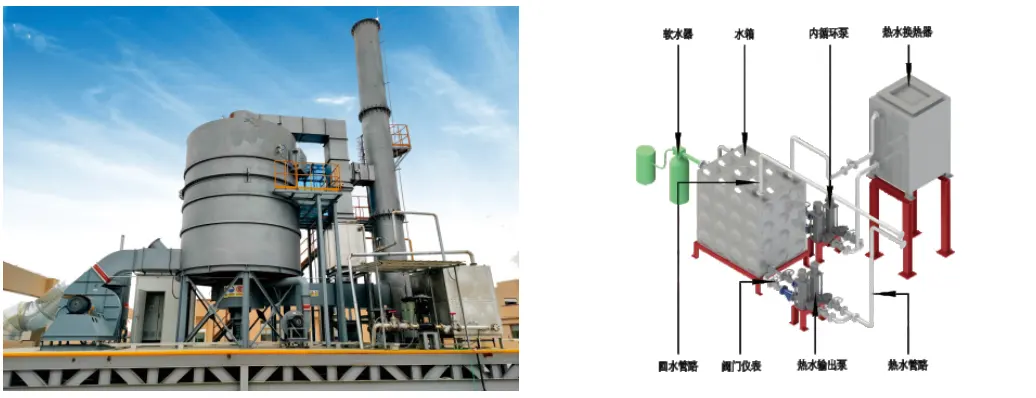

5. Ever Power RTO Technical Specifications
| Performance | 2-bed RTO | 3-bed RTO | Rotary Valve RTO | Notes |
|---|---|---|---|---|
| Technicality | First generation | Second generation | Third generation | |
| Number of chambers | 2 | 3 | 12 | Rotary valve operates continuously |
| Number of valves | 4 | 9 | / | |
| Reliability | Valve switching times per year: 350,000 | Valve switching times per year: 520,000 | / | |
| Piping pressure fluctuation | ±500pa | ±250pa | ±25pa | |
| Discharge compliance | Total purification efficiency: 95% | Total purification efficiency: 99% | Total purification efficiency: 99.5% | 99.5% |
| Maximum treating range | < 1g | < 5g | < 10g | 50mg/m³ discharge standard |
| Heat dissipation surface area | 100m² | 145m² | 95m² | |
| Energy saving | Thermal efficiency: 90% | Thermal efficiency: 95% | Thermal efficiency: 96% | 96% |
| Start-up heating time | 2.5h | 2.5h | 2h | Cold furnace start-up (Ethyl acetate) |
| Self-operation concentration | 2.5g/m³ | 2.2g/m³ | 1.8g/m³ | |
| Economy | Regenerative ceramic filling volume: 18m³ | Regenerative ceramic filling volume: 26m³ | Regenerative ceramic filling volume: 17m³ | 17m³ |
| Practicality | Occupation of land: L12×W7 | Occupation of land: L16×W7 | Occupation of land: L12×W7 | L12×W7 |
6. Equipment Compatibility & Retrofit Analysis
| Existing System / Component | Compatibility Status | Integration Notes |
|---|---|---|
| Direct Fired Thermal Oxidizer (DFTO) | Full Replacement | Our RTO reduces fuel consumption by ~60% compared to legacy DFTOs. |
| Active Carbon Adsorption | Replacement or Hybrid | RTO is preferred for high concentrations where carbon saturates too quickly. |
| Safety Relief Valves (Generic) | Direct Integration | Requires installation of upstream buffer tank/surge vessel. |
| SCADA / PLC Systems (Siemens/Allen-Bradley) | Seamless Integration | Our controls output via Modbus/Profinet for central plant monitoring. |
*Disclaimer: The other brand names mentioned above are provided solely for illustrative purposes. We do not offer original products or equipment bearing these brand names.
7. Future Trends: Smart RTOs in the Chemical Industry
The landscape of industrial air pollution control is shifting rapidly towards “Intelligent Abatement.” In the context of reactor and distillation column operations, we are observing a distinct trend towards the integration of AI-driven predictive maintenance. Modern RTOs are no longer passive equipment; they are active data nodes. By analyzing pressure differentials across the distillation column and correlating them with safety valve micro-leakage data, our systems can predict a venting event before it fully occurs, pre-ramping the oxidation chamber temperature to ensure 100% destruction efficiency from the very first second of release.
Another significant trend is the push for the “Circular Economy” within chemical plants. Simply destroying VOCs is no longer enough; extracting value is key. Advanced RTO designs now incorporate secondary heat exchangers that capture the excess thermal energy from the oxidation process. This recovered heat is effectively looped back into the production facility to generate steam or hot oil, which is then used to heat the very reboilers of the distillation columns. This closed-loop approach drastically reduces the plant’s Scope 1 and Scope 2 carbon footprint, making the RTO not just a compliance cost, but a profit center through energy savings.


8. Custom Engineering Capabilities: Tailored for Your Process
At our manufacturing facility, we understand that “off-the-shelf” solutions rarely suffice for complex chemical engineering applications. Every reactor setup and distillation train has a unique footprint, pressure profile, and chemical composition. We pride ourselves on offering bespoke OEM and ODM services tailored to your specific site constraints in Australia or globally. Whether you require a vertical orientation to save ground space in a cramped refinery or a skid-mounted unit for rapid deployment at a remote mining chemical site, our engineering team utilizes 3D CAD and CFD (Computational Fluid Dynamics) simulation to design the optimal system.
Our factory is equipped with advanced CNC machining centers and robotic welding stations to ensure the highest integrity of the RTO structure. We offer extensive customization in material selection, control logic programming, and auxiliary equipment such as scrubbers (for halogenated compounds) or zeolite concentrators. We invite potential clients to witness our rigorous Factory Acceptance Testing (FAT), where we simulate your specific safety valve load conditions to guarantee performance before shipment. Partnering with us means gaining a solution that is engineered, not just assembled.
9. Customer Success Case
“Our chemical plant in Queensland faced frequent safety valve releases and high VOC emissions. Ever-Power’s RTO system perfectly addressed this challenge. It not only effectively prevented explosion risks but also saved significant energy in our production process through its highly efficient heat recovery system, exceeding our expectations.”
“Previously, we used traditional direct-fired thermal oxidizers, which were inefficient and had high maintenance costs. Ever-Power’s rotary RTO system significantly improved thermal efficiency and incorporated an innovative fast-response valve design, completely eliminating system downtime due to pressure fluctuations, truly resolving our safety concerns.”
“Ever-Power’s RTO technology provides our pharmaceutical plant with a reliable VOC treatment solution. In particular, its LEL control loop and air dilution valve effectively prevent dangerous gases from reaching the lower explosive limit, ensuring safety and compliance during production. We no longer have to worry about emissions issues.”
“As the manager of a large petrochemical facility in Western Australia, we were looking for an emission control system that could handle sudden pressure releases. Ever-Power’s RTO system not only solved the high-pressure VOC emission problem but also ensured that each gas release was safely handled through intelligent control and gas analysis, avoiding the accident risks we previously faced.”
“Ever-Power’s RTO equipment not only complies with Australia’s strict environmental regulations but also meets our company’s global market compliance requirements. The system’s energy efficiency is remarkable, with a heat recovery rate of up to 96%, allowing our plant to save energy while meeting international emission standards, helping us achieve our ESG goals.”
“After using Ever-Power’s RTO at our chemical plant in Altona, emission control has become much more efficient. The system design is compact and requires minimal space, perfectly suiting our spatial needs. Their customized service was also excellent, and the equipment integrated seamlessly into our existing production process, running very smoothly.”
“Ever-Power’s team tailored a perfect solution for us, especially regarding safety valve emission treatment. Their technical team not only provided efficient equipment but also ensured its long-term stable operation. By upgrading to their RTO system, we reduced equipment maintenance time, increased production efficiency, and significantly reduced emissions.”
10. Related Solutions


Frequently Asked Questions (FAQ)
Below are common questions regarding RTO implementation for safety valve venting applications in the Australian market.
Q1. How much does a custom RTO cost for a chemical reactor plant in Sydney?
A1. The cost of a custom RTO for a facility in Sydney varies significantly based on airflow (Nm³/h) and VOC concentration. Generally, a small unit might start around $150,000 USD, while large industrial systems can exceed $500,000 USD. Contact us for a precise quote based on your safety valve specifications.
Q2. What are the EPA Victoria requirements for distillation column safety valve emissions?
A2. EPA Victoria requires that all industrial operators minimize risks to human health and the environment under the General Environmental Duty (GED). This typically means safety valve emissions must be treated to reduce VOCs and odors to negligible levels, often requiring destruction efficiencies exceeding 99%.
Q3. Can an RTO handle the sudden pressure surge from a reactor safety valve?
A3. A standard RTO cannot handle raw pressure surges directly. However, our engineered systems include an upstream buffer tank or surge vessel that captures the high-pressure release and feeds it into the RTO at a controlled rate, ensuring the oxidizer isn’t overwhelmed.
Q4. Which RTO material is best for corrosive chlorinated gas venting in Queensland?
A4. For venting chlorinated compounds often found in Queensland’s heavy industry, we recommend constructing the RTO internals using Hastelloy or high-grade Stainless Steel 316L. Additionally, a downstream scrubber is usually required to neutralize the hydrochloric acid (HCl) formed during combustion.
Q5. How does a Rotary RTO compare to a 3-Bed RTO for continuous manufacturing?
A5. Rotary RTOs are generally more compact and offer a stable pressure profile with fewer moving parts (one valve vs. multiple poppet valves). This makes them ideal for continuous manufacturing processes where footprint is limited and maintenance downtime must be minimized.
Q6. What happens if the VOC concentration in the safety vent exceeds the LEL limit?
A6. Safety is our priority. If sensors detect VOC levels approaching 25% LEL, our system automatically opens a fresh air dilution valve to lower the concentration before it enters the combustion chamber, preventing explosion risks while maintaining treatment.
Q7. Are there energy rebates available in Australia for upgrading to an RTO?
A7. Yes, various Australian state and federal programs offer incentives for energy efficiency and carbon reduction. Since our RTOs recover heat and reduce fuel usage, upgrading from a flare or afterburner may qualify your plant for Energy Savings Scheme (ESS) certificates in NSW or similar grants.
Q8. How long does it take to manufacture and ship an RTO to Melbourne?
A8. Typically, the engineering and manufacturing process takes 3 to 4 months. Shipping to the Port of Melbourne takes an additional 3 to 5 weeks. We provide a detailed project timeline including installation and commissioning support upon order confirmation.
Q9. Can your RTO replace a specific brand like Durr or Eisenmann for maintenance parts?
A9. Absolutely. We can manufacture compatible ceramic media, valves, and burner components that serve as high-quality replacements for major brands like Durr, Eisenmann, or Megtec. Our parts offer equal performance at a significantly more competitive price point.
Q10. Where can I find a supplier of RTOs for pharmaceutical vents in Western Australia?
A10. You have found the right partner. We supply specialized RTO systems for pharmaceutical applications across Western Australia. Our units are designed to handle complex solvents and comply with the strict hygiene and emission standards of the pharma sector. Inquire below.
Ready to Optimize Your Plant’s Safety and Compliance?
Contact our engineering team today for a free consultation and technical proposal tailored to your specific reactor and distillation requirements.
Editor: PXY