

1. Summary
In the demanding world of mineral wool production, managing volatile organic compounds (VOCs) from binders and resins is a top priority for Australian manufacturers. At Ever-Power (Australia) Co., Ltd., we specialize in Regenerative Thermal Oxidizers (RTOs) tailored for rockwool and glass wool industries. These systems not only ensure regulatory compliance but also recover valuable heat to cut operational costs. As Australia’s leading provider of industrial air pollution control, our RTOs are designed to handle the unique challenges of high-silica dust and phenolic resin emissions common in local plants from Victoria’s industrial hubs to Western Australia’s mining-adjacent facilities.
2. Understanding Rockwool and Glass Wool Production in Australia
Australia’s mineral wool sector, encompassing rockwool and glass wool, plays a vital role in construction, insulation, and fireproofing. Rockwool, derived from basalt and slag, and glass wool from recycled glass, both involve melting raw materials at extreme temperatures (up to 1,500°C) followed by fiberization and binder application. The binders—often phenolic resins—release VOCs like formaldehyde and phenols during curing, posing environmental risks if not controlled.
Local production is concentrated in states like New South Wales (NSW) and Queensland, where factories in Sydney and Brisbane supply the building boom. Neighboring countries such as New Zealand (with plants in Auckland) and Indonesia (Jakarta’s expanding insulation market) face similar issues, driven by rapid urbanization. Globally, top producers like China (Shanghai and Guangdong provinces), the United States (California and Texas), Germany (Bavaria), India (Maharashtra), Turkey (Istanbul), South Korea (Seoul), Brazil (São Paulo), Russia (Moscow), Poland (Warsaw), and Mexico (Mexico City) dominate, each with stringent VOC controls influencing Australian standards.
Our Classic Rotary Valve RTO integrates seamlessly into these processes, offering 95%+ thermal efficiency to minimize energy use in Australia’s variable climate.
3. The Waste Gas Challenges in Mineral Wool Manufacturing
During fiber curing, VOC emissions can reach 500-1,000 ppm, mixed with silica dust and high humidity. Untreated, this leads to non-compliance with Australia’s National Environment Protection Measure (NEPM) for air toxics, risking fines up to AUD 1 million under the Environment Protection Act 2017 (Victoria) or similar in NSW’s Protection of the Environment Operations Act 1997.
In neighboring New Zealand, the Resource Management Act 1991 mandates VOC limits below 50 mg/m³, while Indonesia’s Minister of Environment Regulation No. 5/2021 sets thresholds at 20 mg/m³ for industrial emissions. Top global players enforce even tighter rules: China’s GB 16297-1996 caps NMHC at 120 mg/m³; US EPA’s NESHAP for mineral wool (Subpart DDD) requires 99% destruction efficiency; Germany’s TA Luft limits formaldehyde to 5 mg/m³; India’s CPCB standards demand 150 mg/m³ for VOCs; Turkey’s Air Quality Regulation aligns with EU IED (20 mg/m³ for organics); South Korea’s Clean Air Conservation Act sets 100 ppm; Brazil’s CONAMA Resolution 382 caps at 80 mg/m³; Russia’s SanPiN 2.1.6.1032-01 limits phenols to 0.01 mg/m³; Poland’s EU-compliant ordinance requires BAT; and Mexico’s NOM-085-SEMARNAT-2011 mandates 50 mg/m³.

4. How RTO Technology Addresses These Challenges
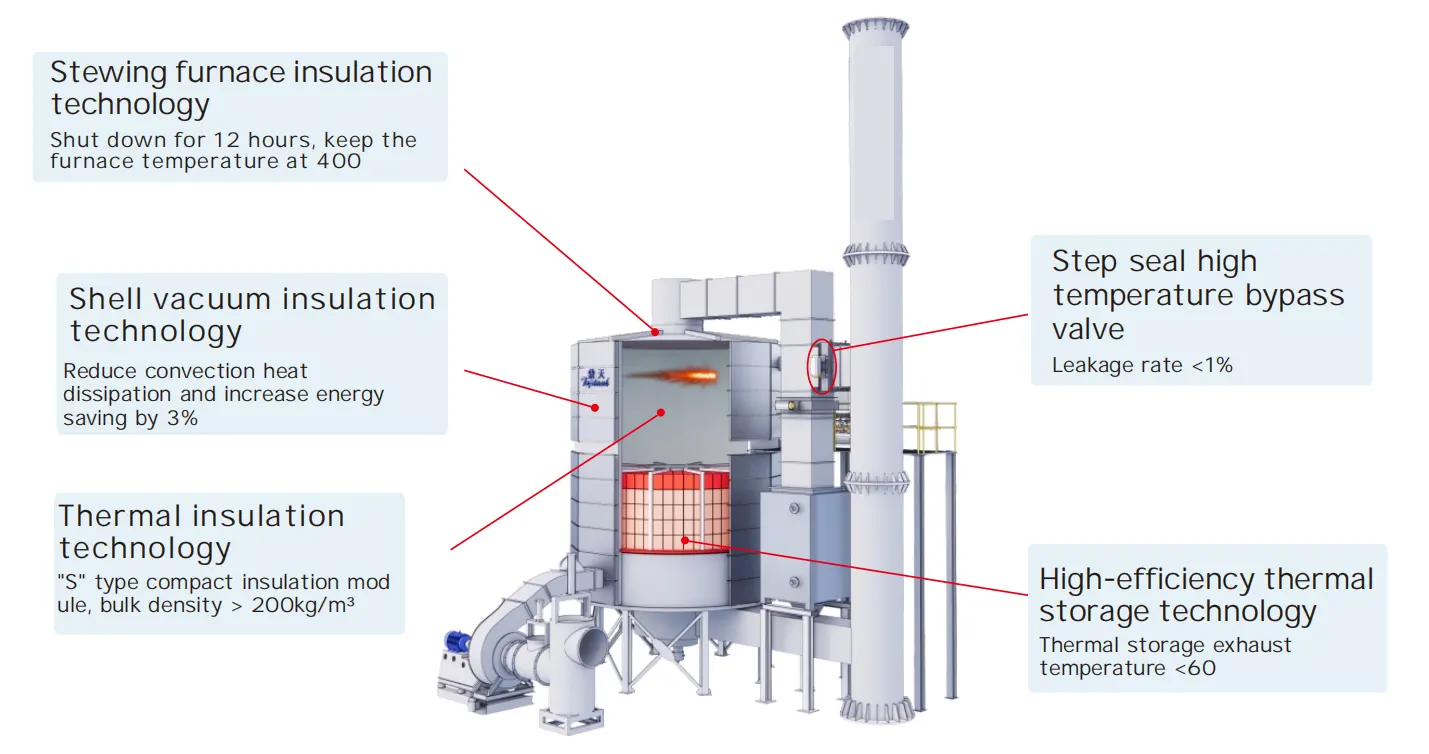
Regenerative Thermal Oxidizers use ceramic media to recover heat from exhaust gases, achieving up to 97% efficiency. In rockwool/glass wool plants, our systems oxidize VOCs at 850°C, converting them to harmless CO₂ and H₂O. Key features include rotary valves for minimal leakage (<1%) and silica-resistant designs to prevent fouling from dust-laden streams.
| Parameter | Ever-Power RTO Value | Industry Average |
|---|---|---|
| VOC Destruction Efficiency | 99% | 95-98% |
| Thermal Recovery Rate | 95-97% | 90-95% |
| Airflow Capacity | 5,000-100,000 m³/h | 10,000-80,000 m³/h |
| Pressure Drop | <200 Pa | 300-500 Pa |
| Energy Consumption | 1-2 kWh/1,000 m³ | 3-5 kWh/1,000 m³ |
For Australian conditions, we incorporate pre-filters to handle dusty outback air, ensuring longevity in harsh environments like Perth’s mining regions.
Ever Power RTO Technical Specifications
| Performance | 2-bed RTO | 3-bed RTO | Rotary Valve RTO | Notes |
|---|---|---|---|---|
| Technicality | First generation | Second generation | Third generation | |
| Number of chambers | 2 | 3 | 12 | Rotary valve operates continuously |
| Number of valves | 4 | 9 | / | |
| Reliability | Valve switching times per year: 350,000 | Valve switching times per year: 520,000 | / | |
| Piping pressure fluctuation | ±500pa | ±250pa | ±25pa | |
| Discharge compliance | Total purification efficiency: 95% | Total purification efficiency: 99% | Total purification efficiency: 99.5% | 99.5% |
| Maximum treating range | < 1g | < 5g | < 10g | 50mg/m³ discharge standard |
| Heat dissipation surface area | 100m² | 145m² | 95m² | |
| Energy saving | Thermal efficiency: 90% | Thermal efficiency: 95% | Thermal efficiency: 96% | 96% |
| Start-up heating time | 2.5h | 2.5h | 2h | Cold furnace start-up (Ethyl acetate) |
| Self-operation concentration | 2.5g/m³ | 2.2g/m³ | 1.8g/m³ | |
| Economy | Regenerative ceramic filling volume: 18m³ | Regenerative ceramic filling volume: 26m³ | Regenerative ceramic filling volume: 17m³ | 17m³ |
| Practicality | Occupation of land: L12×W7 | Occupation of land: L16×W7 | Occupation of land: L12×W7 | L12×W7 |
5. Trends in RTO for Mineral Wool: Innovations and Sustainability
The mineral wool industry is shifting toward sustainable practices. One emerging trend is integrating RTOs with carbon capture units, capturing up to 90% of CO₂ from exhaust for reuse in greenhouses or sequestration—vital for Australia’s net-zero goals by 2050 under the Climate Change Act 2022. Another innovation: hydrogen-fueled burners in RTOs reduce fossil fuel dependency, cutting emissions by 50% as seen in pilot projects in Germany and the US.
Pairing RTOs with zeolite wheel concentrators boosts efficiency for low-VOC streams, concentrating emissions 10-20 times before oxidation, saving energy in humid Queensland plants. Sustainability analysis shows our RTOs reduce carbon footprint by 40-60 tons CO₂e per year per 50,000 m³/h unit, based on heat recovery calculations (e.g., avoiding 20,000 MJ of natural gas annually). AI-driven predictive maintenance, using sensors for real-time valve monitoring, prevents downtime— a unique Ever-Power feature extending system life by 20%.
These trends position RTOs as future-proof investments amid global pushes like the EU’s Green Deal and China’s dual-carbon targets.
6. Our Factory and Customization Capabilities
At Ever-Power (Australia) Co., Ltd., our Sydney-based facility combines global expertise with local insight. Ever-Power specializes in bespoke RTO solutions for the unique challenges of Australian asphalt producers—from high-silica dust in outback quarries to coastal humidity in Queensland plants. Our engineering team conducts on-site exhaust profiling to size pre-filters, select corrosion-resistant alloys, and optimize heat recovery based on your utility needs. With service hubs in Sydney and Perth, we offer rapid spare parts delivery, operator training in English, and 24/7 remote diagnostics. Unlike generic suppliers, we deliver full turnkey projects including civil works coordination, commissioning, and compliance documentation aligned with NSW EPA or VIC DELWP requirements. Every system is factory-tested before shipment to ensure seamless startup.
Explore more about our operations on our company page.


7. Customer Success Stories
“We installed Ever-Power’s RTO system at our rock wool production plant in Queensland, and the results have been remarkable. VOC emissions were reduced by 99%, and the system’s heat recovery efficiency reached 97%, significantly lowering our energy costs. The equipment operates very stably and meets environmental standards.”
“At our glass wool factory in Victoria, we chose Ever-Power’s RTO system. They provided comprehensive service support during the installation process, particularly in on-site commissioning and meeting EPA requirements. Ever-Power’s local support team was very responsive, giving us great peace of mind.”
“At our production facility in Sydney, we adopted Ever-Power’s customized RTO system, specifically designed to handle high silica dust and phenol resin emissions. Ever-Power’s team provided a personalized solution based on our factory’s specific needs, and the results have been excellent.”
“At our glass wool production line in Tasmania, we used Ever-Power’s RTO system, which is equipped with AI predictive maintenance features, reducing downtime. The system’s convenient maintenance schedule also reduced unplanned downtime in our production, significantly improving overall efficiency.”
“At our rock wool production plant in New South Wales, Ever-Power’s RTO system helped us successfully meet environmental emission standards. Its VOC destruction efficiency is as high as 99%, fully complying with Australian EPA and international standards, ensuring our production compliance.”
“At our factory in Brisbane, we installed Ever-Power’s RTO system. The system not only helped us reduce carbon emissions but also provided part of the steam for the factory through its heat recovery system, saving energy costs. Its high efficiency and environmental performance give us great confidence in the future.”
8. Related Solutions



10. FAQ:
Q1:How much does a custom RTO system cost for a rockwool plant in Sydney?
A1. A custom RTO for a medium-sized Sydney rockwool facility typically ranges from AUD 500,000 to 1.5 million, depending on airflow and add-ons like carbon capture. Contact us for a free quote.
Q2. What is the best RTO supplier for glass wool manufacturers in Queensland?
A2. Ever-Power stands out as the top supplier in Queensland, offering tailored systems with hydrogen burners for sustainable VOC control. Get pricing details today.
Q3. Where can I find RTO installation services near Melbourne for mineral wool factories?
A3. Our Melbourne team provides full installation and compliance support under Victoria’s EPA guidelines. Request a site visit quote now.
Q4. Which RTO model handles high-silica dust in Western Australian rockwool production?
A4. The Classic Rotary Valve RTO excels in WA’s dusty environments, with pre-filters for silica. Inquire about costs and specs.
Q5. When should I upgrade my VOC control system in a New Zealand glass wool plant?
A5. Upgrade when emissions exceed RMA limits; our systems ensure 99% efficiency. Get a compliance audit quote for Auckland facilities.
Q6.How to calculate energy savings from RTO in Indonesian mineral wool factories?
A6. Our RTOs save 30-50% on energy via 97% heat recovery; request a Jakarta-specific cost-benefit analysis.
Q7. What are the price differences for RTOs in Chinese rockwool plants versus Australian ones?
A7. Australian models include local certifications, adding 10-20% to costs over Shanghai standards. Contact for comparative quotes.
Q8. Which features make RTOs suitable for US glass wool manufacturers in Texas?
A8. AI predictive maintenance and carbon capture integration suit Texas EPA rules. Ask for supplier pricing.
Q9.Where to buy corrosion-resistant RTOs for German rockwool facilities in Bavaria?
A9. Ever-Power offers TA Luft-compliant systems; get Bavaria delivery quotes from our global network.
Q10. How does RTO pricing vary for Indian mineral wool plants in Maharashtra?
A10. Pricing starts at the AUD equivalent of 400,000, customized for CPCB standards. Inquire for supplier details.
Editor: PXY