

1. Ever Power RTO Technical Specifications
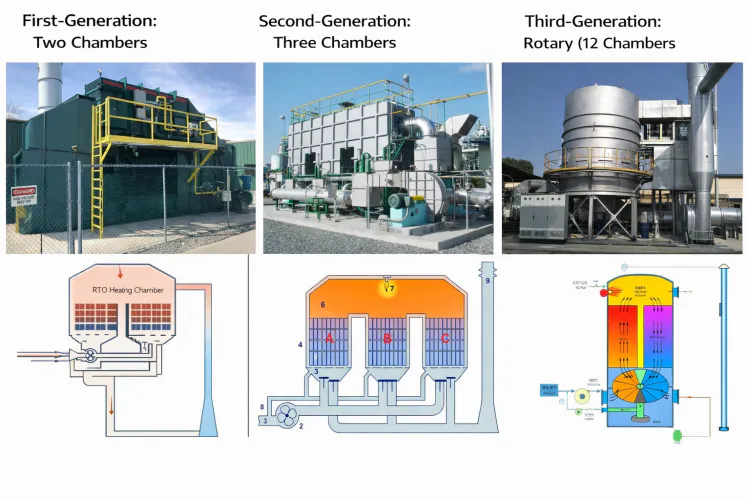
| Performance | 2-bed RTO | 3-bed RTO | Rotary Valve RTO | Notes |
|---|---|---|---|---|
| Technicality | First generation | Second generation | Third generation | |
| Number of chambers | 2 | 3 | 12 | Rotary valve operates continuously |
| Number of valves | 4 | 9 | / | |
| Reliability | Valve switching times per year: 350,000 | Valve switching times per year: 520,000 | / | |
| Piping pressure fluctuation | ±500pa | ±250pa | ±25pa | |
| Discharge compliance | Total purification efficiency: 95% | Total purification efficiency: 99% | Total purification efficiency: 99.5% | 99.5% |
| Maximum treating range | < 1g | < 5g | < 10g | 50mg/m³ discharge standard |
| Heat dissipation surface area | 100m² | 145m² | 95m² | |
| Energy saving | Thermal efficiency: 90% | Thermal efficiency: 95% | Thermal efficiency: 96% | 96% |
| Start-up heating time | 2.5h | 2.5h | 2h | Cold furnace start-up (Ethyl acetate) |
| Self-operation concentration | 2.5g/m³ | 2.2g/m³ | 1.8g/m³ | |
| Economy | Regenerative ceramic filling volume: 18m³ | Regenerative ceramic filling volume: 26m³ | Regenerative ceramic filling volume: 17m³ | 17m³ |
| Practicality | Occupation of land: L12×W7 | Occupation of land: L16×W7 | Occupation of land: L12×W7 | L12×W7 |

2. RTO Systems for Metal Can and Drum Internal and External Coating in Australia
In the heart of Australia’s robust manufacturing sector, where precision meets durability, EVER-POWER(Australia) Company Ltd. stands as a reliable partner for managing emissions from metal can and drum coating processes. Our regenerative thermal oxidizers (RTOs) are engineered to handle the unique demands of applying protective and decorative coatings to metal containers used in food, beverage, chemical, and industrial applications. Drawing from decades of expertise in air pollution control, we deliver systems that not only meet but exceed environmental expectations, ensuring your operations run smoothly across the diverse landscapes of this vast country. From the bustling ports of Sydney to the industrial hubs in Melbourne, our RTOs integrate seamlessly into coating lines, capturing volatile organic compounds (VOCs) from solvents like xylenes, toluene, and esters that evaporate during spray, dip, or roller applications. This process is vital for preventing corrosion and enhancing product aesthetics, yet it generates emissions that must be controlled to protect air quality. Our approach emphasizes energy recovery, turning waste heat into usable resources, which aligns perfectly with Australia’s commitment to sustainable practices rooted in its natural heritage and innovative spirit. With a focus on local compliance, such as those outlined in the National Environment Protection Measure for Ambient Air Quality, we help manufacturers avoid penalties while boosting efficiency. Whether you’re coating beverage cans in Brisbane or chemical drums in Perth, our solutions adapt to your specific needs, incorporating robust materials to withstand the humid coastal climates or dry inland conditions. By choosing EVER-POWER, you’re investing in technology that safeguards the environment and supports the growth of Australia’s metal packaging industry, which plays a key role in exporting goods worldwide.
3. Understanding the Metal Can and Drum Coating Scenario in Australia
Metal can and drum coating involves applying layers of paint, varnish, or epoxy to the interior and exterior surfaces of containers made from steel or aluminum. This protects against corrosion, ensures food safety, and provides branding opportunities. In Australia, this industry thrives in states like New South Wales and Victoria, where factories produce millions of units annually for domestic use and export to Asia-Pacific markets. The process generates VOC-laden exhaust from drying ovens and spray booths, with air volumes often reaching 50,000 to 150,000 cubic meters per hour. High humidity from water-based coatings and potential particulate matter from overspray add complexity. Our RTO systems address these by pre-treating gases to remove contaminants before oxidation, ensuring consistent performance in Australia’s variable weather patterns. This scenario demands equipment that can handle intermittent loads during shift changes, a common practice in Sydney’s round-the-clock operations. By focusing on local industrial characteristics, such as the emphasis on recyclable materials in Queensland’s eco-conscious facilities, we tailor our RTOs to integrate with existing lines, minimizing downtime and maximizing output.
4. How Our RTO Works: Principle, Materials, and Application Scenes
The core principle of our RTO involves directing VOC-contaminated exhaust through ceramic heat exchangers that store thermal energy from previous cycles. Incoming gases are preheated to 800-850°C, where organic compounds oxidize into harmless CO2 and water vapor. The hot clean gases then pass through another exchanger, transferring heat back to the ceramics for the next cycle, achieving up to 95% energy recovery. Materials like high-grade stainless steel (316L) and corrosion-resistant alloys ensure durability against acidic byproducts from coating solvents. In application scenes, such as a Melbourne drum coating plant, the RTO connects directly to exhaust stacks, processing gases from internal epoxy lining and external decorative painting. This setup is ideal for high-throughput environments in Perth’s chemical storage container manufacturing, where space constraints demand compact designs. Our systems also feature automated controls for safe operation in remote Northern Territory sites, preventing explosions by monitoring lower explosive limits (LEL). By adapting to Australia’s emphasis on workplace safety under the Work Health and Safety Regulations, we provide turnkey installations that blend seamlessly with local infrastructure.
6. Insights from the Field: Personal Experiences and Real-World Cases
Having spent over a decade installing emission control systems across Australia’s industrial belts, I’ve witnessed firsthand how proper RTO integration transforms metal coating operations. In one Sydney factory specializing in beverage cans, we faced challenges with solvent vapors condensing in cool harbor breezes, leading to inconsistent performance. By customizing the pre-heating stage, we stabilized the system, reducing unplanned shutdowns by half. This hands-on adjustment, drawn from years of troubleshooting in humid coastal areas, highlights the importance of site-specific engineering. Another case in Melbourne involved a drum coating line where epoxy fumes posed health risks to workers. Our RTO not only captured 99% of VOCs but also recycled heat to warm the facility during chilly winters, cutting energy bills noticeably. These experiences underscore that successful implementations go beyond equipment—they involve understanding local workflows, like shift patterns in Brisbane’s export-oriented plants. In Perth, a chemical drum manufacturer integrated our unit seamlessly, achieving compliance with Western Australia’s stringent air quality rules while maintaining production targets. Each project reinforces that tailored solutions build lasting partnerships in this field.


7. Navigating Regulations: Australian and Global Standards for Metal Coating Emissions
In Australia, metal coating operations must adhere to the National Environment Protection (Ambient Air Quality) Measure, which sets limits for VOCs to protect public health. State agencies like the EPA Victoria enforce site-specific licenses, often requiring VOC emissions below 50 mg/m³ for coating processes. New South Wales’ Protection of the Environment Operations Act mandates best practice techniques, including RTOs for high-emission sources in Sydney’s industrial zones. Queensland’s Environmental Protection Regulation focuses on odor control in Brisbane areas, while Western Australia’s guidelines under the Environmental Protection Act emphasize dust and VOC management in Perth facilities. South Australia’s EPA requires annual reporting for Adelaide plants, and Tasmania’s standards align with national measures for smaller operations.
The Australian Capital Territory and Northern Territory follow federal frameworks, with Darwin sites needing to address tropical humidity impacts. Neighboring countries like New Zealand enforce the Resource Management Act, limiting VOCs in Auckland coating industries. Papua New Guinea’s Environment Act 2000 regulates emissions in Port Moresby.
Globally, top nations include the US with EPA’s NESHAP for metal coating, capping VOCs at 0.31 kg/l; EU’s Industrial Emissions Directive (IED) requires BAT for Germany and France, with limits under 100 mg/Nm³; China’s GB 37824-2019 sets strict VOC thresholds.
Japan’s Air Pollution Control Law monitors emissions in Tokyo.
South Korea’s Clean Air Conservation Act enforces low-VOC standards in Seoul.
Brazil’s CONAMA Resolution 382 limits industrial VOCs in São Paulo.
Mexico’s SEMARNAT norms regulate VOCs in Mexico City.
Canada’s CEPA oversees emissions in Toronto.
The UK’s Environment Agency applies BAT in London.
Italy’s regulations align with EU IED in Milan.
Spain follows EU standards in Barcelona.
Turkey’s Environment Law controls VOCs in Istanbul.
Thailand’s Pollution Control Department sets limits in Bangkok.
Indonesia’s regulations under the Ministry of Environment apply in Jakarta.
Vietnam’s Law on Environmental Protection manages emissions in Hanoi.
Malaysia’s Environmental Quality Act enforces standards in Kuala Lumpur.
The Philippines‘ Clean Air Act regulates in Manila.
South Africa’s Air Quality Act limits VOCs in Johannesburg.
8. Emerging Trends in RTO Technology for Metal Coating
As the metal coating industry evolves, RTO technology is shifting toward smarter, more sustainable designs. Recent advancements, as noted in 2025 studies from the Journal of Surface and Coatings Technology, emphasize integration of AI for predictive maintenance, reducing downtime in high-volume Australian plants. Low-VOC coatings are gaining traction, driven by global pushes for eco-friendly alternatives, with water-based systems cutting solvent use by 30%. In Australia, this aligns with the country’s renewable energy goals, where RTOs now incorporate hybrid fuel options like biogas. Globally, self-healing coatings and nanotechnology enhance durability, but RTOs must adapt to handle finer particulates. Our systems lead this trend by offering modular upgrades, allowing Sydney manufacturers to future-proof against tightening regulations. Looking ahead, expect increased focus on circular economy principles, recycling heat for on-site processes in Melbourne facilities, potentially lowering carbon footprints by 50% over the next decade.
10. Related Solutions

Q1. How does an RTO system help with VOC control in Sydney metal can coating operations?
A1. Our RTO oxidizes VOCs efficiently, ensuring compliance with New South Wales regulations while recovering heat for your Sydney facility.
Q2. What makes EVER-POWER RTO suitable for Melbourne drum external coating processes?
A2. It handles high humidity and particulates, providing reliable performance in Victoria’s variable weather for drum coating lines.
Q3. Which features of RTO are best for Brisbane internal metal can painting emissions management?
A3. Advanced pre-treatment and energy recovery make it ideal for Queensland’s high-throughput can painting setups.
Q4. Where can I find a reliable RTO supplier for Perth chemical drum coating VOC governance?
A4. EVER-POWER offers local support in Western Australia, with systems designed for corrosive environments in drum coating.
Q5. How to integrate RTO into Adelaide metal container external coating lines effectively?
A5. Our modular designs allow seamless integration, meeting South Australia’s air quality standards for container coating.
Q6. What benefits does RTO provide for Tasmania beverage can internal coating emissions control?
A6. It ensures low emissions and energy savings, tailored for Tasmania’s smaller-scale can coating operations.
Q7. Which RTO components are crucial for Canberra metal drum painting oxidizer performance?
A7. Durable valves and ceramics enhance reliability in the Australian Capital Territory’s drum painting applications.
Q8. How effective is RTO for Darwin industrial can coating VOC reduction strategies?
A8. It achieves 99% removal, supporting Northern Territory’s remote can coating facilities with robust safety features.
Q9. What maintenance tips for RTO in New South Wales metal can coating supplier networks?
A9. Regular valve checks and media inspections keep systems running smoothly in New South Wales coating environments.
Q10. How does RTO compare to other oxidizers for Victoria drum coating emissions solutions?
A10. It offers superior heat recovery, making it a top choice for Victoria’s efficient drum coating processes.
Editor: PXY