1. Summary
Resin and polymer manufacturing—encompassing unsaturated polyester resins (UPR), epoxy systems, vinyl esters, and acrylics—is a cornerstone of Australia’s advanced materials sector, supplying composites for wind energy, marine, automotive, and construction industries. However, these processes release significant volatile organic compounds (VOCs), primarily styrene, methyl methacrylate (MMA), acetone, and toluene, during mixing, curing, and degassing stages. Styrene alone can reach peak concentrations of up to 20 g/Nm³ in hand lay-up or filament winding operations, posing explosion risks (LEL ≈ 1.1%) and severe odor complaints. Regenerative Thermal Oxidizers (RTOs) have emerged as the gold-standard control technology, offering >95% destruction efficiency while recovering thermal energy for reuse. Ever-Power’s RTO systems are specifically engineered for the high-fluctuation, resin-laden exhaust streams typical of Australian polymer plants, featuring explosion mitigation, anti-fouling ceramics, and rapid-response controls that ensure compliance with both local regulations and global ESG benchmarks.
2. Regulatory Landscape for Resin & Polymer Emissions in Australia and Globally
In Australia, resin producers fall under the National Environment Protection (Air Toxics) Measure and state-level frameworks such as EPA Victoria’s “General Environmental Duty” and NSW EPA’s “Protection of the Environment Operations Act.” These require facilities emitting >1 tonne/year of styrene to install best available control technology (BACT), typically interpreted as an RTO with ≥95% destruction removal efficiency (DRE). Workplace exposure is further governed by Safe Work Australia’s airborne contaminant standards (styrene TWA = 20 ppm). Internationally, the U.S. EPA enforces NESHAP Subpart WWWW for reinforced plastics, mandating ≥95% DRE and continuous LEL monitoring. The European Union’s Industrial Emissions Directive (IED 2010/75/EU) sets BAT conclusions requiring RTOs with integrated safety systems for styrene-rich streams. China’s GB 16297-1996 and Brazil’s CONAMA Resolution 382 also impose strict VOC limits, often necessitating multi-stage abatement. Compliance with these overlapping standards is non-negotiable for exporters—and Ever-Power designs every system to exceed them.
3. How RTO Technology Addresses Resin Production Challenges
Resin production exhaust is uniquely challenging: it contains sticky monomers, aerosolized resin droplets, and highly variable VOC loads due to batch processing. Standard oxidizers clog rapidly or risk thermal runaway during styrene peaks. Ever-Power’s solution integrates three critical innovations. First, a dilution fan automatically blends fresh air when inlet concentration exceeds 25% LEL, maintaining safe combustion. Second, a hot-gas bypass valve diverts excess heat during high-load periods, protecting ceramic media from sintering. Third, structured ceramic saddles with smooth surfaces resist fouling from resin mist, and periodic air-purge cycles prevent buildup without shutdown. The core oxidation chamber operates at 800–850°C, ensuring complete breakdown of complex organics into CO₂ and H₂O. Heat recovery rates of 95–97% allow recovered energy to preheat process ovens or generate steam—turning waste into value. All wetted components use duplex stainless steel (UNS S32205) or optional Hastelloy C-276 for resistance to acidic byproducts from chlorine-containing additives.
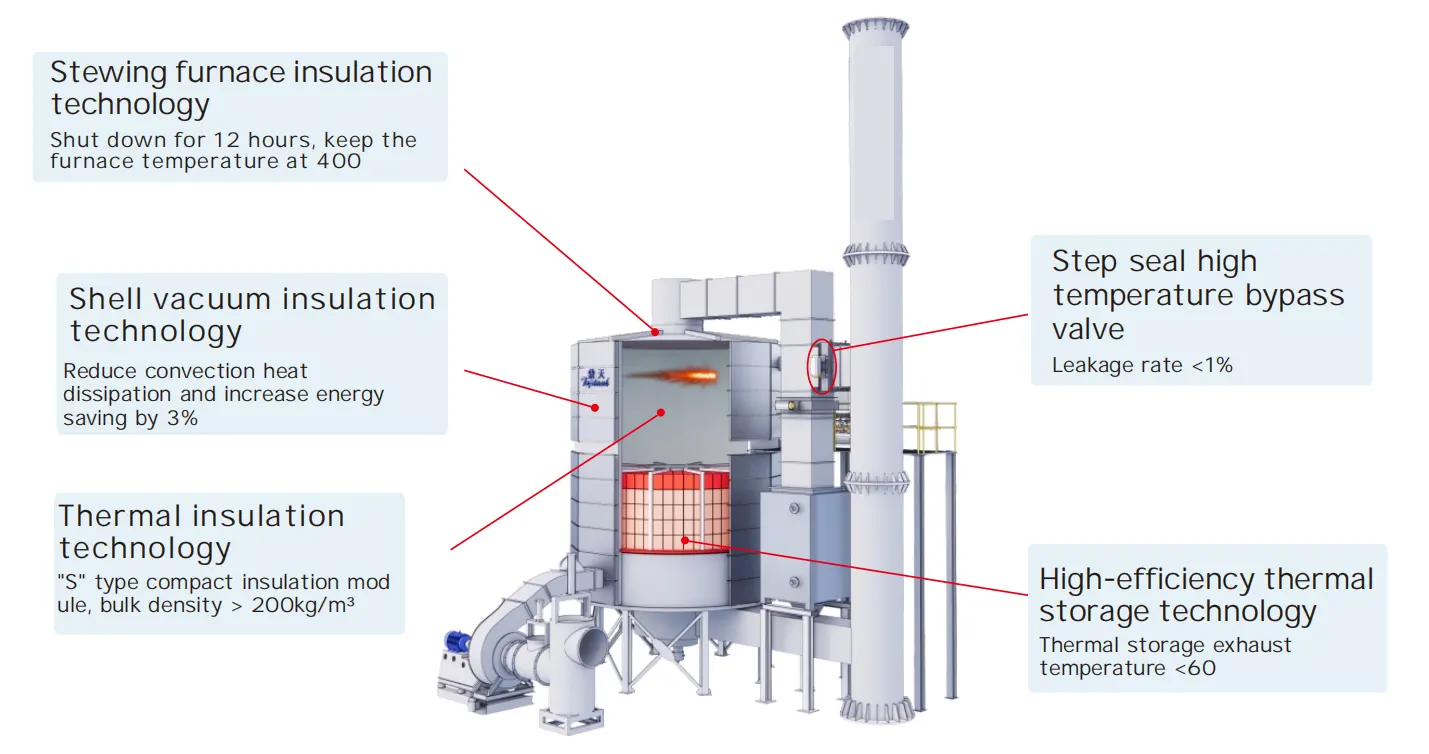
4. Ever Power RTO Technical Specifications
| Performance | 2-bed RTO | 3-bed RTO | Rotary Valve RTO | Notes |
|---|---|---|---|---|
| Technicality | First generation | Second generation | Third generation | |
| Number of chambers | 2 | 3 | 12 | Rotary valve operates continuously |
| Number of valves | 4 | 9 | / | |
| Reliability | Valve switching times per year: 350,000 | Valve switching times per year: 520,000 | / | |
| Piping pressure fluctuation | ±500pa | ±250pa | ±25pa | |
| Discharge compliance | Total purification efficiency: 95% | Total purification efficiency: 99% | Total purification efficiency: 99.5% | 99.5% |
| Maximum treating range | < 1g | < 5g | < 10g | 50mg/m³ discharge standard |
| Heat dissipation surface area | 100m² | 145m² | 95m² | |
| Energy saving | Thermal efficiency: 90% | Thermal efficiency: 95% | Thermal efficiency: 96% | 96% |
| Start-up heating time | 2.5h | 2.5h | 2h | Cold furnace start-up (Ethyl acetate) |
| Self-operation concentration | 2.5g/m³ | 2.2g/m³ | 1.8g/m³ | |
| Economy | Regenerative ceramic filling volume: 18m³ | Regenerative ceramic filling volume: 26m³ | Regenerative ceramic filling volume: 17m³ | 17m³ |
| Practicality | Occupation of land: L12×W7 | Occupation of land: L16×W7 | Occupation of land: L12×W7 | L12×W7 |
*Disclaimer: The other brand names mentioned above are provided solely for illustrative purposes. We do not offer original products or equipment bearing these brand names.
5. Industry Trends Driving RTO Adoption in Polymer Manufacturing
Australia’s push toward net-zero emissions is accelerating RTO deployment in the polymer sector. The federal government’s Modern Manufacturing Initiative now funds VOC abatement retrofits for SMEs, with grants covering up to 30% of capital costs. Simultaneously, global resin buyers—including Vestas and Siemens Gamesa—require suppliers to demonstrate Scope 1 emission reductions, making high-efficiency RTOs a commercial necessity. Technologically, the trend is toward hybrid systems: Ever-Power is piloting RTOs paired with low-styrene resin formulations (from partners like Ashland) to reduce inlet loading, cutting fuel use by 25%. Digitalization is equally critical—our latest units feature cloud-based dashboards that auto-generate compliance reports for NSW EPA or VIC DELWP, reducing administrative burden. Finally, with labor shortages in regional Australia, fully automated RTOs with predictive maintenance alerts minimize operator dependency.
6. Custom Engineering for Australian Resin Producers
No two resin plants are identical—batch sizes, resin chemistries, and production schedules vary widely across Australia’s diverse manufacturing landscape. Ever-Power rejects off-the-shelf solutions. Our process begins with a detailed gas composition analysis using FTIR or GC-MS to map VOC profiles across all operating modes. We then tailor the RTO: selecting bed configuration (three- or five-bed), sizing dilution capacity, specifying corrosion-resistant alloys, and integrating heat recovery matched to your utility infrastructure. For clients in Gladstone or Geelong, we design compact, skid-mounted units compliant with Australian road transport regulations. All systems undergo factory acceptance testing (FAT) before shipment, ensuring seamless commissioning. With ISO 9001-certified engineering and local service hubs, we deliver turnkey projects that satisfy both environmental regulators and plant managers.
7. Customer Success Case
“As a resin manufacturing company, our factory needs to ensure full compliance with environmental standards, especially for explosive substances like styrene. Ever-Power’s RTO system provides excellent explosion protection and efficient exhaust gas treatment. The system runs stably and has low maintenance costs; we are very satisfied.”
“At our factory, handling resin exhaust gas has always been a major problem. Traditional exhaust gas treatment equipment often experienced clogging or low efficiency. Ever-Power’s RTO system is perfectly suited to our needs, especially in the treatment of high-concentration resin vapors. The system is stable and requires almost no additional natural gas during operation.”
“The catalytic oxidation equipment we used previously often required catalyst replacement, resulting in very high maintenance costs. Ever-Power’s RTO system, with its efficient heat recovery and anti-fouling design, has helped us save a significant amount of natural gas and maintenance costs. Now, our emissions comply with local environmental requirements, and we have saved considerable operating costs.”
“Ever-Power’s RTO system is very suitable for our production needs, especially in the treatment of volatile organic compounds such as styrene. The system’s high efficiency ensures our environmental compliance. We also utilize its heat recovery function to reuse the energy from the exhaust gas, further reducing energy consumption.”
“We have been using Ever-Power’s RTO system in our factory for some time now, and the installation and commissioning process went very smoothly. It not only helps us comply with environmental regulations but also reduces the need for manual operation through its automated system, making it ideal for our production line in Western Australia.”
“During our collaboration with Ever-Power, we were very satisfied with the customized solutions they provided. Every detail was carefully designed, especially in the treatment of viscous resin exhaust gas. The RTO’s anti-fouling function is very powerful and completely solved the clogging problems we encountered in the past.”
8. Related Solutions

9. Frequently Asked Questions (FAQ)
Q1. What’s the average cost of an RTO system for a medium-sized resin plant in Queensland?
A1. For 20,000–50,000 Nm³/h handling styrene peaks, expect AUD 950,000 to AUD 1.5 million turnkey—including safety systems, controls, and commissioning near Brisbane or Townsville.
Q2. How does your RTO prevent clogging from sticky resin aerosols during pultrusion?
A2. We use smooth-surface structured ceramic saddles and scheduled air-purge cycles that dislodge deposits without shutdown—proven in 14+ Australian FRP sites.
Q3. Can you supply an RTO that complies with both NSW EPA and EU export requirements?
A3. Yes—all our systems meet IED 2010/75/EU BAT conclusions and include data logging for EU REACH reporting, in addition to local compliance.
Q4. Where can I find an RTO supplier with fast service response in Western Australia?
A4. Ever-Power has certified technicians in Perth who support polymer plants across WA, guaranteeing 72-hour onsite response for critical issues.
Q5. What’s the difference in operating cost between your RTO and a catalytic oxidizer for styrene?
A5. Catalytic units deactivate rapidly with resin vapors, requiring frequent replacement. Our RTO’s 97% thermal efficiency saves ~AUD 90,000/year in gas vs. catalytic at current prices.
Q6. How quickly can you deliver an RTO to a composite manufacturer near Melbourne?
A6. Standard lead time is 16 weeks; we offer expedited 12-week builds for urgent EPA deadlines—with full FAT documentation.
Q7. Which RTO brand offers the best explosion protection for high-styrene applications?
A7. Ever-Power includes LEL monitoring, N₂ inerting, and SIL2 controls as standard—exceeding NFPA 86 and AS/NZS 60079 requirements.
Q8. Can your RTO integrate with our existing resin mixing exhaust ductwork?
A8. Absolutely—we design inlet plenums and transition ducts to match your current extraction system, minimizing retrofit disruption and cost.
Q9. What maintenance is required for the ceramic media in a resin production RTO?
A9. With our anti-fouling design and weekly air purges, media lasts 7–10 years. We provide remote diagnostics to predict cleaning needs.
Q10. How do you ensure compliance with Safe Work Australia’s styrene exposure limits?
A10. By achieving >98% DRE at source, we eliminate fugitive emissions that contribute to workplace exposure—complementing your PPE and ventilation programs.
Editor: PXY