설명
Gas-to-Gas Heat Exchanger (GGH) — Fully-Welded Inflated Plate Design
Built for Australian FGD systems, power plants and heavy industrial stacks. Corrosion-resistant, compact, and engineered to eliminate plume whitening while recovering flue-gas heat.

What Is a Gas-to-Gas Heat Exchanger?
A gas to gas heat exchanger (commonly written as GGH) is a closed-loop thermal device that transfers heat from one flue-gas stream to another without mixing them. In a wet flue-gas desulfurisation (FGD) system, the GGH reheats the saturated, de-sulfurised flue gas using the heat of the raw, untreated flue gas upstream of the scrubber.
The result: the stack plume disappears, downstream ductwork stays dry, and up to 8–12 % of waste flue-gas energy is returned to the process.
How the Ever-power Inflated-Plate GGH Works
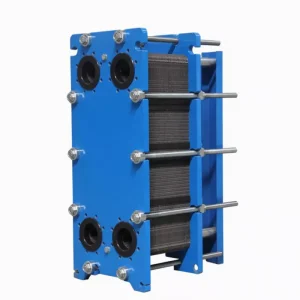
Instead of traditional shell-and-tube banks, the Ever-power GGH uses an inflated (pillow) plate pack. Each plate is produced by laser-welding two thin stainless sheets in a patterned grid, then hydro-forming the assembly under high pressure so that the unwelded zones bulge into a 3D honeycomb channel.
1. Hot-Side Flow
Raw flue gas (120–180 °C) enters the hot side and releases sensible heat to the plate pack as it cools toward scrubber inlet temperature.
2. Cold-Side Reheating
Saturated scrubbed gas (~50 °C) flows on the opposite side, absorbs the recovered heat and leaves the stack 20–35 °C warmer — enough to lift the plume above dew point.
3. Self-Cleaning Geometry
Smooth pillow-plate surfaces and tuned plate spacing (typically 12–25 mm) resist fly-ash bridging and make sonic or steam soot-blowing highly effective.
Key Advantages Over Tubular GGH and Rotary Regenerators
| Parameter | Ever-power Inflated Plate GGH | Tubular / Rotary Alternatives |
|---|---|---|
| Heat-transfer coefficient | 45–75 W/m²·K | 20–35 W/m²·K |
| Footprint (same duty) | 40–55 % smaller | Baseline |
| Cross-side leakage | Zero (fully welded, no seals) | 1–5 % (rotary seals) |
| Acid dew point defence | 316L / 2205 / C-276 cladding on cold end | Often glass-enamel or rubber lining |
| Pressure drop | 600–1,200 Pa | 1,200–2,500 Pa |
| Maintenance cycle | Online soot-blowing; 3–5 yr overhaul | Annual seal replacement |
Technical Specifications
| Item | Standard Range | Custom Option |
|---|---|---|
| Gas flow capacity | 5,000 – 2,000,000 m3/h | Up to 3.5 million m3/h |
| Design temperature | up to 350 °C | up to 550 °C (Inconel) |
| Design pressure | -5 to +10 kPa (g) | up to 0.6 MPa |
| Plate material | 304 / 316L / 2205 | C-276 / Inconel 625 / ND steel |
| Plate thickness | 1.0 / 1.2 / 1.5 mm | 2.0 mm for high-ash streams |
| Plate spacing | 12 / 18 / 25 mm | 30 mm for heavy fly-ash |
| Heat recovery efficiency | 75 – 88 % | Optimised per duty sheet |
| Applicable standards | AS 1210, ASME VIII Div.1 | PED 2014/68/EU, GB 150 |
Typical Applications in Australian Industry
Coal & Biomass Power
Wet-FGD plume abatement and stack reheating at coastal power stations in NSW and QLD.
Cement & Lime
Pre-heater tower flue-gas heat recovery for mills in Western Australia.
Waste-to-Energy
Downstream of scrubbers in EfW plants to reheat cleaned gas above acid dew point.
Petrochemical & Refining
SRU tail-gas reheating and FCC flue-gas energy recovery.
Non-Ferrous Smelting
Copper, lead and zinc smelter stack conditioning for compliance with NEPM air-quality limits.
Hazardous Waste Treatment
Integration with RTO and incinerator trains — see our complete thermal oxidation line-up.
Why Choose Ever-power
▶ 18+ Years of Heat-Transfer Engineering
Over 600 GGH units delivered across Asia-Pacific, including turnkey scope to AS, ASME and PED codes.
▶ In-House Laser-Welding Lines
Four automated laser stations produce weld seams of consistent penetration — no sub-contracting, full traceability per heat number.
▶ CFD-Verified Thermal Design
Every GGH is simulated for flow distribution, temperature mapping and dust deposition before fabrication begins.
▶ Australian Compliance Ready
Design packages include AS 1210 calculations, WorkSafe-compliant lifting lugs, and documentation for local WTIA-certified site welding.
▶ Lifetime Technical Support
Remote performance audits, spare-plate stocking in Sydney, and a 24-month performance warranty. Learn more on our company profile.
▶ Corrosion Allowance Engineered by Zone
Cold-end plates upgraded to 2205 duplex or C-276; hot-end optimised for cost. No one-material-fits-all shortcuts.
Australian Project Reference
Hunter Valley Power Utility — 2 × 660 MW Units
Challenge: Visible white plume after wet-FGD retrofit; community complaints and EPA attention.
Ever-power Scope: Two parallel inflated-plate GGH modules, 1,850,000 m3/h each, 2205 duplex cold-end plates, built to AS 1210 Cl. 3.
Result: Stack plume eliminated at ambient temperatures above 5 °C; 34 °C reheating achieved; payback period under 2.1 years from recovered flue-gas energy and avoided social-licence costs.
Melbourne Hazardous-Waste Treatment Centre
Challenge: Acid dew-point corrosion shortened previous tubular exchanger life to 14 months.
Ever-power Scope: Compact GGH with Hastelloy C-276 cold-section pillow plates and online sonic soot-blowers.
Result: Five-year continuous run with zero plate perforation; maintenance spend down 72 %.
Frequently Asked Questions
Q1. How does a gas to gas heat exchanger differ from a rotary regenerator?
A rotary regenerator transfers heat through a rotating matrix and always has 1–5 % cross-leakage through seals. A fully-welded plate GGH has zero leakage because hot and cold sides are permanently sealed by laser-welded plate edges — critical where treated and untreated flue gas must not mix.
Q2. What reheating temperature rise can I realistically expect?
For typical wet-FGD exit conditions (50 °C saturated) and raw flue gas of 130–160 °C, Ever-power GGH units deliver 25–40 °C reheating — generally sufficient to defeat plume visibility above 0 °C ambient.
Q3. How do you prevent low-temperature acid dew-point corrosion?
Three mechanisms: (1) selection of 2205 duplex, 904L or C-276 on the cold end, (2) controlled plate spacing and gas velocity to keep wall temperature above local acid dew point, and (3) condensate drain channels moulded into the pillow-plate geometry.
Q4. What is the lead time for an Australian project?
Typical: 14–18 weeks from approved drawings to ex-works, plus 4–6 weeks sea freight to Sydney, Melbourne or Fremantle. Expedited production available for emergency replacements.
Q5. Can the GGH be retrofitted into an existing duct layout?
Yes. Because the plate pack is 40–55 % smaller than an equivalent tubular exchanger, most retrofits require only local duct modifications. We supply laser-scan site surveys for Australian sites on request.
Q6. Is online cleaning possible without shutdown?
Yes — we integrate steam soot-blowers, sonic horns, or low-pressure water washers depending on fly-ash characteristics. Cleaning cycles are typically programmed every 8–24 hours.
Q7. What documentation do I receive at delivery?
Full QA/QC dossier: material certificates (EN 10204 3.1 / 3.2), weld maps, PMI reports, hydro-test certificates, thermal-performance datasheet, and installation/O&M manual in English.
Request a No-Obligation GGH Sizing Study
Send us your flue-gas composition, flow and temperature profile. Within 48 hours you will receive a preliminary heat-transfer sizing, budget price and delivery schedule — backed by 18 years of inflated-plate engineering.