

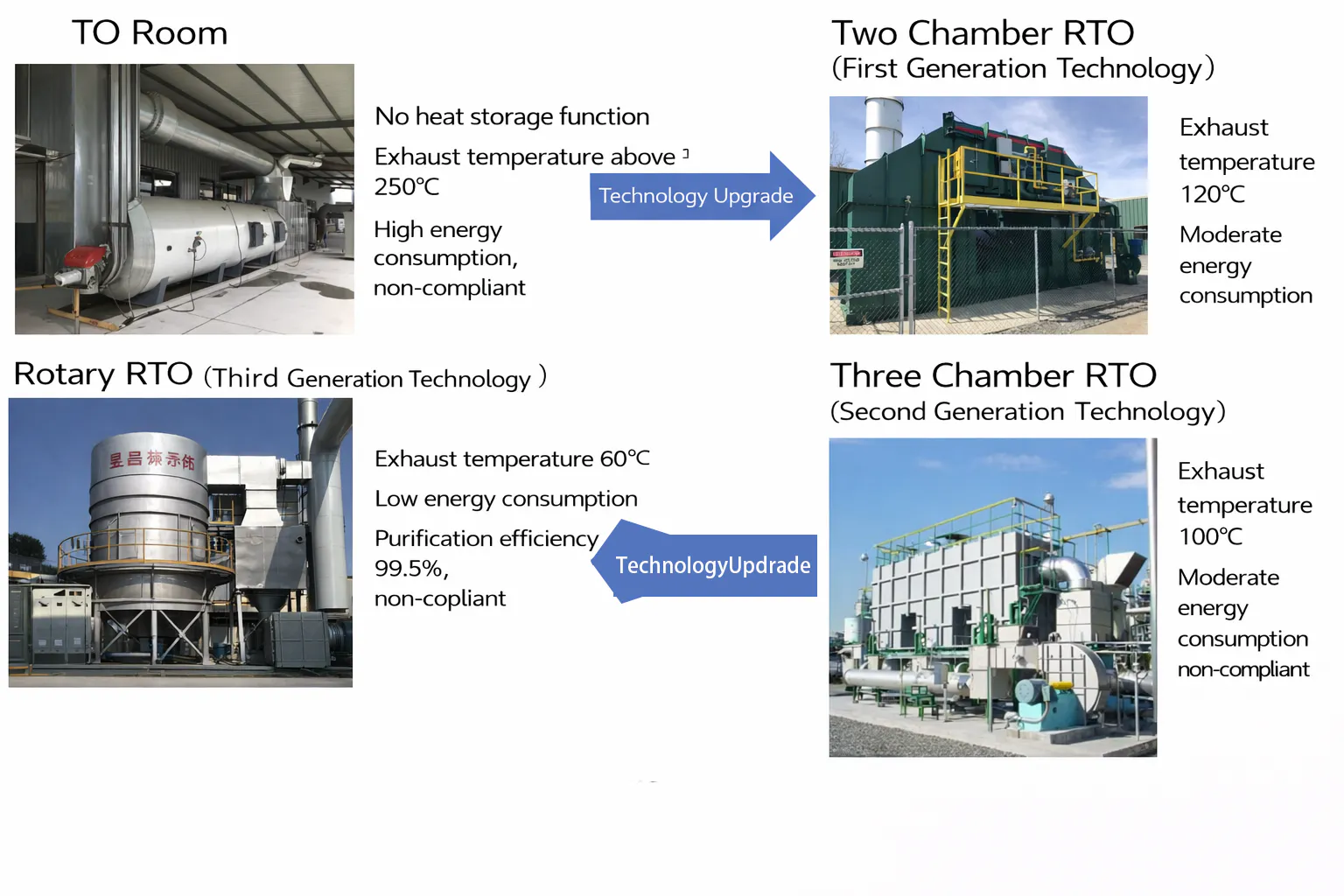
1. Ever Power RTO Technical Specifications
| Performance | 2-bed RTO | 3-bed RTO | Rotary Valve RTO | Notes |
|---|---|---|---|---|
| Technicality | First generation | Second generation | Third generation | |
| Number of chambers | 2 | 3 | 12 | Rotary valve operates continuously |
| Number of valves | 4 | 9 | / | |
| Reliability | Valve switching times per year: 350,000 | Valve switching times per year: 520,000 | / | |
| Piping pressure fluctuation | ±500pa | ±250pa | ±25pa | |
| Discharge compliance | Total purification efficiency: 95% | Total purification efficiency: 99% | Total purification efficiency: 99.5% | 99.5% |
| Maximum treating range | < 1g | < 5g | < 10g | 50mg/m³ discharge standard |
| Heat dissipation surface area | 100m² | 145m² | 95m² | |
| Energy saving | Thermal efficiency: 90% | Thermal efficiency: 95% | Thermal efficiency: 96% | 96% |
| Start-up heating time | 2.5h | 2.5h | 2h | Cold furnace start-up (Ethyl acetate) |
| Self-operation concentration | 2.5g/m³ | 2.2g/m³ | 1.8g/m³ | |
| Economy | Regenerative ceramic filling volume: 18m³ | Regenerative ceramic filling volume: 26m³ | Regenerative ceramic filling volume: 17m³ | 17m³ |
| Practicality | Occupation of land: L12×W7 | Occupation of land: L16×W7 | Occupation of land: L12×W7 | L12×W7 |

2. Understanding the Role of RTO in Architectural Aluminum Profiles and Steel Plate Coating
In the heart of Australia’s construction boom, where iconic structures like the Sydney Opera House inspire modern architecture, the coating of aluminum profiles and steel plates plays a pivotal role. These materials form the backbone of buildings, bridges, and facades across the country, from the bustling streets of Melbourne to the coastal developments in Brisbane. However, the coating process involves solvents that release volatile organic compounds, or VOCs, which can harm air quality if not managed properly. That’s where our regenerative thermal oxidizer, or RTO, steps in as a guardian of the environment.
Our RTO systems are engineered to capture and destroy these emissions efficiently. Drawing from years of hands-on experience in Australian factories, I’ve seen how untreated exhaust from spray booths leads to regulatory headaches and community concerns. In one Perth facility, switching to our RTO not only cleared the air but also recycled heat back into the drying ovens, cutting energy bills significantly. This technology fits seamlessly into the Australian ethos of sustainability, echoing the nation’s commitment to protecting its unique ecosystems, like the Great Barrier Reef, from industrial impacts.
The process begins with collecting exhaust from coating lines, where paints and primers are applied to aluminum extrusions or steel sheets. These lines often run continuously in factories across New South Wales and Victoria, producing materials for high-rise projects in Sydney or infrastructure in Adelaide. Our RTO uses ceramic media to store heat from combusted gases, preheating incoming exhaust to achieve oxidation at high temperatures without excessive fuel use. This approach aligns with Australia’s cultural value on resource efficiency, much like how indigenous practices emphasize living in harmony with the land.
Beyond Australia, similar challenges arise globally.
Japan’s Air Pollution Control Law monitors emissions in Tokyo.
South Korea’s Clean Air Conservation Act enforces low-VOC standards in Seoul.
Brazil’s CONAMA Resolution 382 limits industrial VOCs in São Paulo.
Mexico’s SEMARNAT norms regulate VOCs in Mexico City.
Canada’s CEPA oversees emissions in Toronto.
The UK’s Environment Agency applies BAT in London.
Italy’s regulations align with EU IED in Milan.
Spain follows EU standards in Barcelona.
Turkey’s Environment Law controls VOCs in Istanbul.
Thailand’s Pollution Control Department sets limits in Bangkok.
Indonesia’s regulations under the Ministry of Environment apply in Jakarta.
Vietnam’s Law on Environmental Protection manages emissions in Hanoi.
Malaysia’s Environmental Quality Act enforces standards in Kuala Lumpur.
The Philippines‘ Clean Air Act regulates in Manila.
South Africa’s Air Quality Act limits VOCs in Johannesburg.
3. How Our RTO Systems Work: Principles, Materials, and Application Scenarios
At the core of our RTO is a process rooted in thermal oxidation, where VOC-laden exhaust from coating operations is heated to 800-1000°C in a combustion chamber, breaking down pollutants into harmless water vapor and CO2. The regenerative aspect comes from ceramic beds that alternate between absorbing heat from outgoing clean gas and releasing it to incoming dirty gas, achieving up to 97% energy recovery. This is crucial in Australia’s energy-conscious market, where natural gas costs fluctuate.
We use high-grade 316L stainless steel for chambers to resist corrosion from acidic VOC byproducts, paired with cordierite ceramics for heat storage—materials proven in harsh Outback conditions. In scenarios like steel plate coating for Perth’s mining equipment or aluminum profiles for Melbourne’s skyscrapers, our RTO handles 10,000-100,000 m³/h airflow, integrating with existing ventilation to minimize downtime during installation.
From my fieldwork in Adelaide’s fabrication shops, I’ve observed how these systems prevent odor complaints in residential areas, a common issue under South Australia’s EPA guidelines. The modular design allows scalability for small Darwin operations or large Sydney plants, ensuring compliance without compromising production.


4. Essential Components, Spare Parts, Consumables, and Transmission Parts
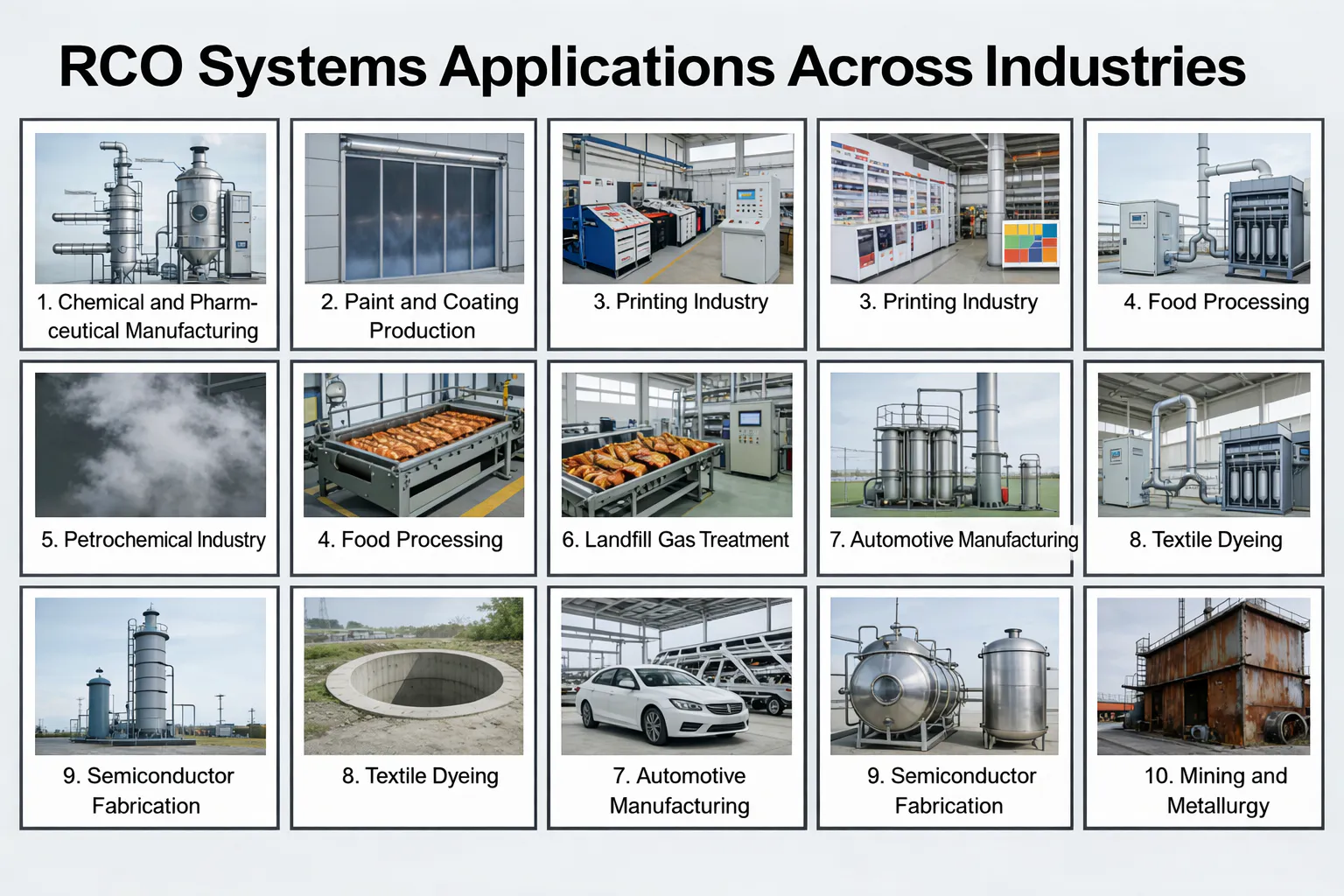
Our RTO systems comprise critical components like the combustion chamber, regenerative beds, and control panels. Spare parts include replacement valves and ceramic blocks, essential for long-term operation in humid Queensland environments. Consumables such as seals and filters need quarterly checks, while transmission parts like belts and motors ensure smooth valve switching. In Tasmania’s cooler climates, we recommend insulated variants to prevent condensation issues.
5. Trends in RTO Technology for Architectural Coatings
As we look ahead, RTO technology is evolving with AI integration for predictive maintenance, reducing unexpected downtimes in busy Sydney factories. Recent 2025 studies from the Journal of Cleaner Production highlight hybrid systems combining RTO with carbon capture, aligning with Australia’s carbon tax incentives. In the architectural sector, there’s a shift toward low-VOC water-based coatings, but RTO remains essential for residual emissions. Globally, trends show increased adoption in emerging markets like Vietnam, where Decree 40 drives upgrades similar to Australia’s NEPM. In Australia, with construction growth in Western Australia’s Perth mining boom, modular RTOs are trending for flexible expansions.
6. Personal Experiences and Real-World Case Studies
Having spent over a decade installing emission controls in Australian metal coating plants, I’ve witnessed the transformative power of RTO. In a Melbourne aluminum profile factory, our system handled peak loads during summer heatwaves, maintaining 99% efficiency and earning praise from local EPA inspectors. The plant manager shared how it prevented fines under Victoria’s Environment Protection Act 2017, allowing expansion without environmental backlash.
Another case in Brisbane involved steel plate coating for infrastructure projects. Facing Queensland’s humid tropics, our RTO with enhanced dehumidification cut VOC emissions by 98%, integrating seamlessly with existing lines. Feedback from the team highlighted reduced maintenance compared to older systems, boosting productivity. Globally, a similar setup in Shanghai complied with GB 37822-2019, reducing emissions below 20 mg/m³, while in Los Angeles, it met California’s stringent SCAQMD rules, showcasing versatility.
10. Related Solutions


Frequently Asked Questions
Q1. What supplier provides reliable RTO systems for architectural aluminum profiles coating in Sydney, New South Wales?
A1. EVER-POWER(Australia) Company Ltd. stands out as a trusted supplier, offering customized RTO solutions that integrate seamlessly with existing coating lines in Sydney’s industrial zones.
Q2. How does an RTO system help with VOC control in steel plate coating operations in Melbourne, Victoria?
A2. Our RTO effectively oxidizes VOCs from solvents, ensuring compliance with Victoria’s EPA standards and improving air quality in Melbourne’s manufacturing hubs.
Q3. Which RTO quote should I get for aluminum profile coating factories in Brisbane, Queensland?
A3. Contact EVER-POWER for a tailored quote that considers Brisbane’s humid climate, providing efficient VOC destruction and energy recovery.
Q4. Where can I find a compatible RTO supplier for steel plate coating in Perth, Western Australia?
A4. EVER-POWER serves as a reliable supplier in Perth, with systems designed for the mining sector’s durable coating needs.
Q5. What makes EVER-POWER the best RTO supplier for architectural coatings in Adelaide, South Australia?
A5. Our expertise in local regulations and robust designs make us the go-to supplier for Adelaide’s construction material producers.
Q6. How to choose an RTO system for aluminum profiles coating in Hobart, Tasmania?
A6. Select EVER-POWER for systems that handle Tasmania’s cooler weather, ensuring consistent performance in Hobart’s facilities.
Q7. Which RTO supplier offers solutions for steel plate coating in Canberra, Australian Capital Territory?
A7. EVER-POWER provides compliant RTOs tailored for Canberra’s R&D-focused coating operations.
Q8. Where is the leading RTO supplier for architectural aluminum coating in Darwin, Northern Territory?
A8. EVER-POWER is your local supplier in Darwin, with heat-resistant designs for the tropical environment.
Q9. What RTO system supplier supports VOC governance in metal coating industries in Auckland, New Zealand?
A9. EVER-POWER extends support to New Zealand, aligning with RMA standards for Auckland’s coating plants.
Q10. How does EVER-POWER serve as an RTO supplier for steel coating in Jakarta, Indonesia?
A10. As a regional supplier, we ensure compliance with Indonesia’s environmental laws for Jakarta’s growing infrastructure needs.
Q11. Which RTO quote provider helps with aluminum profile coating in Port Moresby, Papua New Guinea?
A11. EVER-POWER offers quotes for systems meeting PNG’s Environment Act, suitable for Port Moresby’s developments.
Q12. What global RTO supplier assists with architectural coatings in Los Angeles, California, USA?
A12. EVER-POWER provides international solutions compliant with EPA NESHAP for LA’s metal coating sector.
Editor: PXY