1. Summary: Engineering Precision for VOC Abatement, Odour Control, and Regulatory Compliance
The manufacturing of tires and technical rubber goods is a complex chemical engineering process that inherently generates significant volumes of hazardous air pollutants (HAPs), volatile organic compounds (VOCs), and intense odours. From the initial mixing of natural and synthetic polymers with carbon black in Banbury mixers to the high-temperature curing (vulcanization) of the final product, every stage releases a unique profile of emissions. In the Australian context, where industrial zones are increasingly encroached upon by residential developments, the tolerance for industrial odours—specifically the pungent smell of sulfur compounds like hydrogen sulfide and mercaptans—is effectively zero. The challenge for plant managers and environmental engineers is not merely to install an abatement device, but to integrate a system that can handle the sticky, particulate-laden, and corrosive nature of rubber fumes without compromising production uptime.
Regenerative Thermal Oxidizers (RTOs) have emerged as the Best Available Technique (BAT) globally for this sector. Unlike traditional incinerators or biofilters, which often struggle with the high load and temperature fluctuations typical of batch curing cycles, a properly engineered RTO system offers thermal efficiencies exceeding 95%. This means that once the system reaches its operating temperature (typically around 850°C), the energy content of the solvents in the waste gas is often sufficient to sustain combustion with minimal to no auxiliary fuel. For Australian manufacturers facing high energy costs, this thermal efficiency is a critical economic driver. Furthermore, modern RTOs designed by Ever-Power are equipped to handle the specific “blue smoke” (sub-micron aerosols) and sulfur-laden gases that historically caused fouling and corrosion in lesser systems.
This comprehensive guide delves into the technical nuances of applying RTO technology within the rubber and tire sector. We will explore the stringent regulatory landscape, detailed engineering parameters, and the strategic integration of heat recovery systems. Whether you are operating a retreading facility in Melbourne or a large-scale tire manufacturing plant in Queensland, understanding the synergy between your production process and your air pollution control system is paramount for long-term operational license and sustainability.
2. Five Key Facts
2.1. Heat Recovery: 95-97% Thermal Efficiency (TER).
2.2. High Volume: Handles 10,000 – 500,000 Nm³/h.
2.3. Compliance: Meets NSW EPA & EU IED Standards.
2.4. Flexibility: Turndown ratio up to 10:1.
2.5. Customization: Silicone-resistant & Anti-corrosion.
3. Navigating the Regulatory Framework: Global Standards & Australian Compliance
The regulatory environment governing the rubber industry is tightening globally, driven by scientific understanding of the health risks associated with vulcanization fumes (which often contain carcinogens like benzene and polycyclic aromatic hydrocarbons – PAHs). In the European Union, the Industrial Emissions Directive (IED 2010/75/EU) and the specific Best Available Techniques Reference Document (BREF) for the surface treatment using organic solvents set a precedent. They mandate VOC destruction efficiencies of >95% and strict limits on particulate matter (<10 mg/Nm³). Similarly, the United States EPA enforces the National Emission Standards for Hazardous Air Pollutants (NESHAP) Subpart XXXX for Tire Manufacturing, requiring Maximum Achievable Control Technology (MACT) to limit HAPs such as hexane, toluene, and formaldehyde.
In Australia, while there is no single federal “Clean Air Act” equivalent, the National Environment Protection (Air Toxics) Measure (Air Toxics NEPM) provides a framework for monitoring key pollutants. However, strict enforcement is managed at the state level by bodies such as the EPA Victoria, NSW EPA, and DES Queensland.
For instance, in New South Wales, the Protection of the Environment Operations (Clean Air) Regulation 2021 classifies rubber processing activities as scheduled activities requiring an Environmental Protection License (EPL). These licenses often impose stringent limits on:
- Solid Particles (Total): Often capped at 20-50 mg/m³.
- Type 1 & Type 2 Substances: Specific heavy metals and hazardous compounds.
- Odour: This is frequently the most contentious issue. Regulations often stipulate that no offensive odour should be detectable at the boundary of the premises. For rubber plants, this requires dynamic olfactometry testing and often necessitates >99% odour destruction efficiency, which only thermal oxidation can reliably achieve.
Furthermore, the National Pollutant Inventory (NPI) requires Australian facilities exceeding certain thresholds to report annual emissions. Implementing an Ever-Power RTO system significantly lowers a facility’s reportable load, improving corporate social responsibility (CSR) standing. Understanding these overlapping layers of regulation—from global best practices to local council development approvals—is crucial. Our systems are designed not just to meet current Australian standards but to future-proof against the inevitable tightening of emission limits over the next decade.
4. Technical Deep Dive: RTO Working Principle
4.1 Working Principle & Handling “Sticky” Streams
The fundamental principle of a Regenerative Thermal Oxidizer involves passing the exhaust stream through a pre-heated ceramic heat exchange bed. The gas absorbs heat, raising its temperature close to the oxidation setpoint (approx. 800°C – 950°C) before entering the combustion chamber. Here, VOCs are oxidized into harmless CO2 and H2O. The hot purified gas then exits through a second ceramic bed, transferring its thermal energy to the ceramics for the next cycle.
However, rubber fumes present unique challenges: Particulates and Condensables. Fumes from mixers and curing ovens contain vaporized oils and plasticizers that condense at lower temperatures (below 100°C) and polymerize into sticky deposits. Standard RTOs will foul rapidly. Ever-Power addresses this with a dedicated “Bake-Out” (Burn-Out) capability. This offline or online cycle raises the inlet temperature to burn off organic deposits on the cold face of the heat exchange media, restoring pressure drop without manual cleaning. Additionally, we utilize Structured Ceramic Packing (Monolith or Saddle) with larger void fractions to minimize blockage risks compared to random packing.
4.2 Material Selection for Corrosion Resistance
Vulcanization utilizes sulfur, accelerators (thiazoles, sulfenamides), and antioxidants. Upon oxidation, these generate Sulfur Dioxide (SO2) and potentially traces of Sulfuric Acid (H2SO4) if moisture is present. Standard carbon steel or even 304 stainless steel is insufficient for the cold-face plenum and exhaust stacks where acid condensation occurs.
Ever-Power engineers specify 316L Stainless Steel for all wetted surfaces susceptible to acid attack. For high-sulfur applications (e.g., ebonite or reclaimed rubber), we upgrade to Duplex 2205 or high-nickel alloys (like Inconel 625) in critical zones. We also integrate upstream Alkaline Scrubbers (using NaOH) to neutralize H2S and CS2 before they enter the RTO, or downstream scrubbers to remove SO2 generated during combustion, ensuring the final plume is acid-free.
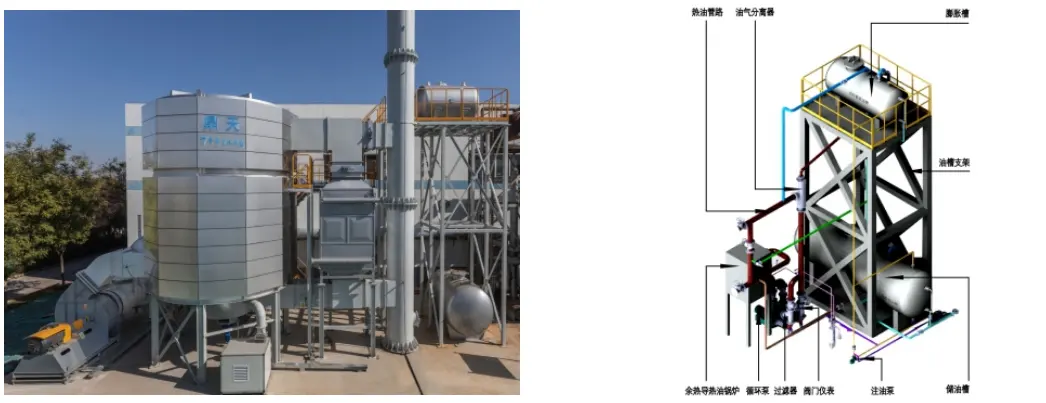
5. EVER POWER Technical Specifications & Performance
| Parameter | Standard Configuration | High-Performance Configuration (Rubber Spec) |
|---|---|---|
| Process Airflow | 5,000 – 100,000 Nm³/h | 50,000 – 300,000 Nm³/h (Multi-module) |
| VOC Concentration | 0.5 – 2 g/Nm³ | up to 5 – 8 g/Nm³ (with LEL Control) |
| Thermal Efficiency (TER) | 95% | ≥ 97% (Self-sustaining at ~1.5 g/Nm³) |
| Destruction Efficiency (DRE) | 98% | > 99.5% (with Purge System / 3-Bed) |
| Particulate Handling | Standard Filtration | Ceramic Filter / Bake-out Feature / Washdown |
| Performance | 2-bed RTO | 3-bed RTO | Rotary Valve RTO | Notes |
|---|---|---|---|---|
| Technicality | First generation | Second generation | Third generation | |
| Number of chambers | 2 | 3 | 12 | Rotary valve operates continuously |
| Number of valves | 4 | 9 | / | |
| Reliability | Valve switching times per year | 350,000 | 520,000 | / |
| Piping pressure fluctuation | ±500pa | ±250pa | ±25pa | |
| Discharge compliance | Total purification efficiency | 95% | 99% | 99.5% |
| Maximum treating range | < 1g | < 5g | < 10g | 50mg/m³ discharge standard |
| Heat dissipation surface area | 100m² | 145m² | 95m² | |
| Energy saving | Thermal efficiency | 90% | 95% | 96% |
| Start-up heating time | 2.5h | 2.5h | 2h | Cold furnace start-up (Ethyl acetate) |
| Self-operation concentration | 2.5g/m³ | 2.2g/m³ | 1.8g/m³ | |
| Economy | Regenerative ceramic filling volume | 18m³ | 26m³ | 17m³ |
| Practicality | Occupation of land | L12×W7 | L16×W7 | L12×W7 |
6. Brand & Component Compatibility Comparison
Upgrading existing infrastructure often requires compatibility with legacy systems. Ever-Power RTOs are designed with open-architecture controls (Siemens/Allen-Bradley) to interface seamlessly with global mixer and curing press brands.
| Component Category | Global Standard Brands | Ever-Power Integration Capability |
|---|---|---|
| Mixing/Extrusion Equipment | Kobelco, Farrel Pomini, HF Group | Seamless damper integration; VFD control for variable flow exhaust. |
| Combustion Systems | Maxon (Honeywell), Eclipse, Kromschröder | Standard fitment. Capable of retrofitting Low-NOx burners. |
| PLC / HMI Control | Allen-Bradley (Rockwell), Siemens S7 | Fully programmable logic; Remote monitoring integration; SCADA ready. |
| Valves & Actuators | Festo, SMC, Asco | Direct replacement support; High-cycle pneumatic switching valves. |
*Disclaimer: The other brand names mentioned above are provided solely for illustrative purposes. We do not offer original products or equipment bearing these brand names.
7. Application Scenarios
7.1 Tire Compounding/Extrusion
• Exhaust gas composition: Rubber fumes and particulates.• Treatment method: Dust removal + RTO, to prevent particulates from entering the regenerative thermal oxidizer.7.2 Tire Vulcanization (Mold/Bladder)
• Exhaust gas composition: Carbon disulfide, hydrogen sulfide, accelerators.• Treatment method: Stainless steel three-bed RTO + scrubbing.• Representative cases: Goodyear Ohio (USA), Michelin Clermont (France), Michelin Thailand (Thailand), Pirelli Campinas (Brazil), Bridgestone Indonesia, Transport & Engineering (Egypt).7.3 Conveyor Belt/Sealing Strip Vulcanization
• Exhaust gas composition: High-concentration sulfur-containing exhaust gas.• Treatment method: Three-bed RTO with dilution system.7.4 Recycled Rubber Desulfurization
• Exhaust gas composition: Extremely malodorous sulfur-containing gases.• Treatment method: Multi-stage pretreatment + RTO, with SCR denitrification added if necessary.
8. Future Trends: Smart Integration and Sustainability
The trajectory for air pollution control in the rubber industry is moving decisively towards integrated energy management. The standalone “end-of-pipe” solution is becoming obsolete. The trend for 2025 and beyond is the coupling of RTOs with secondary heat recovery systems. For tire plants, this means directing the clean, hot exhaust from the RTO (approx. 150°C-200°C) into waste heat boilers to generate low-pressure steam, which is then fed back into the vulcanization presses or used for space heating.
Another significant trend is Smart Monitoring and Predictive Maintenance. With the rise of Industry 4.0, Ever-Power is equipping RTOs with IoT sensors that monitor valve timing, pressure differentials across the ceramic beds, and burner efficiency in real-time. This data allows for the prediction of particulate fouling or valve seal degradation before emissions limits are breached, shifting maintenance from a reactive to a proactive schedule. Furthermore, as “Green Tire” initiatives gain momentum, the carbon footprint of the abatement system itself is under scrutiny, driving the adoption of electric-heated RTOs where renewable electricity is available, replacing natural gas burners entirely.
9. Global Customer Success Case:
“The 3-Bed RTO installed in our facility has been a game-changer. With its robust design, we’ve seen major improvements in operational efficiency and emission reductions. Plus, it’s easy to maintain.”— Sustainability Lead, Carbon Fiber Manufacturer, Perth, Australia
“We were struggling with VOC emissions from our composite materials manufacturing. Since we upgraded to Ever Power’s RTO, compliance has been a breeze. The team has been supportive throughout the process.”— Environmental Manager, Automotive Supplier, Sydney, Australia
“Ever Power’s Rotary Valve RTO helped us manage our high-volume exhaust while maintaining the precise pressure profile required for our slitting and coating processes. The product quality has improved drastically.”— Engineering Director, Technical Textile Producer, Melbourne, Australia
“After installing Ever Power’s RTO, our natural gas bills dropped significantly, and we now achieve compliance without any issues. The waste heat recovery system has also helped us reduce energy consumption.”— Facility Manager, Fiber Manufacturing, Brisbane, Australia
“As a leading producer of high-performance composites, we needed a solution that would meet both our production and environmental needs. Ever Power’s RTO not only ensures full compliance with regulatory standards but also delivers a low-cost operational solution.”— Production Lead, Aerospace Manufacturer, Perth, Australia
10. Strategic SWOT Analysis of RTO in Tire Manufacturing
Strengths (Internal)
- High Destruction Efficiency: >99% removal of VOCs and odour, surpassing biofilter capabilities.
- Energy Neutrality: Autothermal operation at low concentrations reduces OpEx significantly.
- Robustness: 3-bed designs tolerate flow fluctuations from batch curing processes better than concentrators.
- Proven Tech: Validated by industry leaders like Michelin and Bridgestone globally.
Weaknesses (Internal)
- High Initial CapEx: More expensive upfront than simple carbon adsorption or wet scrubbers.
- Footprint: Requires significant physical space for the unit and ducting.
- NOx Generation: Thermal oxidation can generate NOx, requiring low-NOx burners or SCR integration.
Opportunities (External)
- Heat Recovery: Integration with steam boilers to feed vulcanization presses (Circular Energy).
- Regulatory Pressure: Stricter Australian odour laws make RTO the only viable long-term option.
- Green Manufacturing: Enhances brand image for “Eco-Tire” marketing and ESG reporting.
Threats (External)
- Electric Vulcanization: Shift to electric presses might change heat demand profiles.
- Emerging Tech: Cold plasma or biological technologies improving for low-concentration streams.
- Fuel Price Volatility: Natural gas price spikes affect startup/supplemental fuel costs.
11. Related Solutions
12. Frequently Asked Questions (FAQ)
Q1. How much does an RTO cost for a standard tire curing line?
A1. The cost varies significantly based on airflow (Nm³/h) and pollutant concentration. For a typical line treating 30,000 Nm³/h, capital expenditure can range significantly. However, Ever-Power provides competitive pricing with high ROI due to our energy-efficient designs. Please contact us for a tailored quote specific to your facility size.
Q2. Can the RTO handle the “sticky” fumes and sulfur smells from vulcanization?
A2. Yes, this is a core strength of our design. We utilize specialized structured ceramic packing that resists clogging and incorporate a “bake-out” feature that burns off sticky organic deposits (like plasticizers and oils) during maintenance cycles. For sulfur smells, we often integrate a pre-scrubber to neutralize sulfides before oxidation.
Q3. What is the typical lead time for delivering an RTO to Australia?
A3. Our standard lead time from design approval to shipment is approximately 4 to 6 months. We offer modular, skid-mounted designs that significantly reduce on-site installation and commissioning time, ensuring you get up and running faster to meet compliance deadlines.
Q4. How does an RTO compare to a biofilter for odour control?
A4. While biofilters are cheaper initially, they are sensitive to temperature and humidity changes and struggle with high fluctuations in VOC loads. RTOs provide much higher destruction efficiency (>99% vs ~85-90% for biofilters) and are far more reliable for meeting strict statutory odour limits, regardless of ambient weather conditions.
Q5. Is it possible to recover energy from the RTO to use elsewhere in the plant?
A5. Absolutely. This is a major trend in 2025. We can install a secondary heat exchanger or waste heat boiler at the RTO outlet. This can generate hot water or steam that can be fed back into your tire curing presses or used for facility heating, effectively lowering your overall plant energy bill.
Q6. What maintenance does a rubber industry RTO require?
A6. Routine maintenance includes checking the burner system, fan bearings, and valve seals. For rubber applications, the most critical task is monitoring the pressure drop across the ceramic beds. Our automated bake-out cycle handles most cleaning, but an annual internal inspection is recommended to check for ceramic integrity and corrosion.
Q7. Does Ever-Power provide local support for commissioning in Australia?
A7. Yes, we have a global network of technical partners and engineers. We provide comprehensive on-site commissioning, operator training, and remote monitoring support to ensure your system operates at peak efficiency from day one.
Q8: What industries can benefit from an RTO system?
A8.RTO systems are used in a variety of industries, including automotive, flexographic printing, metal packaging, plastic manufacturing, and chemical processing. Any industry that deals with high-volume, fluctuating VOC emissions can benefit from RTO technology.
Q9: What are the environmental benefits of using an RTO?
A9. An RTO helps companies significantly reduce VOC emissions, which can be harmful to the environment and human health. By destroying up to 99% of VOCs and recovering thermal energy, RTO systems help companies meet environmental regulations while reducing their carbon footprint.
Q10: How do I know if my facility needs an RTO?
A10. If your facility generates high volumes of VOC emissions from processes such as printing, coating, or chemical manufacturing, and you need to meet strict environmental regulations, an RTO could be an ideal solution. Additionally, if you are looking to reduce energy costs and improve compliance, an RTO system may be beneficial.
Editor: PXY