


What Is an MTO Waste Heat Boiler?
The Ever-power MTO waste heat boiler is a high-pressure heat recovery unit designed specifically for methanol-to-olefins (MTO) process regenerator flue gas. In DMTO, SMTO and equivalent licensor schemes, spent catalyst is continuously burned clean in a regenerator, releasing a 680–750 °C flue gas that carries residual CO, catalyst fines and trace hydrocarbons. Capturing that thermal energy as HP steam is the difference between a profitable olefins complex and one that bleeds utility costs.
Flue gas enters the boiler, burns out residual CO in an engineered combustion chamber, and then cools across a radiant evaporator, superheater and economiser train — exiting at 180–210 °C toward the flue gas cleaning island. A single 600 kt/yr ethylene-propylene MTO unit typically produces 180–230 t/h of 9.8 MPa superheated steam, most of which drives a site steam turbine for power generation and residual process heating.
Compared with a catalogue waste heat boiler or a retrofitted waste liquid incinerator heat recovery unit, the MTO-specific design handles the distinctive challenges of this service: higher-than-FCC flue gas dust loadings, different coke yield patterns, and tight coordination with downstream expander and scrubber systems. Every Ever-power MTO unit is sized against the licensor heat and mass balance, not a catalogue curve.
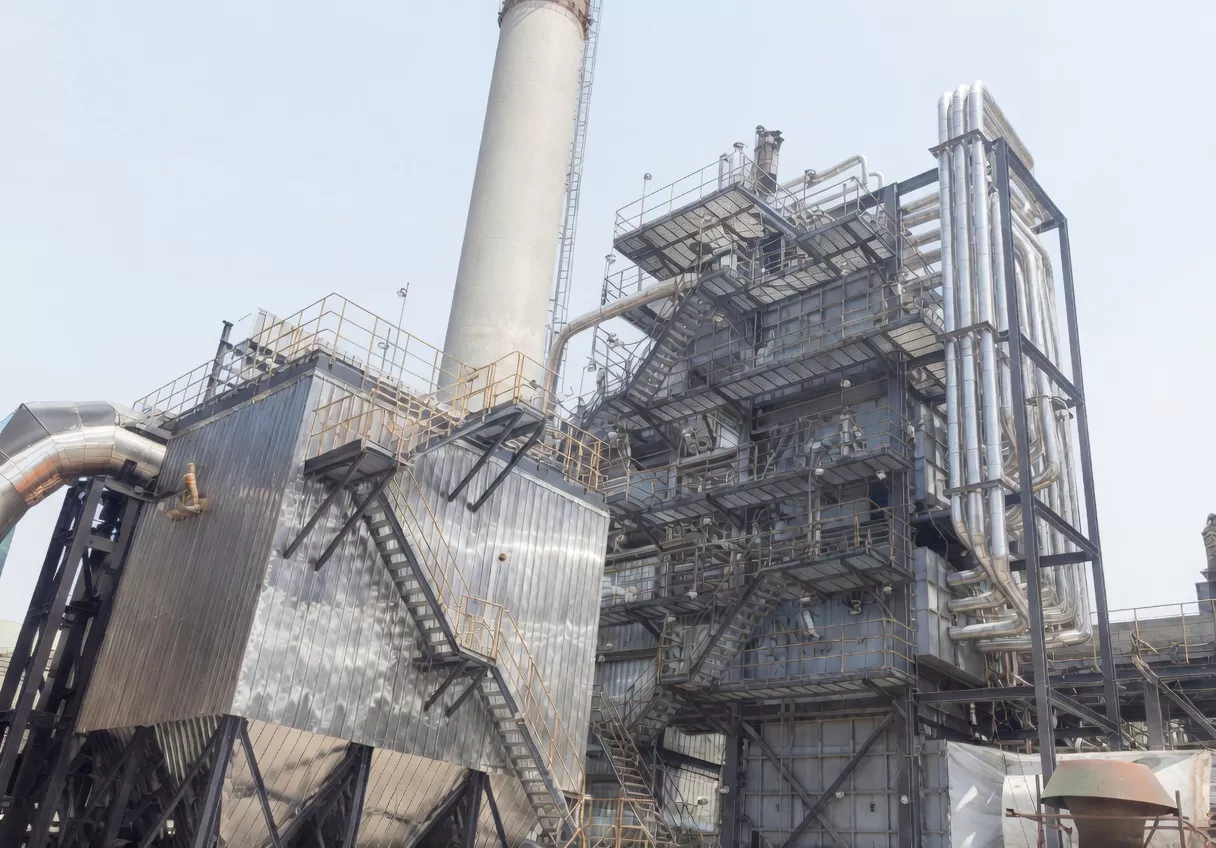

Integration with MTO & Coal Chemical Units
MTO Regenerator
Coke burn-off flue gas with residual CO 0.3–1.5 vol%. Boiler CO chamber sized for complete oxidation at all load cases.
Third-Stage Separator
Catalyst fines trap downstream of regenerator cyclones. Boiler inlet duct engineered to handle residual fines loading.
Flue Gas Expander
Pressure letdown coordinated with expander swallowing capacity. Upset bypass duct built into every installation.
Steam Turbine Driver
HP steam feeds condensing or back-pressure turbines for main air blower, cracked gas compressor or site power.
Upstream Coal Gasification
Coordinated with upstream gasification steam balance on coal-to-olefins (CTO) complexes.
Flue Gas Cleaning Island
Bag filter, dry sorbent injection and optional SCR downstream — designed to meet regional air quality standards.
How the MTO Waste Heat Boiler Works
Five engineered stages carry regenerator flue gas from the MTO unit to the stack, extracting maximum HP steam to the site utility loop.
Flue Gas Inlet & Distribution
Regenerator flue gas at 680–750 °C enters through a refractory-lined duct with flow-conditioning vanes. Inlet dampers isolate the boiler for maintenance.
CO Burnout Chamber
A refinery-fuel-gas or tail-gas auxiliary burner holds ≥ 950 °C for 1.0 s minimum. CO is fully oxidised to CO₂ and unburnt hydrocarbons are destroyed.
Radiant Evaporator
Welded membrane water walls absorb radiant heat, dropping gas temperature from ~1,000 °C to about 550 °C. Natural circulation lifts steam to the HP drum.
Superheater Banks
Two-stage pendant superheaters lift steam temperature to 510–540 °C. Inter-stage attemperator holds outlet temperature inside a ± 3 °C band.
Economiser & Flue Gas Exit
Feedwater is preheated against flue gas cooled to 180–210 °C. Gas exits to downstream bag filter, SCR and scrubber before the stack.
Key Features & Engineering Advantages
MTO-Specific Heat Balance
Designed against licensor heat balance curves for DMTO, SMTO and equivalent routes — not extrapolated from FCC catalogue data.
Robust CO Burnout Chamber
Oversized residence time and staged air injection hold CO < 100 ppm across regenerator load swings from 70% to 110% of design.
Erosion & Fouling Defence
Low gas velocity, sacrificial shields, retractable soot blowers and retubable modular banks — field-proven for MTO dust loadings that are 2–3× typical FCC levels.
HP Steam to Turbine Driver
Outlet steam matched to main air blower turbine and cracked gas compressor turbine inlet conditions, usually 9.8 MPa / 510 °C.
Class A Pressure Parts
ASME Section I plus AS/NZS 3788 dossier on all pressure parts. Welder qualification records and radiograph film package supplied as standard.
Turn-Key or Module-Only
Delivered as a full EPC wrap or as a module-only scope for licensor-led project builds — or as a replacement of legacy MTO boiler under a turnaround window.
Technical Specifications
Capacity bands below match typical DMTO, SMTO and coal-to-olefins (CTO) unit scales. Every MTO waste heat boiler is ultimately sized to the licensor heat and mass balance.
| Model | Steam Output (t/h) | Steam Pressure (MPa) | Steam Temp. (°C) | MTO Unit Scale (kt/yr ethylene+propylene) | Efficiency |
|---|---|---|---|---|---|
| EP-MTO-40 | 40 | 5.3 | 485 | ~180 | ≥ 91% |
| EP-MTO-90 | 90 | 9.8 | 510 | ~300 | ≥ 92% |
| EP-MTO-150 | 150 | 9.8 | 510 | ~500 | ≥ 92% |
| EP-MTO-200 | 200 | 9.8 / 13.7 | 525 / 540 | ~700 | ≥ 92.5% |
| EP-MTO-260 | 260 | 13.7 | 540 | ~900 | ≥ 92.5% |
Performance & Compliance
| Parameter | Ever-power Guarantee | Reference Standard |
|---|---|---|
| CO at Boiler Outlet | < 100 ppm | GB 31571 / US EPA |
| NOx (with SCR) | < 100 mg/Nm³ | AUS state EPA |
| Particulates | < 20 mg/Nm³ | AUS state EPA |
| Steam Temperature Stability | ± 3 °C at MCR | EN 12952-7 |
| Pressure-Part Design Life | 200,000 h / 25 yr | EN 12952-3 |
| Pressure Code | ASME Section I + U stamp | AS/NZS 3788 |
Applications Across Coal Chemical & Olefin Industry
DMTO / SMTO / S-MTO
Standard licensor MTO schemes producing ethylene and propylene from methanol. HP superheated steam supplies site turbines.
Coal-to-Olefins (CTO)
Integrated coal gasification + methanol synthesis + MTO complexes. Steam balance tied to upstream gasifier waste heat recovery.
MTP — Methanol to Propylene
Fixed-bed methanol-to-propylene routes with periodic regenerator duty. Alternative heat-recovery sizing for batch operation.
Site Cogeneration
MTO boiler paired with condensing steam turbine for power generation — 60–120 MWe captured from regenerator flue gas alone.
Future Australian CTO / MTO
Supporting feasibility studies for Australian coal-to-chemicals and biogenic-methanol-to-olefins concepts aligned to domestic gas and CCS roadmaps.
Revamp & Debottleneck
Replacement of legacy MTO waste heat boilers where throughput uplift or emission retightening forces an upgrade.
Why Choose Ever-power
Building a 200 t/h MTO waste heat boiler is an exercise in patience, licensor coordination, and metallurgical discipline. Shortcuts at FEED reappear as tube failures in year three. These six engineering commitments separate the Ever-power build from a generic replacement of catalogue waste heat boiler pressed into MTO service.
Coal chemical and olefin industry credentials are documented on the Ever-power company page, and the full boiler and waste liquid incinerator range is on the home page.
Asia-Pacific Project Case Studies Relevant to Australia
600 kt/yr MTO Unit — Regional Asia-Pacific
A CTO complex was commissioning a 600 kt/yr DMTO unit and needed an HP waste heat boiler feeding a 90 MWe condensing turbine. The licensor heat balance was released late, compressing the original boiler vendor’s schedule and forcing a switch to a supplier with faster engineering.
Ever-power solution: EP-MTO-200 unit at 9.8 MPa / 525 °C with oversized CO chamber for first-year operating uncertainty. CFD-verified fines-impingement resistance.
Result: Boiler first-fire on schedule despite 14-week licensor delay. Acceptance test 92.7% efficiency, CO 44 ppm, no tube failures in first 18 months.
Legacy MTO Boiler Replacement — Asia-Pacific
A 500 kt/yr MTO facility was operating a 10-year-old waste heat boiler with rising tube failure rate, forced outages and a downgrading CO emission profile. The owner wanted a direct replacement inside a single 45-day turnaround window.
Ever-power solution: Modular EP-MTO-150 unit with pre-assembled skid modules, bolt-up site erection, re-use of existing stack and feedwater connections.
Result: Boiler replaced inside the 45-day window. First-year tube failures: zero. CO stack concentration reduced from 320 ppm to 54 ppm on acceptance testing.
Frequently Asked Questions
How is an MTO waste heat boiler different from an FCC CO boiler?
Same family, different operating envelope. MTO regenerator flue gas typically carries higher catalyst-fines loading than FCC and less CO. Coke yield patterns differ — so tube erosion design, CO chamber sizing and SOx exposure all shift. A boiler specified purely from FCC datasheets will underperform on MTO service within the first overhaul cycle.
Which MTO licensors have you worked with?
We have supplied waste heat boilers alongside DMTO (Dalian Institute of Chemical Physics / SYN Energy), SMTO and equivalent licensor schemes. Detailed reference letters are available under mutual NDA during the tender evaluation phase.
What steam pressure and temperature do typical MTO units need?
Most units specify 9.8 MPa superheated steam at 510 °C for main air blower and cracked gas compressor turbines. Larger and newer units are moving to 13.7 MPa at 540 °C for better cogeneration efficiency. Ever-power designs across the full range.
How do you handle the high dust loading on MTO regenerator flue gas?
Four-step defence. First, inlet flow-conditioning vanes prevent stratified dust streams reaching the first bank. Second, gas velocity in the tube bundles is capped below 14 m/s. Third, sacrificial erosion shields on leading tubes. Fourth, retractable soot blowers on a PLC-scheduled cycle. Annual inspection data shows tube wall-thickness loss under 0.12 mm/yr in typical service.
Is the boiler able to start up independently of the MTO unit?
Yes. The auxiliary firing burner rated for cold-start fuel-gas firing supports an independent warm-up before regenerator cut-in. This allows the HP steam header to be brought to pressure before the MTO unit starts up — critical for site-wide startup coordination.
Can the unit be shipped to Australian or Asia-Pacific ports in modular form?
Yes. Large pressure parts ship as transportable modules inside oversize OOG containers. Steel structure, piping and platforms ship in standard 40ft containers. Typical project ships in 18–30 containers plus 3–6 flat-racks. Site erection is bolt-up with a small amount of field welding on the main headers.
What warranty do you offer on a project this size?
Standard pressure-part warranty is 24 months from commissioning or 30 months from shipment. Performance guarantees on steam output, heat efficiency and CO emission are backed by site acceptance testing. An optional 5-year extended warranty covers the superheater and first-bank evaporator tubes when paired with an Ever-power service agreement.
Need an MTO Waste Heat Boiler Feasibility Study?
Send your MTO licensor heat balance, regenerator flue gas data and site steam header demand to sales@rtooxidizer.com or use the contact page. A feasibility study, CFD-based design concept and budget price will be returned within 15 working days — free of charge.