Описание
Specialised VOC Catalysts for Industrial Waste Gas Purification
Ever-power has been engaged in volatile organic compound treatment catalyst R&D for more than 20 years, developing the FVB, MVC and BV series for industrial waste gas oxidation. Our specialised VOC catalysts are deployed in phenol-acetone, PTA, phthalic anhydride, acrylic acid, coating, printing and pharmaceutical operations across Australia, with measured destruction efficiency above 98% on light hydrocarbons and oxygenated VOCs at light-off temperatures as low as 220 °C.
Why Specialised VOC Catalysts Outperform Generic Honeycomb
Generic catalysts are often optimised for a narrow band of solvents. In real industrial waste gas streams, VOC composition shifts with batch chemistry, equipment cleaning cycles and seasonal feedstock changes. Specialised catalysts are formulated for a defined application family, with tailored precious metal loading, washcoat porosity and substrate cell density that maintain conversion across the full operating window.
Catalyst Series Overview
| Series | Active Component | Target Application | Operating Range |
|---|---|---|---|
| FVB Series | Pt-Pd on alumina washcoat | General hydrocarbons, solvents, coating, printing | 220 to 480 °C |
| MVC Series | Pd-rich precious metal blend | Methane, light alkanes, biogas tail gas | 350 to 550 °C |
| BV Series | Pt-promoted base metal oxide | Petrochemical tail gas, oxygenated VOCs | 280 to 500 °C |
| CO-Specific Variant | High Pt loading | CO oxidation in syngas and process tail gas | 180 to 400 °C |
Technical Specifications
| Parameter | Value |
|---|---|
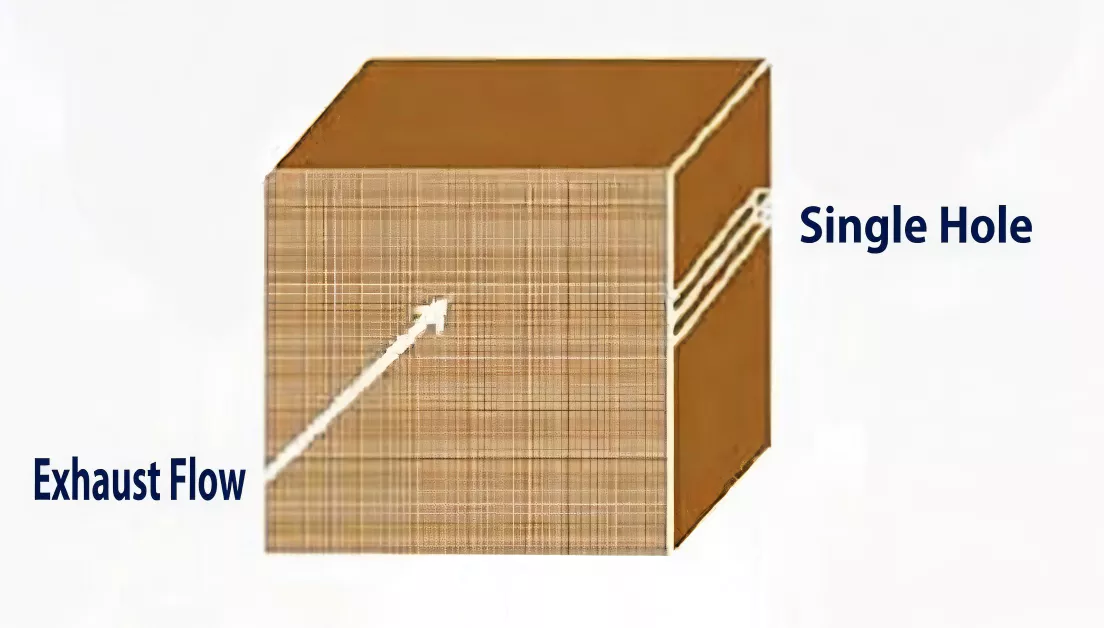
| Substrate | Cordierite ceramic honeycomb or metallic foil |
| Cell density (CPSI) | 100, 200, 300, 400 |
| Block dimensions | 150×150 mm to 150x150x150 mm, custom on request |
| Bulk density | 450 to 650 kg/m3 |
| Crush strength (axial) | ≥ 1.5 MPa |
| VOC destruction efficiency | ≥ 98% on common solvents, ≥ 99% on tuned formulations |
| Light-off temperature (toluene) | 220 to 250 °C |
| Pressure drop | ≤ 200 Pa per 150 mm module |
| Service life | 3 to 5 years on clean streams, 2 to 3 years on tough streams |
| Maximum continuous temperature | 650 °C |
| Maximum exposure temperature | 800 °C, brief excursion |
Industrial Applications
Cumene oxidation off-gas with phenol, acetone, AMS and cumene traces. FVB and BV series remove these efficiently below 380 °C.
Para-xylene oxidation tail gas with methyl bromide, p-xylene and acetic acid. Specialised formulations resist halogen poisoning.
o-Xylene oxidation tail gas with PA, MA and CO. Sulphur-tolerant variants are recommended where SO2 is present.
Propylene oxidation off-gas. BV series handles oxygenates, aldehydes and acid mist with high stability.
Ethyl acetate, MEK, toluene, IPA, xylene. FVB series delivers high conversion at low light-off, ideal for RTO and CTO retrofits.
Reactor vent gases with chlorinated, oxygenated and nitrogenous VOCs. Tailored loading minimises by-product formation.
Performance Curves and Light-Off Behaviour
Light-off temperature defines where conversion crosses 50%. For an Ever-power FVB catalyst on 200 ppm toluene at GHSV 30,000 h-1, T50 sits at 215 °C and T99 at 285 °C. Operators typically run at 320 to 360 °C to maintain conversion above 99% with margin for fluctuations in inlet load.
| VOC Compound | T50 (°C) | T99 (°C) | Recommended Series |
|---|---|---|---|
| Toluene | 215 | 285 | FVB |
| Ethyl acetate | 200 | 270 | FVB |
| Methyl ethyl ketone | 230 | 300 | FVB / BV |
| Isopropanol | 195 | 260 | BV |
| Methane | 410 | 520 | MVC |
| Carbon monoxide | 170 | 220 | CO Variant |
Why Choose Ever-power Specialised VOC Catalysts
Detailed datasheets, MSDS and warranty terms are available from the Ever-power contact page.
Australian Project Highlight
A flexible packaging printer in Western Sydney faced an EPA NSW load-based licence review on toluene and ethyl acetate emissions. Ever-power supplied 14 m3 of FVB-series specialised VOC catalyst for a 60,000 m3/h catalytic oxidiser. Stack testing recorded 99.4% destruction efficiency on solvent mix at an operating temperature of 340 °C, with fan power dropping 8% versus the legacy bed.
Frequently Asked Questions
How do I size a specialised VOC catalyst bed?
Sizing starts with flow rate, inlet VOC concentration, target conversion and operating temperature. Most installations run at GHSV between 20,000 and 40,000 h-1. Send us your inlet data and we will return a sized bed with confidence margin.
What contaminants poison VOC catalysts most quickly?
Phosphorus, silicone, lead and zinc cause irreversible deactivation. Sulphur and chlorine cause reversible inhibition that can often be tolerated with the right formulation. We always request inlet sampling before recommending a series.
Can specialised catalysts replace generic monoliths in an existing reactor?
Yes. Standard module dimensions match common reactor frame sizes. We provide drop-in replacements that cut light-off temperature and improve destruction efficiency without modifying the steelwork.
What is the typical service life?
On clean inlet streams, 3 to 5 years is normal. Streams with sulphur, halogens or particulate may shorten life to 2 to 3 years, with regeneration extending it further depending on the deactivation mechanism.
Do you offer catalyst regeneration?
Yes. Light deactivation by sulphur or organic deposits can usually be reversed by controlled thermal or chemical regeneration. We assess samples free of charge and quote regeneration where it makes economic sense.
How are catalysts shipped to Australia?
Honeycomb modules are packed in custom timber crates with shock-absorbing foam, palletised and shipped FCL or LCL via Sydney, Melbourne, Brisbane or Fremantle. Short-notice air freight is available for emergency replacement.
Do specialised VOC catalysts work in regenerative thermal oxidisers?
Yes. When loaded in an RTO it becomes a regenerative catalytic oxidiser (RCO), reducing operating temperature from around 800 °C to 350 °C and cutting auxiliary fuel consumption by up to 60%.
Get a Catalyst Recommendation for Your Plant
Provide flow rate, VOC speciation, contaminant analysis and target emissions. You will receive a written sizing, recommended series and budget pricing within five working days.