

The core differences between RTO, RCO, CO, and TO
1. Summary: Navigating the Alphabet Soup of VOC Abatement
In the complex world of industrial air pollution control, selecting the right technology to treat Volatile Organic Compounds (VOCs) is a critical decision that impacts both environmental compliance and your company’s bottom line.
The acronyms—RTO (Regenerative Thermal Oxidizer), RCO (Regenerative Catalytic Oxidizer), CO (Catalytic Oxidizer), and TO (Thermal Oxidizer)—represent distinct engineering approaches to the same problem: oxidizing hazardous organic gases into harmless carbon dioxide (CO₂) and water vapor (H₂O). However, the similarity ends there. The difference in operational mechanics, thermal efficiency, and capital cost between these systems is vast.
A simple Direct Fired TO might seem cheap upfront, but can bankrupt a facility in fuel costs, whereas an RTO acts as a thermal battery, often running fuel-free. For industries like printing, manufacturing, and fishmeal processing, where emissions fluctuate and regulations are tightening, making the wrong choice is not an option. Ever Power provides this comprehensive guide to demystify these technologies, helping you engineer a solution that turns compliance into a competitive advantage.
2. Five Key Facts You Need to Know
Five Key Facts You Need to Know
- 1. Energy saving: RTOs boast heat recovery rates exceeding 95%, making them a practical choice for handling large-volume, low-concentration gas streams, such as printing press exhaust. Once the operating temperature is reached, it can typically operate “fuel-free.”
- 2. Catalysts are susceptible to contaminants: RCOs and CO2 operate at lower temperatures and are more energy-efficient, but if your process uses silicones, heavy metals, or certain adhesives (common in the packaging industry), they can damage the catalyst. Therefore, careful matching is essential when selecting equipment.
- 3. “Concentrator” combination: For diluting gas streams (common in the printing industry), combining a zeolite rotor concentrator with an RTO is the modern standard. It reduces air volume, thereby reducing the size and cost of the required RTO.
- 4. Increasingly stringent regulations: Local VOC regulations in various countries are cracking down on fugitive emissions. Removal efficiency is crucial.
- 5. Cost return: Upgrading from an older direct-fired TO to a modern Ever Power RTO typically recoups the cost within 18 months through savings on natural gas costs.
3. The Regulatory Drivers: Why Technology Choice Matters
The selection of an oxidizer is heavily dictated by the specific legal frameworks governing your region. In the United States, the EPA’s NESHAP standards (40 CFR Part 63) mandate strict destruction efficiencies (often 98%+) for Hazardous Air Pollutants (HAPs), pushing industries towards high-efficiency RTOs. Similarly, the US FDA regulates indirect additives in food packaging, requiring absolute elimination of solvent residues in printing processes. In Europe, the Industrial Emissions Directive (IED) sets the benchmark for Best Available Techniques (BAT).
Crucially, for our partners in Southeast Asia, the regulatory landscape is evolving rapidly. Vietnam’s QCVN 20:2009/BTNMT establishes strict technical regulations on industrial emission of organic substances, requiring robust treatment for compounds like Toluene and Xylene. Malaysia’s Environmental Quality (Clean Air) Regulations 2014 mandate that facilities employ Best Available Techniques, often citing RTOs as the standard for achieving the required < 10 mg/Nm³ limits in specific sectors. Indonesia, under Government Regulation 41/1999 and recent climate commitments, is enforcing tighter controls on coal mine methane (VAM) and industrial VOCs. Thailand’s Pollution Control Department (PCD) has established specific standards for 9 toxic VOCs, aligning with JICA recommendations. Failure to meet these specific local standards can result in immediate plant shutdowns, making the stability and reliability of your oxidizer choice paramount.
4. Deep Dive Comparison: TO vs. CO vs. RTO vs. RCO
3.1 TO (Thermal Oxidizer) – The Direct Flame
Principle: The Thermal Oxidizer, often called a Direct Fired Thermal Oxidizer (DFTO) or Afterburner, is the simplest technology. It pumps VOC-laden air directly into a combustion chamber where a burner maintains a temperature of 760°C – 820°C. The “Three Ts” of combustion—Time, Temperature, and Turbulence—ensure the VOCs are oxidized.
Actual situation: It’s very effective at decomposing VOCs (over 99%), but inefficient. Without heat recovery, you’re essentially continuously heating ambient air to 800°C. We generally only recommend using thermal oxidizers in situations with extremely high VOC concentrations but low airflow, where the exhaust gas itself can serve as fuel; or if you require large amounts of steam/hot water and need to connect a waste heat boiler to the exhaust.
3.2 CO (Catalytic Oxidizer) – The Low-Temp Solution
Principle: A Catalytic Oxidizer functions similarly to a TO but utilizes a catalyst block (typically platinum, palladium, or rhodium on a ceramic honeycomb) to lower the activation energy of the oxidation reaction. This allows the process to occur at 280°C – 350°C instead of 800°C.
Actual situation: Fuel consumption is significantly reduced compared to TO (total oxidation). However, the catalyst is very sensitive; if your printing ink contains silicones (often used as slip agents) or phosphorus, they can coat the catalyst, rendering it ineffective. Replacing the entire catalyst bed is costly. Therefore, catalytic oxidizers are best suited for very clean, stable processes.
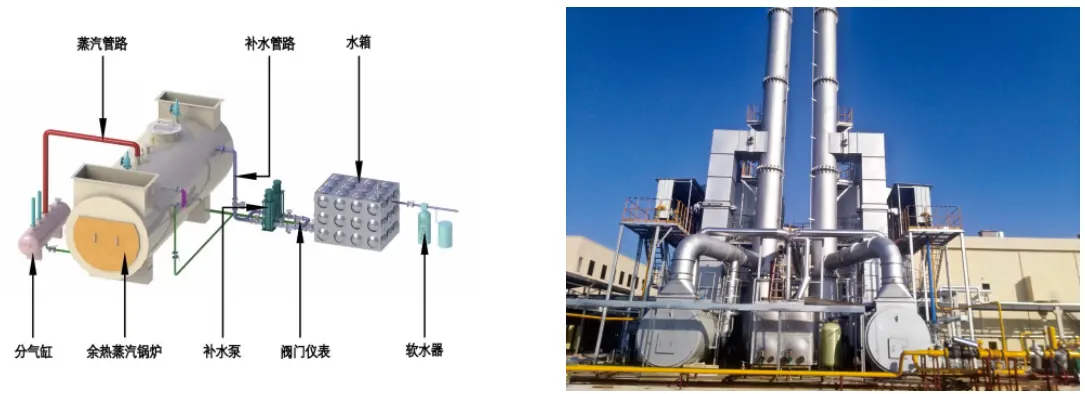

3.3 RTO (Regenerative Thermal Oxidizer) – The Efficiency King
Principle: The RTO is the industry standard for high-volume, low-concentration streams. It uses ceramic heat exchange media beds to capture heat from the purified exhaust gas. By periodically reversing the airflow direction (via poppet or rotary valves), the stored heat is released to preheat the incoming dirty air.
Actual situation: Extremely high thermal efficiency (95-97%). If the solvent concentration is higher than 1.5-2.0 g/m³, the heat released from burning the solvent is sufficient to maintain the combustion chamber temperature. The burner shuts off, and the equipment enters “automatic thermal mode.”
3.4 RCO (Regenerative Catalytic Oxidizer) – The Hybrid
Principle: An RCO combines the heat recovery beds of an RTO with a layer of catalyst on top. This allows the unit to operate with the high thermal efficiency of an RTO but at the lower temperatures of a CO (350°C).
Actual situation: Theoretically, this is the lowest cost option. However, in practice, the initial investment cost is high, and the risk of catalyst poisoning still exists. We typically use RCO in situations where VOC concentrations are too low, RTO cannot achieve self-heating circulation, but we can still ensure that the airflow is free of toxic substances.
3.5Parameter Specifications
| Feature | TO (Thermal) | CO (Catalytic) | RTO (Regenerative) | RCO (Hybrid) |
|---|---|---|---|---|
| Operating Temp | 760°C – 820°C | 280°C – 350°C | 760°C – 850°C | 300°C – 450°C |
| Thermal Efficiency | 0% – 60% (Recuperative) | 50% – 70% | 95% – 97% | 90% – 97% |
| Initial Cost (CapEx) | Low | Medium | Medium-High | Very High |
| Operating Cost (OpEx) | Very High (Fuel intensive) | Medium | Very Low (Auto-thermal) | Lowest |
| Best Application | Small flow, Ultra-high VOC | Clean air, Low VOC | Large flow, Variable VOC | Stable flow, Energy critical |
4. 80+ Application Scenarios
Part 1: Coil coating, coating of large marine and aerospace components, coating of plastic and household appliance casings, coating of metal cans, coating of aluminum and steel for construction, and gravure printing.</p>
Part 2: Petrochemical catalytic cracking/hydrogenation/delayed coking, petrochemical wastewater treatment.Part 3: Pesticide dye intermediates, pharmaceutical fermentation tail gas, fragrances, and flavors.
Part 4: Pesticide dye intermediates, pharmaceutical fermentation tail gas, fragrance, and flavors.
Part 5: Wood furniture finishing, adhesive production, animal by-product rendering, and FRP manufacturing.
Part 6: Tire vulcanization, municipal wastewater treatment, and coal mine VAM.
Part 7: Automotive painting, fishmeal, and fish oil production.
Part 8: Flexographic printing, resin production.
5. Ever Power RTO: The 3rd Generation Advantage
At Ever Power, we have moved beyond standard catalog equipment. Our flagship product is the 3rd Generation Rotary Valve RTO. Unlike traditional 3-bed poppet valve systems, which suffer from pressure fluctuations and mechanical wear, our rotary valve design ensures a seamless transition of airflow. This results in a stable pressure profile, crucial for maintaining print quality in rotogravure presses. We utilize high-grade Structured Ceramic Monoliths (MLM) instead of random saddles, reducing system pressure drop by 30% and saving significant electricity on fan operation.
For materials, we refuse to compromise. In applications dealing with acid gases (such as in fishmeal processing or chlorinated solvents), we upgrade internal wet surfaces to SS316L or Hastelloy to prevent corrosion. Furthermore, our systems are designed to integrate seamlessly with Zeolite Rotor Concentrators. This hybrid approach allows us to take massive volumes of dilute air (e.g., from spray painting booths), concentrate them by 20x, and treat them with a much smaller RTO, slashing capital and operating costs simultaneously.
5.1 Certifications and Standards
ISO 9001 – Quality Management
NFPA 86 / EN 746-2 – Fire and Explosion Safety
CE – Conformity for the European Market
US EPA NESHAP – Compliance with US Environmental Standards
VOC Reduction Compliance – Adheres to stringent VOC reduction regulations in Southeast Asia, including Vietnam’s QCVN 20:2009/BTNMT and Malaysia’s Environmental Quality (Clean Air) Regulations 2014

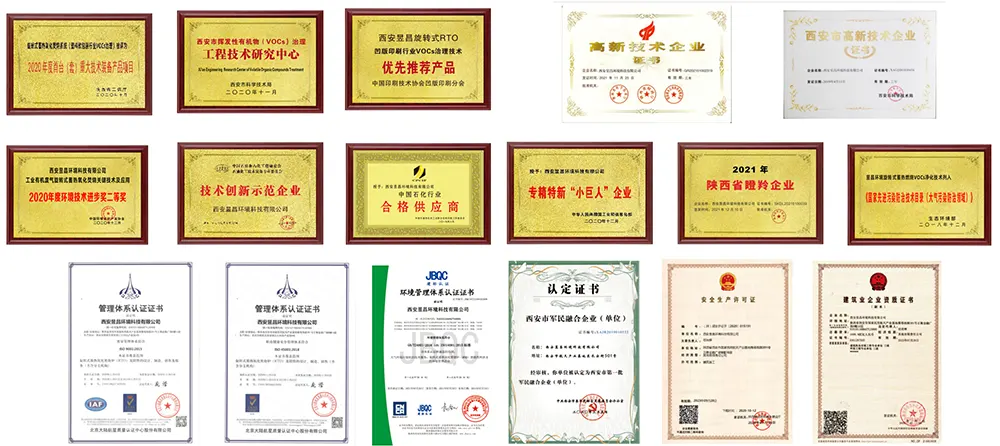
5.2 Expert Endorsement and Experience
We specialize in industrial waste gas treatment, providing a full range of air pollution control equipment including regenerative thermal oxidizers (RTO), regenerative catalytic oxidizers (RCO), direct thermal oxidizers (TO), catalytic oxidation systems, and hybrid combined solutions, complemented by pretreatment and auxiliary modules such as rotary concentrators, wet scrubbers, SCR denitrification, and solvent recovery units, which address complex industrial emissions with varying concentrations, volumes, and compositions through standalone or integrated systems achieving ultra-deep purification of VOCs, NOx, odors, HAPs, particulate matter, acid gases, and coal mine VAMs at removal efficiencies exceeding 95%+, fully compliant with domestic and international regulations like the 2025 Global GHG Reduction Agreement and Best Available Technology (BAT) principles, leveraging core technologies such as regenerative thermal oxidation, heat recovery, direct combustion, and catalytic oxidation to deliver energy-efficient, customized solutions for diverse sectors including manufacturing, mining, petrochemicals, and chemical production, ensuring compliance, cost optimization, and environmental responsibility.
At Ever Power, we are proud of our team of highly experienced professionals, including three senior engineers with over 20 years of experience in industrial emissions control, six senior engineers in mechanical and chemical engineering, and two Ph.D. experts in thermodynamics. With more than 10 years of hands-on experience in designing and implementing RTO systems globally, our team ensures that every project is handled with the utmost expertise and attention to detail.
Our expertise has been acknowledged by leaders in the industry. For example, we’ve partnered with industry giants to implement RTO solutions that meet the most stringent environmental standards. Our technologies have been a key part of clients achieving 99%+ destruction efficiency, successfully navigating EPA and EU regulations, and significantly reducing their carbon footprint, especially in VOC reduction regulations.
6. Strategic Technology Analysis (SWOT)
💪 Strengths (RTO Focus)
- Fuel Independence: Auto-thermal capability eliminates natural gas reliance during production.
- Durability: Ceramic media lasts 10+ years; no catalyst replacement costs.
- Compliance: Easily meets 99% DRE required by NESHAP and ASEAN regulations.
📉 Weaknesses (RTO Focus)
- Footprint: RTOs are physically larger and heavier than Catalytic units.
- NOx: High combustion temps can generate thermal NOx (mitigated by our Low-NOx burners).
- Initial CapEx: Higher upfront investment than a simple TO.
🚀 Opportunities
- Energy Integration: Waste heat from RTO stack can power production ovens or boilers.
- Carbon Credits: High efficiency supports corporate ESG and carbon neutrality goals.
- Market Growth: Increasing enforcement in Vietnam and Indonesia drives demand for reliable upgrades.
⚠️ Threats
- Gas Prices: Spikes in natural gas prices hurt non-regenerative systems (TO).
- Regulatory Flux: Rapidly changing local standards require flexible, over-engineered solutions.
7. Future Trends: The Evolution of VOC Control
The abatement industry is moving decisively away from simple “burners” towards integrated energy systems. The future lies in Smart RTOs equipped with IoT sensors that predict ceramic bed fouling and valve seal wear before failure occurs. We are seeing a trend towards “Zero-Carbon” abatement, where RTOs are electrically heated during startup to utilize renewable grid energy, eliminating scope 1 emissions. In Southeast Asia, specifically in the fishmeal and rubber sectors, there is a massive shift towards Odor Control + Energy Recovery, where the RTO is no longer seen just as a cost center, but as a source of process steam via waste heat boilers.
8. Customization & Manufacturing Excellence
Ever Power is not an equipment broker; we are a specialized manufacturer. We understand that a printing press in Bangkok faces different humidity and space constraints than a chemical plant in Texas. Our customization capability allows us to adjust the Combustion Chamber Residence Time (0.5s to 2.0s) based on your specific VOC destruction requirements. We offer skid-mounted, pre-wired units to minimize on-site installation time. Our engineering team, comprised of Ph.D. thermodynamics experts, simulates airflow dynamics to ensure zero dead zones in the combustion chamber. Whether you need a compact vertical design or a robust outdoor horizontal unit, we tailor the solution to your factory.
9. Customer Success Case: Chemical Manufacturing in Indonesia
“I’m very satisfied with our partnership with Ever-Power. The RTO system they provided solved the problem of the strong odor from the release of sulfur compounds from the protein during our fishmeal production process. Their waste heat recovery system is truly amazing. To be honest, the most noticeable change I’ve seen is the reduction in complaints from the surrounding community since the RTO was installed, hahaha. I highly recommend their products, trust me.”—from Brazil Manufacturer
“Our previous exhaust gas treatment system was expensive to maintain and difficult to completely remove the odor, which caused frequent complaints and was really annoying. After upgrading to the RTO system, the exhaust gas treatment effect is stable, the odor concentration has been greatly reduced, and community complaints have decreased by 70%! Moreover, this system is very intelligent, saving a lot of operating costs. The whole system runs smoothly, and we are very satisfied!”—from USA Manufacturer
“After using their third-generation RTO system, the efficiency of exhaust gas treatment in our painting workshop is truly astonishing! The system operates stably, the pungent odor is almost undetectable, and environmental standards are easily met. The most impressive feature is the heat recovery function, which saves a significant amount of energy and directly reduces operating costs. Overall, this solution has helped us reduce our environmental impact and improve production efficiency, and we are extremely satisfied!”—from USA Manufacturer
“The RTO provided by Ever-Power is truly amazing! Its strong corrosion resistance perfectly handles the waste heat recovery function of the gases generated in our production process, saving us a lot of costs. Since using this system, production efficiency has improved significantly, and it also meets environmental protection requirements. I highly recommend it!”—from Brazil Manufacturer
“The RTO system Ever-Power provided for us is truly amazing! Its corrosion resistance is exceptional, perfectly solving the problem of harmful gases generated during our vulcanization process. Furthermore, the system is equipped with waste heat recovery, which has saved us a significant amount of energy costs. I love them!”—from Brazil Manufacturer
First-Hand Factory Success Stories
Client: A specialized resin and adhesive manufacturer in West Java, Indonesia.
Challenge: We are a large chemical manufacturing plant with sulfide emissions. Previously, we faced a severe odor problem, and the fuel costs of our direct combustion thermal oxidizer (TO) were rapidly escalating, exceeding $40,000 per month. This was simply too expensive, so we began looking for a new solution last year.
Solution: We upgraded our existing TO to an EVER-POWER third-generation RTO and equipped it with a waste heat recovery system to minimize fuel consumption and eliminate odors.
Result:
- The most noticeable improvement is a reduction in fuel consumption.
- The persistent odor problem was completely eliminated, and worker complaints decreased.
- Reducing maintenance downtime from monthly to annually.
10. Frequently Asked Questions
Q1. What is the primary cost difference between an RTO and a Direct Thermal Oxidizer?
A1. The primary cost difference lies in operational expenditure (OPEX); while a Direct Thermal Oxidizer (TO) is cheaper to buy, an RTO saves 95% more fuel, offering a lower total cost of ownership over 2 years.
Q2. Which VOC treatment technology is best for the printing and packaging industry in Southeast Asia?
A2. For the printing and packaging industry in Southeast Asia, the Regenerative Thermal Oxidizer (RTO) is best due to its ability to handle high volumes of air with fluctuating solvent concentrations while meeting strict regulations like Vietnam’s QCVN 20:2009.
Q3. How does a Catalytic Oxidizer (CO) differ from a Regenerative Catalytic Oxidizer (RCO)?
A3. A Catalytic Oxidizer (CO) uses a recuperative heat exchanger with 60-70% efficiency, whereas a Regenerative Catalytic Oxidizer (RCO) uses ceramic media beds to achieve 95%+ thermal efficiency, drastically reducing fuel usage.
Q4. When should I choose a Thermal Oxidizer over a Catalytic system for my factory?
A4. You should choose a Thermal Oxidizer (TO or RTO) over a catalytic system if your exhaust stream contains catalyst poisons like silicones, sulfur, or heavy particulates which would destroy the expensive catalyst blocks.
Q5. Where can I get a custom quote for an RTO system compliant with US EPA standards?
A5. You can get a custom quote for an RTO system compliant with US EPA standards from Ever Power, where we engineer specific residence times and destruction efficiencies to meet NESHAP requirements.
Q6. How to install RTO in Brazil?
A6.
1. Modular “Skid” Design: We build the RTO in pre-wired, pre-piped modules. This means less welding on your site and faster assembly.
2. NR-12 Compliance: We are familiar with Brazil’s NR-12 safety standards. Our guarding, interlocks, and labeling can be customized to pass local inspection immediately.
3. Local Commissioning: We have protocols for on-site startup assistance to fine-tune the burner tuning and valve timing to match your actual production lines.
Q7. What does RTO mean?
A7. RTO (Regenerative Thermal Oxidizer) is a waste gas treatment device that removes harmful substances through high-temperature oxidation and recovers heat for energy utilization.
Q8. What are the application scenarios for RTO?
A8. 80+ Application Cases:
Part 1: Coil coating, coating of large marine and aerospace components, coating of plastic and household appliance casings, coating of metal cans, coating of aluminum and steel for construction, and gravure printing.
Part 2: Petrochemical catalytic cracking/hydrogenation/delayed coking, petrochemical wastewater treatment.
Part 3: Pesticide dye intermediates, pharmaceutical fermentation tail gas, fragrances, and flavors.
Part 4: Pesticide dye intermediates, pharmaceutical fermentation tail gas, fragrance, and flavors.
Part 5: Wood furniture finishing, adhesive production, animal by-product rendering, and FRP manufacturing.
Part 6: Tire vulcanization, municipal wastewater treatment, and coal mine VAM.
Part 7: Automotive painting, fishmeal, and fish oil production.
Part 8: Flexographic printing, resin production.
Q9.What is the primary function of an RTO in industrial applications?
A9. The primary function of a Regenerative Thermal Oxidizer (RTO) is to destroy volatile organic compounds (VOCs) and hazardous air pollutants through high-temperature oxidation, achieving up to 99% efficiency while recovering 95% of thermal energy for cost savings.
Q10.Can an RTO handle varying VOC concentrations?
Q10. Yes, an RTO can handle varying VOC concentrations through auto-thermal operation and LEL control loops, adapting to fluctuations in industries like printing where solvent loads change during production shifts.
Editor: PXY