Beskrivning
Introduction
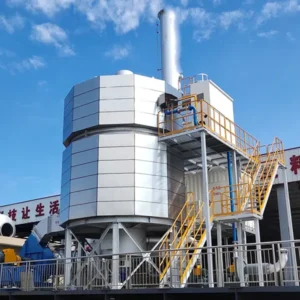
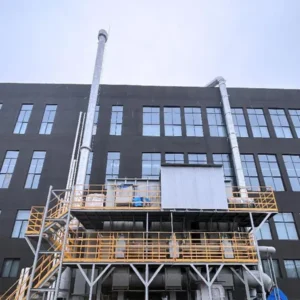
In today’s era of increasingly stringent environmental regulations, High Air Volume Rotary RTO, as an advanced rotary regenerative thermal oxidizer, has become the preferred equipment in the field of industrial waste gas treatment. It is designed to treat large air volumes and low concentrations of volatile organic compounds (VOCs), and can efficiently convert harmful waste gases into harmless substances. Such equipment, such as the High Air Volume RTO series, combined with zeolite molecular sieve concentration technology, is widely used in industries such as printing, chemical and kiln. The core of High Air Volume Rotary RTO lies in its rotary valve design, which ensures continuous heat exchange and achieves a heat recovery efficiency of up to 95%. This not only reduces energy consumption, but also helps companies achieve their “dual carbon” goals.
Working Principle of High Air Volume Rotary RTO
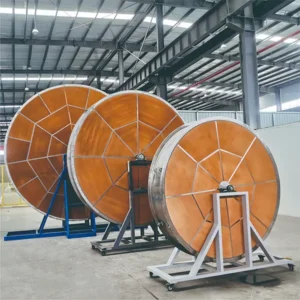
The working principle of High Air Volume Rotary RTO is based on regenerative thermal oxidation technology. The exhaust gas is first preheated by a ceramic heat storage body, and then enters the combustion chamber for high-temperature oxidation and decomposition at above 760°C. The rotating structure allows the gas flow direction to switch periodically, maximizing the utilization of thermal energy and avoiding energy waste. This equipment is particularly suitable for high-volume applications with air flow exceeding 5000 SCFM, such as semiconductor manufacturing and oil field associated gas processing. Compared with the traditional three-bed RTO, High Air Volume Rotary RTO is more compact and economical when processing high air volume rotary RTO for low concentration VOCs, reducing fuel consumption. In the printing industry, the process scheme includes unorganized exhaust gas leaching + organic acid concentration + organized emission reduction tower concentration + waste RO + waste heat recovery to ensure that exhaust gas components such as ethyl acetate, isopropanol, etc. are efficiently decomposed.

Core Advantages of Products
The advantages of this product lie in its high destruction efficiency and energy-saving performance. High Air Volume Rotary RTO can achieve a VOCs removal rate of 99%, and supports waste heat recovery forms such as steam, hot water or hot air reuse, helping enterprises achieve “environmental protection + energy saving”. Its modular design is easy to expand and is suitable for ultra-large air volume scenarios above 100,000 SCFM. These high air volume rotary RTO with heat recovery highlight its leading position in the utilization of industrial waste gas heat energy. In addition, there are 98 steam waste heat recovery projects, 129 thermal oil projects, and 1,500 hot water projects, which proves the reliability and wide application of this Rotary Regenerative Thermal Oxidizer (Valve Type Rotary RTO).
High Air Volume Rotary RTO Solutions in the Chemical Industry
Waste gas treatment in the chemical industry is another important area of High Air Volume Rotary RTO. For the benzene removal industry, the waste gas is characterized by large air volume and low concentration, and the components include toluene, xylene, butanone, etc. The process scheme is filtration + deparaffinization + dehydrogenation + debenzenization + RTO. High Air Volume Rotary RTO is suitable for high-concentration waste gas treatment, using ceramic regeneration body to store heat and oxidatively decompose VOCs. The principle of our Classic rotary valve RTO is to oxidize combustible waste gas into oxides and water, and there are 41 special projects for treating chlorine and sulfur elements. This integration of high air volume rotary RTO for chemical industry has achieved an HC treatment efficiency of more than 99%, which is particularly suitable for complex oil corrosion projects.

The Role of High Air Volume Rotary RTO in PVC Resin Manufacturing
For the PVC resin manufacturing industry, the waste gas treated by High Air Volume Rotary RTO is characterized by high boiling point of DOTP, easy condensation, and low concentration. The sources of waste gas include dissolved organized waste gas and unorganized waste gas in the workshop, and the components are DOTP and D80 solvent oil. The process scheme is oil filtration + denitrification + desulfurization + deodorization + RTO. High Air Volume Rotary RTO performs well in low-high volume and high concentration flow, and is suitable for applications with 5-25% BTU. This high air volume rotary RTO for PVC resin production scheme ensures efficient purification of exhaust gas while achieving energy saving through waste heat recovery.
Heat Recovery Technology of High Air Volume Rotary RTO
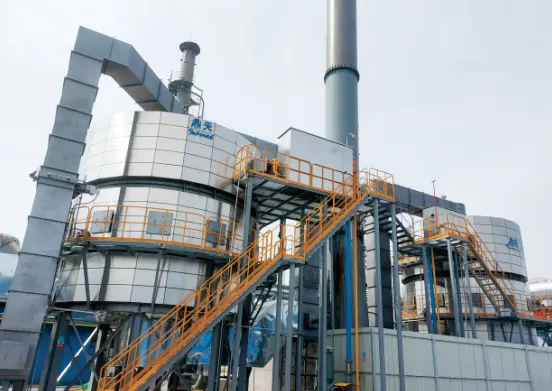
Heat recovery is one of the core highlights of High Air Volume Rotary RTO. Waste heat recovery methods include hot water heat recovery, steam heat recovery, hot air heat recovery and heat transfer oil heat recovery. Heat recovery forms are hot air, steam, ethylene glycol, and oil, which are suitable for low-high volume flow. A comparison between Ever-power’s rotary RTO and 3-Beds RTO shows that the former has more efficient heat recovery and handles a larger air volume. This high air volume rotary RTO with heat recovery technology not only reduces fuel consumption, but also supports the “dual carbon” strategy and promotes the transformation of enterprises to a low-carbon society.
Application of High Air Volume Rotary RTO in Kiln Waste Gas Treatment
In the industrial kiln treatment scheme, the waste gas treated by High Air Volume Rotary RTO is characterized by low comprehensive volume and high carbon monoxide concentration. The process is degassing system + cyclone RTO + waste heat recovery. High Air Volume Rotary RTO is suitable for high air volume of 5,000+ SCFM, with a thermal efficiency of up to 95%. The application of this high air volume rotary RTO for industrial kiln emissions has achieved the treatment of 8 sets of nitrogen-containing organic sulfur waste gas projects, combined with SCR+SNCR technology to ensure emission compliance.
High Air Volume Rotary RTO in Waste Chemical and Oilfield Associated Gas Treatment
In the waste chemical low-temperature methanol washing waste gas treatment scheme, High Air Volume Rotary RTO treats methane, carbon monoxide, hydrogen and light hydrocarbons. The process is reduction system + ultra-low nitrogen RTO + waste heat recovery. The oilfield fire drive associated gas scheme includes gas-liquid separation + desulfurization + methanol + RTO. High Air Volume Rotary RTO manages etching and cleaning emissions in semiconductor manufacturing, and the concentrated air enters the RTO to preheat VOCs for oxidation. This integration of high air volume rotary RTO for oilfield flare gas has achieved 45 sets of sulfane waste gas projects and avoided excessive sulfur dioxide.

Comparison of High Air Volume Rotary RTO and Other Types of RTO
Compared with the three-bed RTO, the High Air Volume Rotary RTO is more suitable for large air volume treatment. The rotary RTO heats the organic waste gas to above 760℃ and oxidizes and decomposes VOCs, while the three-bed type is slightly inferior in fuel efficiency. The RTO achieves high fuel efficiency by switching the flow direction every 3 minutes and treats the dirty air volume. The RTO is suitable for 5,000+ SCFM, but misuse should be avoided. This analysis of high air volume rotary RTO vs 3-beds RTO highlights the former’s advantages in compact design and heat exchange.

Reviews
| Alex Johnson, Operations Manager | Maria Lopez, Environmental Specialist | Robert Kim, Production Engineer |
| We’ve been using the High Air Volume Rotary RTO for six months in our printing plant. It handles large exhaust volumes effectively, achieving consistent VOC reduction through its regenerative ceramic beds. The heat recovery system recycles energy back into our processes, lowering fuel use by about 15%. Setup was straightforward with minimal downtime. | In our chemical facility, the High Air Volume Rotary RTO processes low-concentration gases like toluene efficiently. The rotary valve ensures smooth flow switching, maintaining 95% thermal efficiency. We’ve noted reliable performance in daily operations, with easy access for maintenance on the modular components. | The High Air Volume Rotary RTO fits well in our kiln setup, managing carbon monoxide emissions at high volumes. Its oxidation chamber operates at stable temperatures, and the excess heat is recovered via steam, supporting our energy needs. Regular checks show durable construction against corrosion. |
Environmental Protection and Energy Saving Significance
Under the background of the “dual carbon” strategy, High Air Volume Rotary RTO promotes green production and gives the world a blue sky. We emphasize the green production concept of enterprises, and RTO reduces VOCs, odors and smoke, and meets emission standards. This high air volume rotary RTO environmental benefits not only improves air quality, but also reduces carbon footprint through energy-saving technology.
Choosing High Air Volume Rotary RTO
High Air Volume Rotary RTO is an efficient and reliable exhaust gas treatment solution. It demonstrates excellent performance in many industries. When enterprises choose this equipment, they are investing in the future of environmental protection and energy saving.