Processable Gases
—VOC
EVER-POWER(Australia) Company Ltd.
Noxs
Odor
Haps
PM 2.5
Wam
Acidic Gas
Advanced RTO Solutions: Mastering VOC Abatement for the Australian Industrial Landscape
In the contemporary industrial environment of Australia, managing Volatile Organic Compounds (VOCs) and Hazardous Air Pollutants (HAPs) is no longer just a regulatory box-ticking exercise; it is a critical component of sustainable operational strategy and corporate social responsibility. At EVER-POWER (Australia) Company Ltd., we recognize that Australian manufacturers—from the mining sectors of Western Australia to the chemical processing plants in New South Wales—face unique challenges driven by harsh climatic conditions and stringent environmental standards. Our flagship Regenerative Thermal Oxidizer (RTO) systems are engineered to address these specific needs, transforming the burden of emissions control into an opportunity for energy recovery and operational excellence. Unlike traditional thermal oxidizers that consume vast amounts of natural gas, our RTO technology utilizes a high-density ceramic heat exchange media to capture and recycle up to 97% of the thermal energy generated during combustion. This means that once the system reaches its operating temperature, it can often sustain itself using the calorific value of the solvent vapors alone, achieving what is known as “autothermal operation.” This capability is paramount for Australian businesses looking to insulate themselves from fluctuating energy prices while ensuring absolute compliance with local air quality mandates.
The core philosophy behind our RTO design is “Robustness through Precision.” We understand that a breakdown in an emissions control device can halt an entire production line, costing thousands of dollars per hour. Therefore, our systems are built with redundancy and durability at the forefront. We utilize heavy-duty 316L stainless steel and specific alloys like Hastelloy for corrosive environments, ensuring longevity even when treating halogenated compounds common in pharmaceutical and petrochemical applications.
Whether you are dealing with high-volume, low-concentration exhaust from spray painting booths or complex chemical off-gassing, our RTOs deliver a Destruction Removal Efficiency (DRE) consistently exceeding 99%.
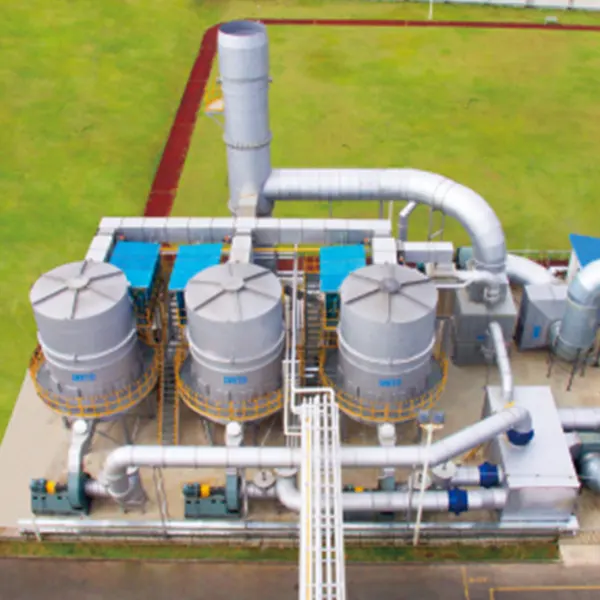
Engineering Principles
- Adsorption and Heat Recovery:
-
-
In the initial stage of operation, VOC-containing exhaust gas enters the RTO, passing through ceramic materials in the heat exchange bed. These ceramic materials have high heat capacity and can recover heat from the exhaust gas. During this process, the gas is heated, and the heat is stored in the ceramic bed.
-
The stored heat in the ceramic bed is then used in the next phase of the process.
-
2. High-Temperature Oxidation Reaction:
-
The heated gas flows into the combustion chamber (oxidizer), where temperatures typically range from 760°C to 1000°C. At these high temperatures, VOCs undergo oxidation with oxygen to form carbon dioxide (CO₂) and water (H₂O), while releasing additional heat.
For specific VOCs, the reactions are as follows:
-
Benzene (C₆H₆) oxidation:
2C6H6+15O2→12CO2+6H2O2C₆H₆ + 15O₂ \rightarrow 12CO₂ + 6H₂O
-
Toluene (C₆H₅CH₃) oxidation:
2C6H5CH3+15O2→12CO2+6H2O2C₆H₅CH₃ + 15O₂ \rightarrow 12CO₂ + 6H₂O

3. Cooling the Exhaust Gases:
-
-
After the oxidation reaction, the exhaust gases are still at a high temperature. These gases are then cooled to a safe discharge temperature through a cooling system. During this cooling process, the gases pass through the ceramic bed, where the heat is recovered, and the ceramic bed is again heated.
-
4. Heat Energy Regeneration:
-
-
A key feature of the RTO system is its ability to recover thermal energy. By utilizing the heat released from the oxidation reaction, the system preheats the incoming cold exhaust gas, significantly reducing energy consumption.
-
Partial RTO parameter diagram
| Performance | 2-bed RTO | 3-bed RTO | Rotary Valve RTO | Notes |
|---|---|---|---|---|
| Technicality | First generation | Second generation | Third generation | |
| Number of chambers | 2 | 3 | 12 | Rotary valve operates continuously |
| Number of valves | 4 | 9 | / | |
| Reliability | Valve switching times per year: 350,000 | Valve switching times per year: 520,000 | / | |
| Piping pressure fluctuation | ±500pa | ±250pa | ±25pa | |
| Discharge compliance | Total purification efficiency: 95% | Total purification efficiency: 99% | Total purification efficiency: 99.5% | 99.5% |
| Maximum treating range | < 1g | < 5g | < 10g | 50mg/m³ discharge standard |
| Heat dissipation surface area | 100m² | 145m² | 95m² | |
| Energy saving | Thermal efficiency: 90% | Thermal efficiency: 95% | Thermal efficiency: 96% | 96% |
| Start-up heating time | 2.5h | 2.5h | 2h | Cold furnace start-up (Ethyl acetate) |
| Self-operation concentration | 2.5g/m³ | 2.2g/m³ | 1.8g/m³ | |
| Economy | Regenerative ceramic filling volume: 18m³ | Regenerative ceramic filling volume: 26m³ | Regenerative ceramic filling volume: 17m³ | 17m³ |
| Practicality | Occupation of land: L12×W7 | Occupation of land: L16×W7 | Occupation of land: L12×W7 | L12×W7 |
What is VOCs?
1. Characteristics of VOCs:
Volatility: VOCs have a low boiling point, meaning they can easily transition from liquid or solid form to gas at room temperature, allowing them to disperse into the atmosphere.
Organic Compounds: These compounds contain carbon and are typically made up of hydrogen, carbon, and sometimes oxygen, nitrogen, or other elements.
2. Sources of VOCs:
Natural Sources: VOCs are naturally emitted by plants, trees, and forests. They can also be produced by wildfires, volcanic eruptions, and certain biological processes.
Human-made Sources: These include industrial processes, vehicle emissions, use of solvents, paints, varnishes, cleaning agents, and fuels. VOCs can also be released from consumer products such as air fresheners, deodorants, and household cleaners.
3. Examples of Common VOCs:
Benzene, Formaldehyde, Toluene, Xylene, Acetone ,Ethylbenzene,
4. Health Impacts:
VOCs can have significant health effects, particularly when inhaled in high concentrations. Short-term exposure to certain VOCs can cause: Headaches, Dizziness, Eye, nose, or throat irritation.
Long-term exposure may lead to more serious health issues such as liver and kidney damage, neurological effects, and even cancer (for certain VOCs like benzene).
5. Environmental Impact:
Ozone Formation: VOCs, in the presence of sunlight, react with nitrogen oxides (NOx) in the atmosphere to form ground-level ozone, a major component of smog. Ground-level ozone is harmful to both human health and the environment.
Advantages of RTO for treating VOCs
High VOC Removal Efficiency:
Since high-temperature oxidation can fully convert VOCs into CO₂ and H₂O, RTO effectively removes harmful gases from the exhaust.
Energy Recovery:
The RTO system recovers heat from the oxidation reaction, allowing the system to use this heat to preheat incoming gases, reducing energy consumption.
Wide Application Range:
RTO is highly effective in treating a wide variety of VOC gases, especially in industries where high VOC concentrations are present.
FAQ
Frequently asked question.
Q1. What is the typical cost of installing an RTO system for a manufacturing plant in Sydney?
A1. The cost varies significantly based on airflow volume (Nm³/h) and VOC concentration. We recommend requesting a quote for a precise turnkey estimate that includes shipping to Port Botany and local installation commissioning.
Q2. How does an RTO compare to a Carbon Adsorption system for treating high-flow, low-concentration VOCs?
A2. Carbon adsorption requires frequent media replacement and creates a secondary waste stream (spent carbon), which can be expensive in Australia. An RTO, especially when paired with a Zeolite Concentrator, offers lower long-term Operating Expenses (OpEx) because it destroys the VOCs permanently and recovers heat, rather than just trapping them.
Q3. Can EVER-POWER provide maintenance services for my existing Dürr or Anguil RTO in Western Australia?
A3. Yes, absolutely. We supply compatible ceramic media, valves, and burner parts for major brands like Dürr and Anguil. We can ship replacement parts directly to Western Australia and provide remote technical guidance or on-site support to ensure your system remains compliant with WA EPA regulations.
Q4. What happens if the VOC concentration in my exhaust stream fluctuates wildly during production?
A4. Our RTOs are designed with a “Hot Bypass” and fresh air dilution valves. If the concentration spikes towards 25% LEL (Lower Explosive Limit), the system automatically introduces fresh air to dilute the stream or bypasses heat recovery to prevent over-temperature trips, ensuring safe, uninterrupted operation.
Q5. Does your equipment comply with the specific requirements of the NSW Protection of the Environment Operations Act?
A5. Yes, our systems are engineered to meet the strict emission limits defined in the POEO (Clean Air) Regulation 2021. We provide detailed performance guarantees regarding NOx, CO, and VOC output levels to help you secure and maintain your Environmental Protection Licence (EPL) in New South Wales.
Q6. How often does the ceramic heat exchange media need to be replaced or cleaned?
A6. In clean applications, structured ceramic media can last 5-10 years. However, if your process involves sticky particulates (like in printing or food processing), we recommend a “Bake-Out” (self-cleaning cycle) regularly. Physical replacement depends on pressure drop readings, which our IoT monitoring can track for you.
Q7. Can the RTO system handle chlorinated or halogenated organic compounds?
A7. Yes, but it requires specific materials. For halogenated streams, we construct the combustion chamber using Hastelloy or high-grade stainless steel to resist acid corrosion. We also install a Quench and Scrubber system downstream to neutralize any hydrochloric acid (HCl) formed during oxidation.
Q8. Is it possible to recover the heat from the RTO to heat my factory during the Australian winter?
A8. Definitely. We can install a secondary air-to-air heat exchanger or a waste heat boiler at the RTO outlet. This captured energy can be directed back to your facility for space heating or process heating, significantly reducing your natural gas consumption during colder months.