Applications of RTO in the Resin and Polymer Production Industry
Waste Gas Composition and Process Characteristics
Resin production includes polymerization, devolatilization, drying, and post-treatment processes. The composition of the waste gas generated at each stage differs:
• Polymerization Reaction Waste Gas: Styrene, acrylic monomer, formaldehyde, methanol, and catalyst residue. Temperatures can reach 200 °C during the reaction, with large exhaust flow rates and water vapor content. Concentration may rise instantaneously and requires timely dilution.
• Devolatilization and Drying Waste Gas: Contains unreacted monomers and low molecular weight substances such as styrene, acrylates, and volatile additives. Most waste gases are high-temperature and dusty, posing a potential explosion risk.
• Product Storage and Handling: Low concentrations of BTEX and thiols are generated during tank breathing gas and volatilization during loading and unloading, requiring large-volume ventilation.

| Processing Stage | Source of VOC Emission | Key Pollutant Types | Adapted Treatment Solutions | Advantages & Application Scenarios |
|---|---|---|---|---|
| Resin Synthesis | Unpolymerized volatile monomers; organic solvents for viscosity adjustment (e.g., toluene, xylene, ethyl acetate); volatilization of reaction by-products | BTEX, esters, aldehydes, alcohols | 1. RTO (Regenerative Thermal Oxidizer) 2. Catalytic Oxidation (CO) |
1. RTO: High treatment efficiency for high-concentration, large-airflow waste gas with heat recovery rate ≥95%, suitable for large-scale resin synthesis production lines 2. Catalytic Oxidation: Low ignition temperature (200-400℃), low energy consumption, suitable for medium-low concentration waste gas |
| Heating & Melting (Injection Molding/Extrusion) | Volatilization of residual small-molecule monomers, plasticizers, stabilizers in resin; volatilization of solvents entrained in raw materials | Esters, ketones, plasticizer volatiles | 1. Activated Carbon Adsorption Concentration + Catalytic Oxidation 2. Zeolite Rotor Adsorption + RTO |
1. Activated Carbon + CO: Low investment cost, suitable for small-medium airflow and intermittent emission scenarios 2. Zeolite Rotor + RTO: High adsorption efficiency, capable of treating large-airflow low-concentration waste gas, suitable for continuous injection molding/extrusion workshops |
| Coating/Laminating | Organic solvents in coatings/adhesives (e.g., butyl acetate, cyclohexanone); volatilization of crosslinking agents during film formation | BTEX, esters, ketones, ethers | 1. High-Voltage Electrostatic Adsorption + Catalytic Oxidation 2. Solvent Recovery Unit (Condensation Method) |
1. Electrostatic Adsorption + CO: Removes mist-like VOCs, suitable for oil-mist-containing waste gas in coating processes 2. Condensation Method: Recovers organic solvents (e.g., ethanol, acetone), suitable for high-concentration solvent-based coating processes |
| Curing/Drying | Volatile components of curing agents and crosslinking agents; volatilization of uncured resin small molecules | Amines, isocyanates, aldehydes | 1. Hot Air Circulation Catalytic Oxidation 2. Photocatalytic Oxidation + Activated Carbon Adsorption |
1. Hot Air Circulation CO: Reusable heat reduces drying energy consumption, suitable for curing oven waste gas 2. Photocatalytic Oxidation + Activated Carbon: Suitable for low-concentration, odor-type VOC treatment, assists in reducing tail gas odor |
| Grinding/Cleaning | Resin residual volatiles carried by grinding dust; volatilization of cleaning organic solvents (e.g., acetone, cleaning agents) | Resin oligomers, alcohols, ethers | 1. Bag Dust Removal + Activated Carbon Adsorption 2. Wet Scrubbing + UV Photolysis |
1. Bag Dust Removal + Activated Carbon: Removes dust first then adsorbs VOCs to avoid dust clogging adsorption materials, suitable for grinding processes 2. Wet Scrubbing + UV Photolysis: Removes water-soluble VOCs, suitable for low-concentration waste gas in cleaning processes |
RTO Configuration and Technical Requirements
1. Dilution and Bypass: Due to the low lower explosive limits (LELs) of styrene and acrylic acid in the waste gas, dilution or a thermal bypass must be implemented before entering the RTO to ensure the waste gas concentration is below 25% LEL. For reaction processes with large fluctuations, a dilution fan and automatic bypass valve can be installed before the RTO to handle instantaneous concentration peaks.

2. Three-bed/Five-bed RTO: When the waste gas composition is complex and the organic load is high, a three-bed or five-bed RTO can maintain a higher outlet temperature during reversal, achieve a heat recovery rate ≥95%, and reduce fuel consumption. A five-bed RTO is particularly suitable for high-concentration waste gas containing styrene, and can automatically clean the regenerative bed without shutting down the unit.
3. Corrosion-resistant Design: Acrylic acid monomers easily polymerize into solids at high temperatures, clogging the bed. Anti-coking ceramic packing and regular backflushing are required. The unit material must be corrosion-resistant stainless steel such as 310S or Hastelloy to prevent organic acid corrosion. 4. Dust Removal and Pretreatment: For exhaust gas containing solid dust, a bag filter or cyclone separator should be installed before the RTO to protect the regenerator bed from clogging. Some exhaust gas needs to pass through an alkaline scrubbing tower to remove acidic gases before entering the RTO.
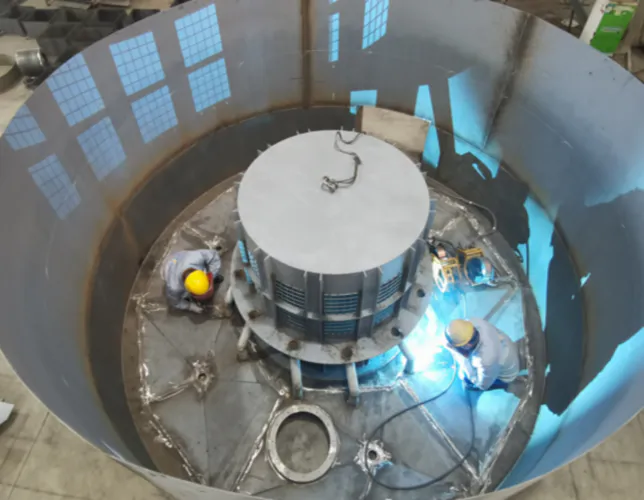
4. Dust Removal and Pretreatment: For exhaust gas containing solid dust, a bag filter or cyclone separator should be installed before the RTO to protect the regenerator bed from clogging. Some exhaust gas needs to pass through an alkaline scrubbing tower to remove acidic gases before entering the RTO.
Working principle of RTO for purifying exhaust gas and recovering waste heat

Our RTO’s technological iteration

| Performance Comparison Table of Different RTO Types | ||||
|---|---|---|---|---|
| Type | 2-Chamber RTO | 3-Chamber RTO | Rotary Valve RTO | Remarks |
| Technology Generation | 1st Generation | 2nd Generation | 3rd Generation | |
| Technological Advancement Features | Added Purge Function | Adopts Rotary Air Exchange Valve | 2.5-chamber type has purge function; fan power is 1.5 times higher | |
| Number of Regenerators | 2 | 3 | 12 | Airflow design per regenerator ≤ 50,000 m³/h |
| Purification Efficiency | 95% | 99% | 99.5% | |
| Thermal Efficiency | 90% | 95% | 97.0% | Temperature difference between inlet and outlet ≤ 20°C |
| Floor Area | 100% | 130% | 65% | Based on 2-chamber RTO |
Rotary RTO, Third-Generation Technology Product – Features
Rotary RTO, Third-Generation RTO With 12 Chambers
Small footprint
High thermal efficiency
High purification efficiency
Minimal pipeline pressure fluctuations
Low maintenance frequency and costs
Why Choose Us?
• EU: WGC BREF 2023 proposes that resin and polymer production should use thermal oxidation or catalytic oxidation as the primary treatment technology, requiring VOC removal efficiency ≥95%, and proposes best practices for monomer recovery and process enclosure.
• US: The EPA’s RACT/BACT/LAER lists propose best available control technologies for styrene and acrylic acid production in each state. OSHA sets occupational exposure limits of 100 ppm for styrene and 0.75 ppm for formaldehyde.
• China: The chemical industry emission standard (HJ 606-2016) requires styrene emission concentrations ≤50 mg/m³; local standards such as Jiangsu DB32/3151-2017 require the installation of recovery devices in organic liquid storage tanks and loading/unloading facilities.
• Brazil and the Middle East: These countries mostly refer to EU or US standards, employing local environmental agency permitting systems that require companies to self-monitor emissions.

FAQ:
Q1: Is a water scrubbing tower needed before the RTO?
A1: For exhaust gases containing organic acids or halogenated hydrocarbons, it is recommended to install a quench scrubbing tower to remove some acidic gases and particulate matter, thereby extending the RTO’s lifespan and reducing corrosion.
Q2: How to deal with fluctuations in exhaust gas concentration?
A2: Ever-Power provides dilution fans, bypass valves, and an online LFL monitoring system to automatically adjust the inlet gas concentration; during peak periods, a short-term bypass can be implemented, and the RTO temperature can be maintained through a bypass burner to avoid shutdown.