


1. Selective Catalytic Reduction (SCR) System Structure
-
1. Catalyst:
-
Function: The catalyst is the core component of the SCR system, facilitating the chemical reaction between NOx and the reducing agent (such as ammonia or urea). The catalyst is typically made from high-temperature resistant materials such as titanium, vanadium, or molecular sieves. The catalyst provides a surface where NOx reacts with the reducing agent to be converted into harmless nitrogen (N₂) and water vapor (H₂O).
-
-
2. Reducing Agent Injection System:
-
Function: The reducing agent is critical in the SCR process. The most common reducing agents are urea (for diesel engines as Diesel Exhaust Fluid, DEF) or ammonia (NH₃). The reducing agent is injected into the SCR system where it reacts with NOx to convert it into N₂ and H₂O.
-
-
3. Reactor (Combustion Chamber):
-
Function: The reactor or combustion chamber is where the exhaust gases and reducing agent react. The temperature is usually maintained between 750°C and 1,200°C to facilitate effective NOx reduction.
-
-
4. Gas Flow Control System:
-
Function: The flow control system manages the direction and volume of gases passing through the system. This ensures that the gases are evenly distributed, and the reducing agent is thoroughly mixed with the exhaust gases before entering the catalyst.
-
-
5. Heat Exchange System:
-
Function: In some SCR systems, a heat exchange system recovers heat from the exhaust gases to improve energy efficiency. By recovering heat, the system can preheat the incoming exhaust gases, reducing the need for additional fuel.
-
-
6. Exhaust System:
-
Function: The exhaust system safely directs the treated gases out of the SCR system into the atmosphere. After treatment, the gases typically consist mainly of nitrogen and water vapor, which are harmless to the environment.
-
-
7. Control System:
-
Function: The control system monitors and regulates the operation of the SCR system. Sensors measure NOx concentration, temperature, pressure, and other parameters, and the system adjusts the injection rate and gas flow to maintain optimal performance.
-
-
8. Sensors and Monitoring Systems:
-
Function: Sensors monitor the various parameters of the SCR system, such as NOx concentration, temperature, gas flow, etc., to ensure efficient operation.
-


2. Mastering NOx Emissions with Precision Engineering
The operational philosophy of our SCR systems is “Maximum Reduction, Minimum Slip.” Ammonia slip—the release of unreacted ammonia—is a common pitfall in poorly designed systems. Our SCR units feature advanced Ammonia Injection Grids (AIG) and Computational Fluid Dynamics (CFD) modeled flow distribution to ensure perfect mixing of the reducing agent (Urea or Anhydrous Ammonia) with the flue gas. This precision engineering prevents localized hotspots and ensures uniform catalyst utilization. Collaborating with global environmental leaders like Baolan EP, we bring proven, world-class deNOx technology to the local market.
3. Engineering Mechanics: How SCR Works
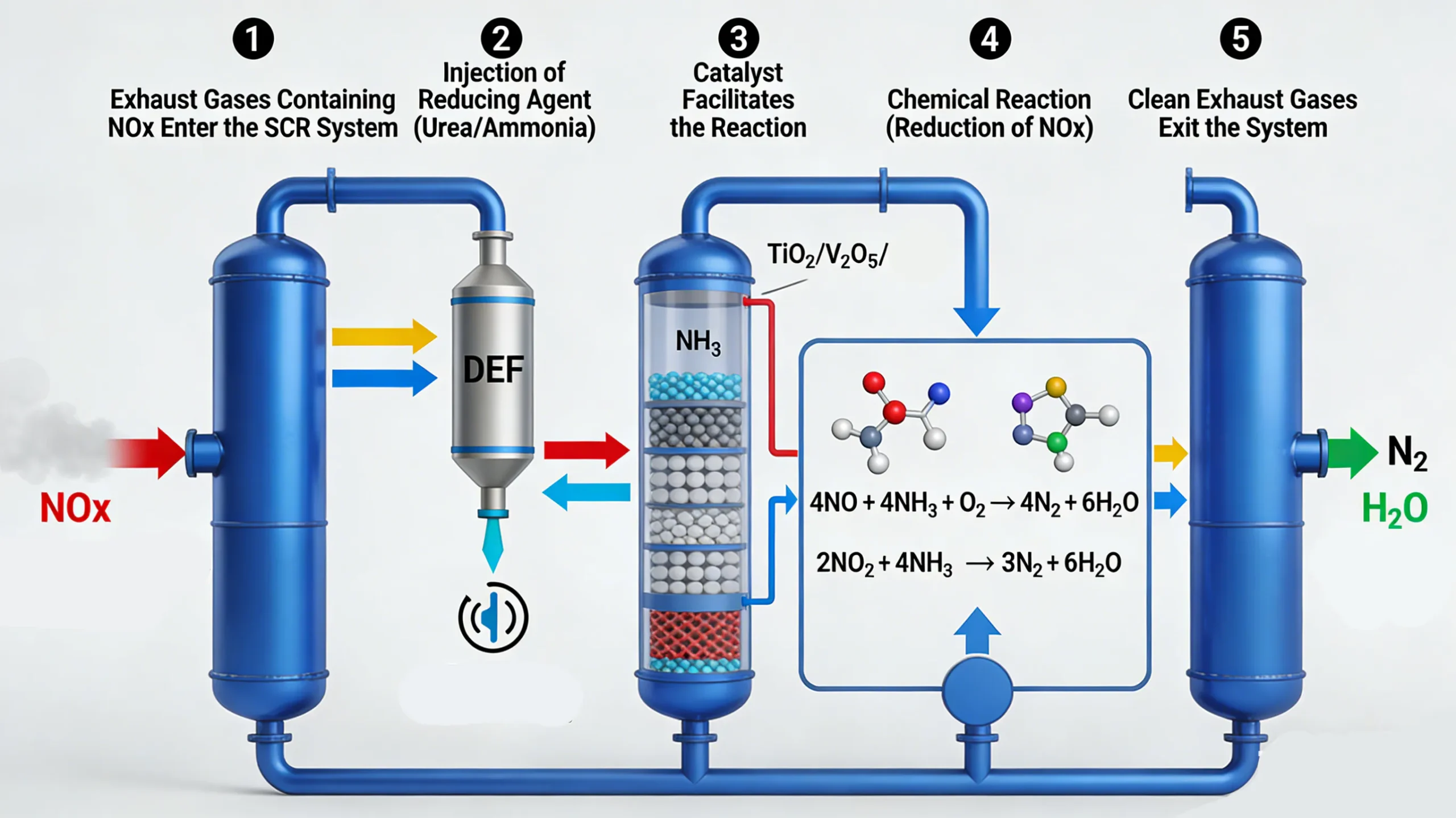
1. Exhaust Gases Containing NOx Enter the SCR System:
The exhaust gases, which contain nitrogen oxides (NOx), pass through the SCR system. NOx is a harmful pollutant that contributes to air pollution and environmental problems like smog and acid rain. In the SCR system, the goal is to break down these NOx emissions into harmless substances.
2. Injection of Reducing Agent (Typically Urea or Ammonia):
A reducing agent is injected into the exhaust stream. The most commonly used reducing agent is urea (often in the form of aqueous urea solution, commonly known as Diesel Exhaust Fluid or DEF), though ammonia (NH₃) can also be used in some systems. When urea or ammonia is injected into the exhaust gases, it decomposes and forms ammonia gas (NH₃), which reacts with the NOx emissions in the presence of a catalyst.
3. Catalyst Facilitates the Reaction:
The exhaust gases, now mixed with ammonia, pass through a catalytic converter inside the SCR system. The catalyst is typically made from materials like titanium dioxide (TiO₂), vanadium pentoxide (V₂O₅), or zeolites, which help to facilitate the chemical reactions without being consumed in the process. The catalyst provides a surface where the NOx molecules can react with the ammonia (or urea).
4. Chemical Reaction (Reduction of NOx):
Inside the SCR system, the ammonia reacts with the nitrogen oxides (NO and NO₂) in a process called reduction. The ammonia breaks the NOx molecules apart, forming nitrogen (N₂) and water vapor (H₂O) as the byproducts. The main reaction is as follows:
4NO + 4NH₃ + O₂ → 4N₂ + 6H₂O
2NO₂ + 4NH₃ → 3N₂ + 6H₂O
5. Clean Exhaust Gases Exit the System:
After the reaction, the clean, treated exhaust gases (mostly nitrogen and water vapor) exit the SCR system and are released into the atmosphere. As a result, the NOx emissions are reduced by up to 90%, making the exhaust gases significantly less harmful to the environment.

4. Five key facts
High Efficiency: The SCR system can achieve NOx reduction efficiency of up to 90%.
Catalyst Function: The core component of the SCR system is the catalyst, typically made of high-temperature resistant materials such as titanium dioxide (TiO₂), vanadium pentoxide (V₂O₅), and zeolites. It facilitates the chemical reaction between the reducing agent (urea or ammonia) and NOx, converting harmful NOx into harmless nitrogen gas (N₂) and water vapor (H₂O).
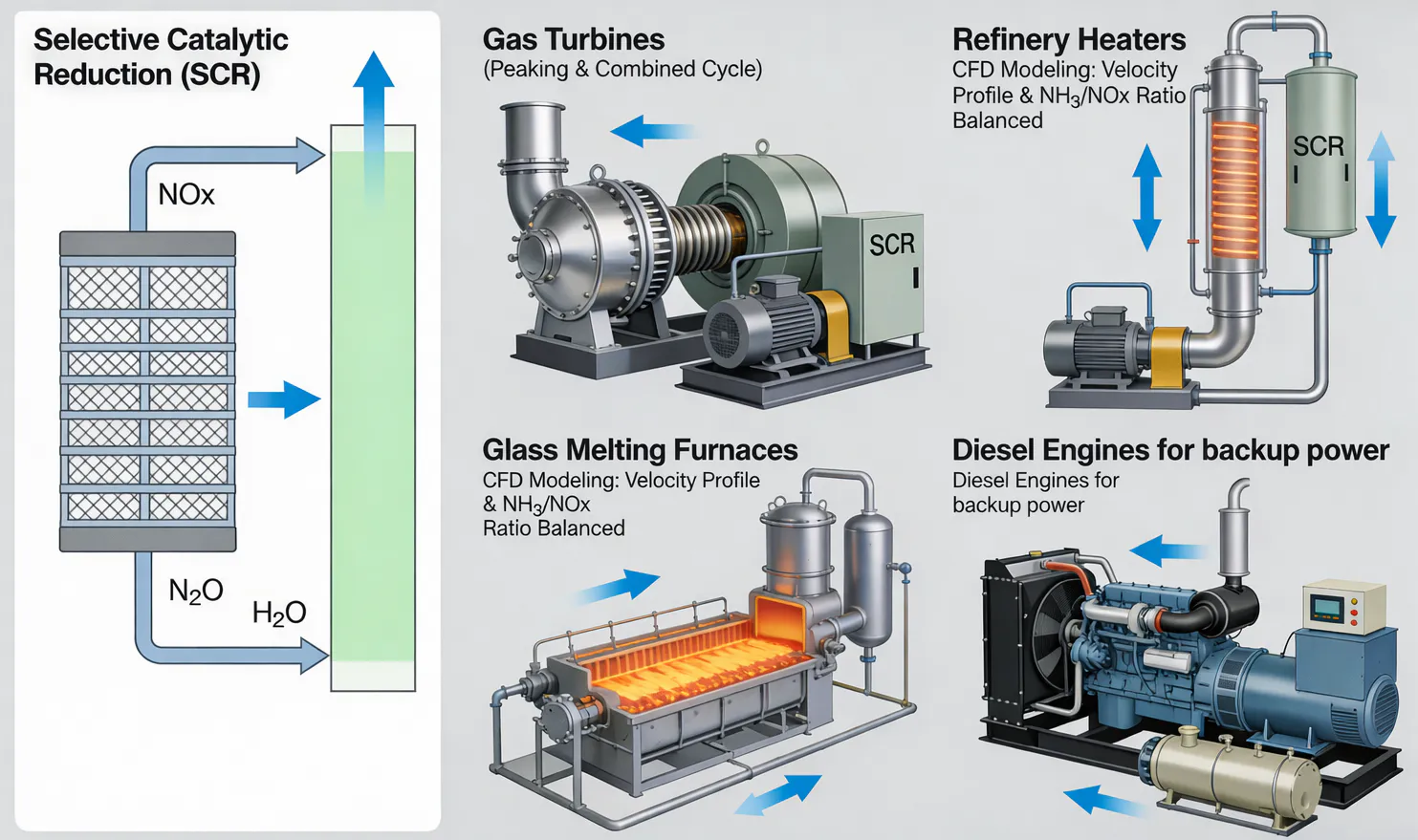
Widely Used in Various Industries: SCR systems are widely used in numerous industries, including automobiles, ships, stationary power generation, chemical plants, and fossil fuel power plants.
Advanced Ammonia Injection Grid (AIG): Optimizes the mixing of the reducing agent with the exhaust gas, ensuring uniform catalyst utilization and preventing ammonia leakage.
Compliant with Environmental Regulations: Meets stringent environmental regulations, significantly reducing harmful NOx emissions and improving air quality.
5. Advantages of Selective Catalytic Reduction:
-
High Efficiency: SCR systems can achieve NOx reduction efficiencies of up to 90%.
-
Meets Environmental Standards: It helps meet stringent emissions regulations in many regions, including those set by the EPA (Environmental Protection Agency) in the U.S., and EU regulations in Europe.
-
Versatility: SCR systems are used in a variety of industries, including automotive, marine, and stationary power generation.
-
Improved Air Quality: By reducing NOx emissions, SCR systems contribute to better air quality and the reduction of acid rain, smog, and ozone depletion.

6. Market Trend Analysis: The Rise of Ultra-Low NOx and Slip Control
The Australian industrial emissions sector is witnessing a paradigm shift towards “Ultra-Low NOx” standards. With urban encroachment on industrial zones, regulators are imposing tighter limits on NOx emissions to combat ground-level ozone. This trend is driving the demand for High-Efficiency SCR Systems capable of achieving sub-5 ppm NOx levels. To meet this, EVER-POWER is deploying advanced catalyst formulations with higher surface area and activity per volume, allowing for more compact reactors without sacrificing performance. Additionally, there is a strong focus on Ammonia Slip Catalyst (ASC) layers. These “guard beds” are installed downstream of the main SCR catalyst to oxidize any unreacted ammonia, ensuring that the push for higher NOx reduction does not result in secondary ammonia pollution.
Another emerging trend is the integration of Low-Temperature Catalysts. Traditionally, SCR required flue gas reheating for applications like Waste-to-Energy or Biomass boilers where exhaust temperatures are low (180°C – 250°C). Reheating consumes significant fuel. New Manganese or specialized Vanadium catalysts can now operate effectively at these lower temperatures, eliminating the need for duct burners and improving the overall energy efficiency of the plant. Furthermore, digitization is playing a key role; Predictive Emission Monitoring Systems (PEMS) are being integrated to model catalyst degradation and optimize urea injection rates in real-time, reducing reagent waste by up to 15%.
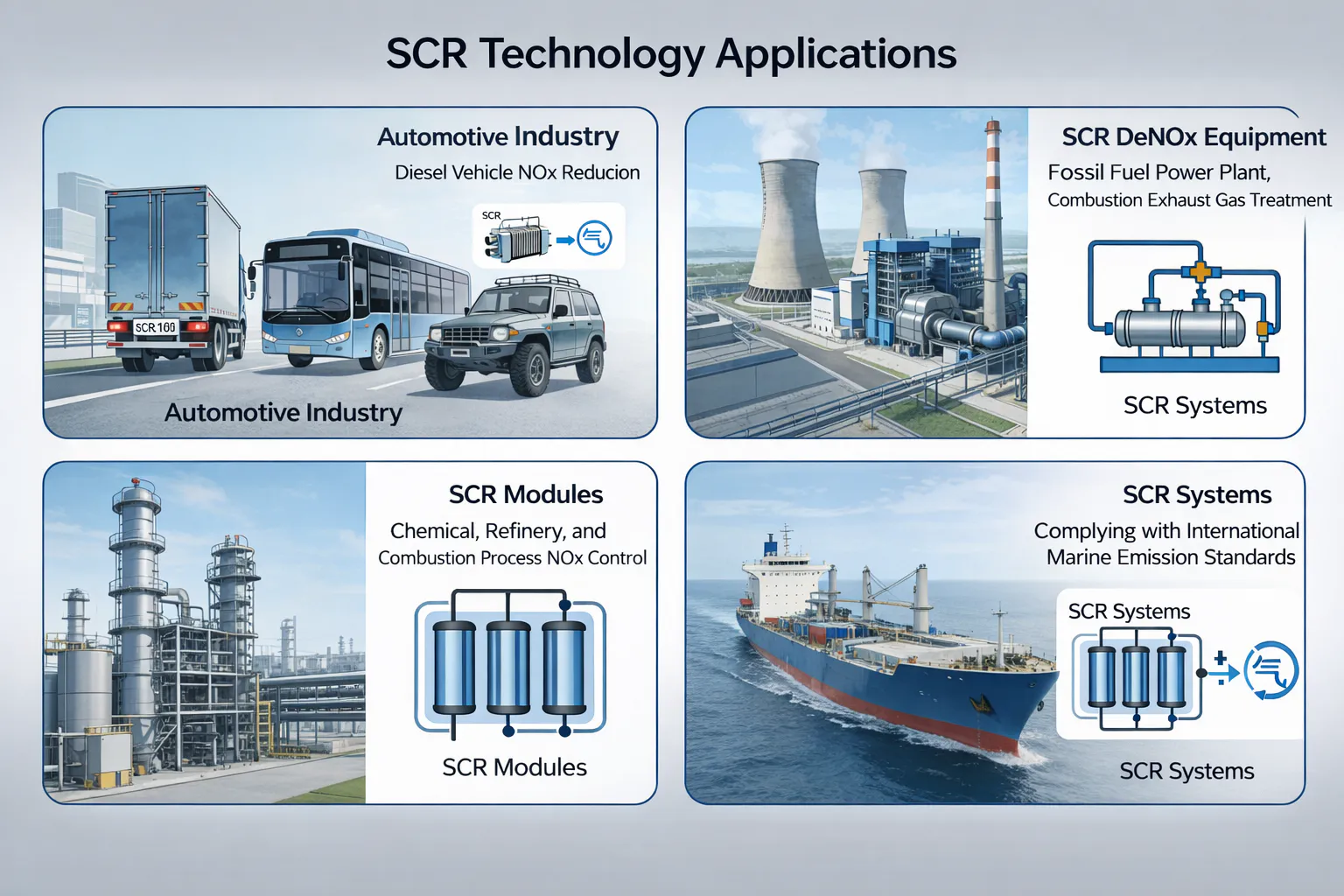
7. Application Scenarios of Selective Catalytic Reduction
-
Automotive Industry: SCR is commonly used in diesel-powered vehicles to reduce NOx emissions, especially in heavy-duty trucks, buses, and off-road vehicles.
-
Power Plants: SCR is used in fossil fuel power plants to reduce the NOx emissions from combustion processes.
-
Industrial Facilities: Many industrial processes that involve combustion (such as chemical plants and refineries) use SCR to control NOx emissions.
-
Marine and Shipping: SCR systems are used on ships to reduce emissions from marine diesel engines, ensuring compliance with international maritime emission standards.
8. Selective Catalytic Reduction vs RTO
| Feature | Selective Catalytic Reduction (SCR) | Regenerative Thermal Oxidizer (RTO) |
|---|---|---|
| Primary Function | NOx Reduction: SCR is used primarily for reducing nitrogen oxides (NOx) from exhaust gases. | VOC and CO Destruction: RTO is used primarily for oxidizing volatile organic compounds (VOCs) and carbon monoxide (CO) in industrial emissions. |
| Technology Type | Catalytic Process: In SCR, a reducing agent (such as ammonia or urea) reacts with NOx over a catalyst to convert it into nitrogen and water. | Thermal Oxidation: RTO uses high temperatures (750-1,200°C) to oxidize pollutants like VOCs and CO into carbon dioxide and water. |
| Emissions Treated | NOx (Nitrogen Oxides) | VOCs (Volatile Organic Compounds), CO (Carbon Monoxide), Particulate Matter |
| Operating Temperature | SCR operates at relatively lower temperatures, typically between 250°C and 450°C (482°F – 842°F). | RTO requires higher temperatures (750°C – 1,200°C or 1,382°F – 2,192°F) to ensure proper oxidation of VOCs and CO. |
| Catalyst/Heat Recovery | Catalyst: SCR relies on a catalyst to lower the activation energy of the NOx reduction reaction. | Heat Recovery: RTOs have a regenerative heat recovery system that preheats incoming exhaust gases to reduce energy consumption. |
| Energy Use | SCR is generally energy-efficient because it operates at lower temperatures and can be self-sustaining once the catalyst is in place. | RTOs can have high energy consumption unless equipped with a heat recovery system, which can save energy by reusing exhaust heat. |
| Maintenance | Medium Maintenance: SCR systems require regular monitoring of catalysts and reducing agents, as well as maintenance of pumps and injectors. | High Maintenance: RTO systems require regular cleaning of ceramic media, burner maintenance, and replacement of valves and seals. |
| Operating Cost | Low Operating Cost: Once installed, SCR typically has low operating costs due to energy efficiency, but it requires maintenance of catalysts and reducing agents. | Moderate Operating Cost: RTOs can be more expensive to operate without heat recovery due to their high temperature needs, but they are efficient at destroying VOCs. |
| Suitability for Different Industries | SCR is highly suitable for NOx emissions from mobile sources like vehicles or stationary sources like power plants and chemical factories. | RTO is ideal for VOC and CO emissions from industries like chemical manufacturing, coating, and wastewater treatment. |
| Installation and Integration | SCR is often installed as an after-treatment solution in diesel engines, power plants, or other combustion systems. | RTO is typically integrated into industrial exhaust systems for continuous treatment of waste gases in sectors like manufacturing and wastewater treatment. |
| Regulatory Compliance | SCR systems are widely used to meet stringent NOx emission standards in countries with strict environmental regulations (e.g., EU, US, and Australia). | RTO systems are used for VOC compliance in industries regulated by environmental bodies like the EPA in the US, the EU Industrial Emissions Directive (IED), and local regulations in various countries. |
9. Customer Reviews
Australian Customer Testimonial:
“We have been using EVER-POWER’s SCR system on our coal-fired boilers, and the results are impressive. The NOx reduction efficiency is outstanding, and we are pleased to be compliant with Australian environmental regulations.” – Peter L., Environmental Compliance Manager
US Customer Testimonial:
“As a US-based pharmaceutical company, we needed a solution to control nitrogen oxide emissions generated during our manufacturing process. EVER-POWER’s SCR system has completely transformed our situation.” – Sarah K.
German Customer Testimonial:
“Our plant in Germany recently adopted EVER-POWER’s SCR technology for our diesel generators, and we have noticed a significant improvement in both emissions and fuel efficiency. The ammonia slip control is top-notch.” – Marcus W., Engineering Manager
Chinese Customer Testimonial:
“We needed an effective solution to address nitrogen oxide emissions at our industrial facility in Shanghai. EVER-POWER’s SCR system not only helped us comply with local environmental regulations but also reduced our operating costs. Their team provided excellent support during the installation process, and the system has been running very reliably ever since.” – Chen J., Plant Manager
Brazilian Customer Testimonial:
“At our chemical plant in Brazil, EVER-POWER’s SCR system has played a crucial role in reducing nitrogen oxide emissions. The technology is easy to maintain, and the reactor design handles our fluctuating exhaust gas flow. We are very satisfied with the results.” – Luisa G., Environmental Health and Safety Officer
Frequently Asked Questions (FAQ)
Q1. What is the primary difference between SCR and SNCR technologies for NOx reduction?
A1. The main difference is the catalyst. SCR uses a catalyst bed to react ammonia with NOx at lower temperatures (300-400°C) with high efficiency (up to 99%). SNCR injects reagent directly into the boiler furnace at high temperatures (900-1100°C) without a catalyst, achieving lower efficiency (30-50%). SCR is preferred for strict compliance.
Q2. Can your SCR system handle high-dust flue gas from a coal-fired boiler?
A2. Yes, absolutely. For high-dust applications, we design the SCR reactor with a “High-Dust” configuration located before the particulate collector. We use wide-pitch honeycomb or plate catalysts to prevent plugging and install sonic horns or steam soot blowers to keep the channels clean.
Q3. What reagent is best for my facility: Urea or Anhydrous Ammonia?
A3. Anhydrous Ammonia is cheaper and more efficient but requires strict hazardous chemical handling and storage safety measures. Urea is safer and easier to store but requires a hydrolysis or pyrolysis system to convert it to ammonia gas before injection. For smaller to mid-sized plants in Australia, Urea (AdBlue) is often preferred for safety.
Q4. How long does the SCR catalyst typically last before replacement?
A4. Catalyst life depends on the fuel type and operating conditions. For natural gas turbines, it can last 5-7 years. For coal or biomass applications with potential poisons (like Arsenic or Potassium), it may last 3-4 years (24,000 hours). We offer catalyst management plans including testing and regeneration.
Q5. What maintenance is required for the Ammonia Injection Grid (AIG)?
A5. The AIG nozzles can become plugged with ash or urea crystallization over time. Routine maintenance involves inspecting and cleaning the nozzles during outages. Our designs often include purge air systems to keep nozzles clear during operation.
Q6. What causes “Ammonia Slip” and how do you prevent it?
A6. Ammonia slip occurs when unreacted ammonia passes through the catalyst. It is caused by over-injection, poor mixing, or catalyst deactivation. We prevent it by using CFD modeling to design precise Ammonia Injection Grids (AIG) and by using a control loop that monitors NOx inlet/outlet to dose ammonia accurately.
Q7. Can the SCR system operate at low temperatures, such as 200°C?
A7. Standard Vanadium catalysts require >300°C to avoid ammonium bisulfate formation. However, for low-temp applications (like waste-to-energy), we can supply specialized catalysts or install a duct burner to raise the flue gas temperature to the optimal range.
Q8. Is the catalyst susceptible to poisoning from sulfur or heavy metals?
A8. Yes, certain elements like Arsenic, Lead, and Phosphorus can mask active sites, and Sulfur can form pore-blocking salts at low temperatures. We analyze your fuel and flue gas to select a catalyst formulation with high resistance to these specific poisons, or design the system to operate above the dew point of these salts.
Editor: PXY