描述
Built for Harsh, Dust-Laden Process Streams
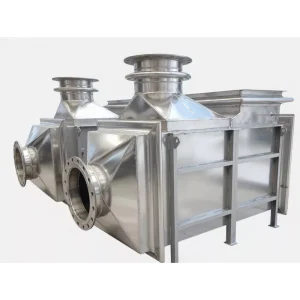
Traditional shell-and-tube coolers struggle when the medium is a hot solid: clinker, lithium carbonate, PVC powder, catalyst beads, silica sand, soda ash or sugar crystals. They clog, waste floor space and leak heat to the atmosphere. The Ever-power wide-channel plate heat exchanger replaces those legacy units with a vertical, gravity-fed pillow-plate bundle.
Hot material enters the top feed bin, flows downward through straight wide channels, and is cooled by water, glycol or thermal oil running inside the laser-welded pillow plates. Because the channels are straight and wide (typically 18 mm to 80 mm), the exchanger handles powders and granules that would bridge or burn out a spiral plate unit.
Every Ever-power system is sized in our Melbourne-supported engineering office against AS 1210 pressure vessel requirements and shipped as a skid-mounted module ready to bolt into your plant. Full engineering details are available on the Ever-power company page.

Key Performance at a Glance
Product Features
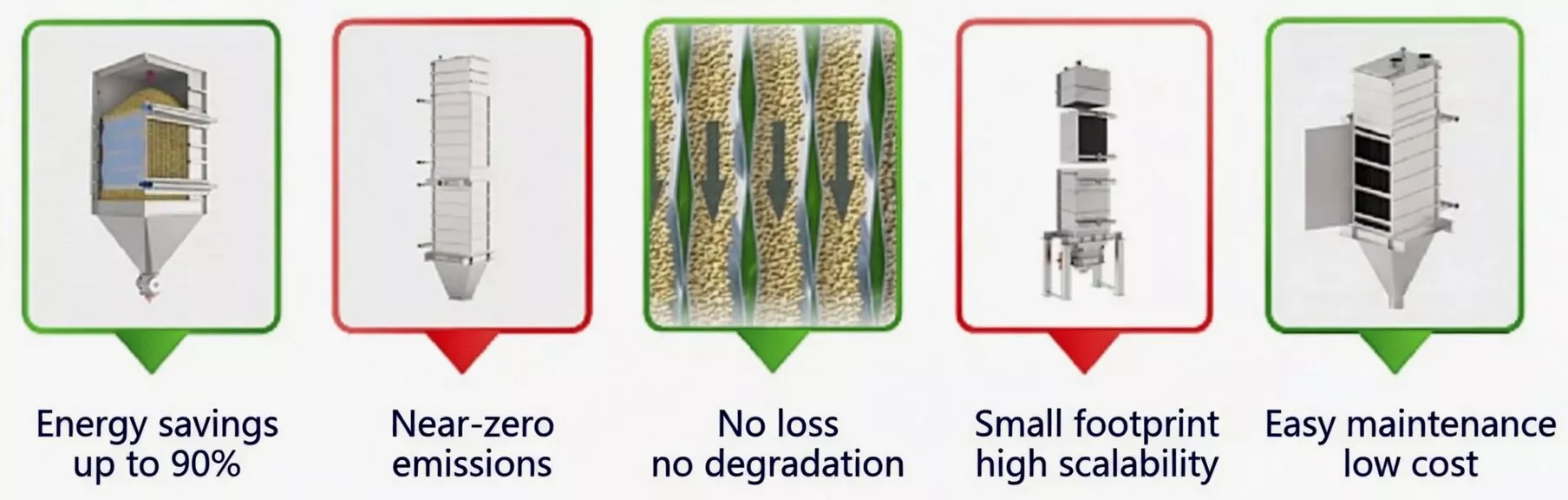
- 01Energy savings up to 90% — recovered heat can be pre-heated combustion air or boiler feed water.
- 02Near-zero fugitive emissions — fully sealed vertical shell, no dust cloud during cooling.
- 03No product loss, no degradation — gentle gravity flow keeps particle size distribution intact.
- 04Small footprint, high scalability — add modules on top of each other to lift duty by 2x or 3x.
- 05Easy maintenance, low OPEX — quick-opening doors, pull-out plate packs, single-plate replacement.
Technical Advantages of the Pillow-Plate Design
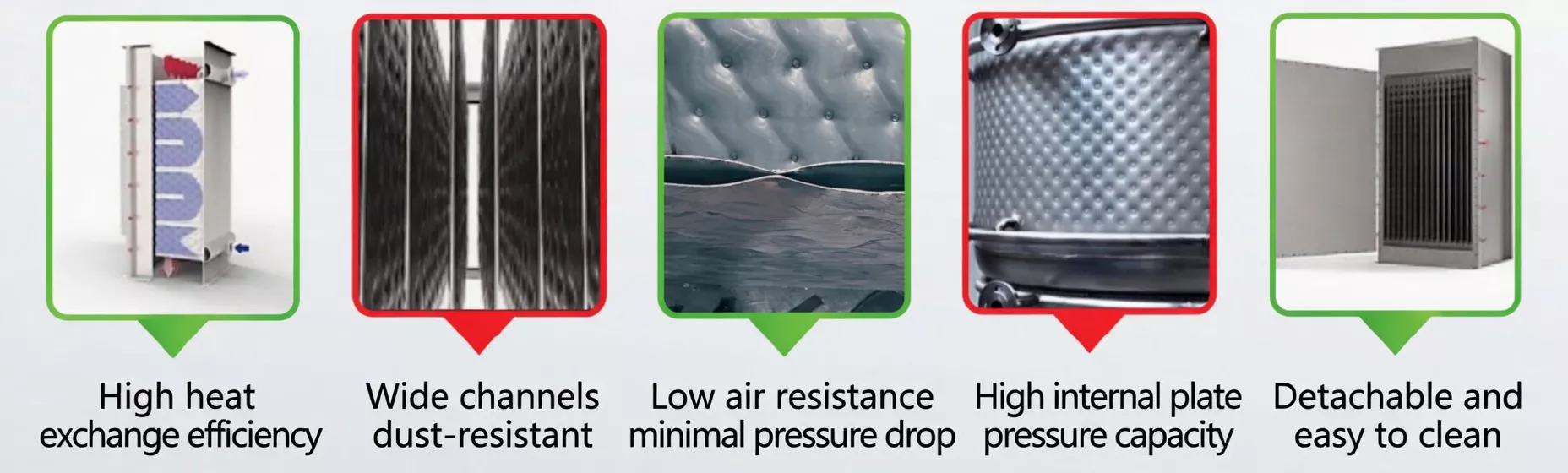
Every pillow plate is formed by laser welding two stainless-steel sheets (304, 316L or duplex on request) and hydro-forming them so that the internal flow path becomes a 3D pattern of welded spots. This creates the turbulence that drives a high heat-transfer coefficient without forcing us to narrow the gap between plates.
Flue gas or air passes sinusoidally along the outside of the plates. Pressure drop stays below 600 Pa at design flow, a fraction of what a finned-tube economiser would demand. Each plate withstands 60 bar working pressure, with burst pressure exceeding 200 bar — a safety margin that matters in lithium-ion precursor drying and hydrocarbon cracking service.
Counter-Flow Heat Transfer Principle
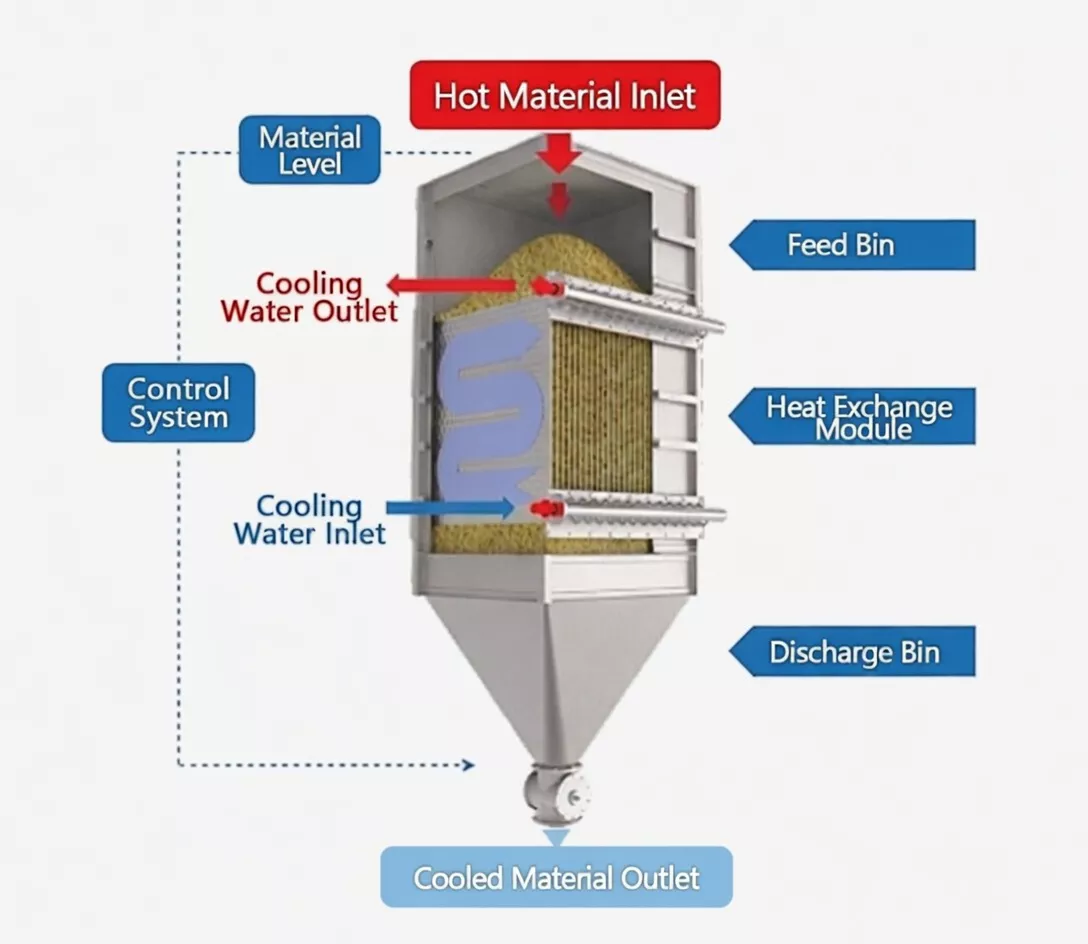
Why true counter-flow matters
Hot powder enters at the top at temperatures up to 500 °C. Cooling water enters at the bottom at roughly 28 °C (typical Australian makeup water). The two media move in opposite directions, so the temperature difference stays almost constant along the full height of the exchanger.
The result: outlet powder temperature can be driven within 10-15 °C of the inlet cooling water, a performance level that fluidised bed coolers simply cannot match. This is the core reason the wide-channel plate heat exchanger keeps improving your overall energy balance year after year.
Technical Specifications
| Model | Heat Duty (kW) | Throughput (t/h) | Plate Area (m²) | Channel Gap (mm) | Footprint (m) |
|---|---|---|---|---|---|
| EP-WPHE-200 | 200 | 2 – 4 | 40 | 18 – 25 | 1.6 x 1.2 |
| EP-WPHE-500 | 500 | 5 – 10 | 95 | 25 – 40 | 2.2 x 1.6 |
| EP-WPHE-1000 | 1000 | 10 – 20 | 180 | 40 – 60 | 2.8 x 2.2 |
| EP-WPHE-2500 | 2500 | 25 – 50 | 420 | 50 – 70 | 3.6 x 2.8 |
| EP-WPHE-5000+ | 5000 and above | 50 – 120 | 800+ | 60 – 80 | Custom skid |
Media: cooling water, glycol, thermal oil or low-pressure steam. Plate materials: SS304 / SS316L / Duplex 2205 / Hastelloy on request. Design code: AS 1210, ASME Section VIII Div.1, PED 2014/68/EU.
Typical Applications in Australian Industry
Lithium & Battery Materials
Cooling lithium carbonate, lithium hydroxide and cathode precursors after calcination in WA and QLD refineries.
Cement & Lime
Clinker cooling replacement of grate coolers, heat recovery to pre-heat secondary combustion air.
Chemical & Polymer
PVC, polyethylene, urea and ammonium nitrate granule cooling without caking or spec drift.
Pharmaceutical & Food
Sugar crystal, skim milk powder and API intermediate cooling with hygienic 316L plates.
Hazardous Waste Centres
Bottom ash and fly ash cooling downstream of rotary kiln incinerators and RTO systems.
Mining & Minerals
Iron ore pellet, alumina and silica sand cooling at integrated processing hubs.
Wide-Channel Plate vs. Traditional Coolers
| Parameter | Ever-power Wide-Channel Plate | Rotary Drum Cooler | Fluidised Bed Cooler |
|---|---|---|---|
| Heat Recovery | Up to 90% | 30 – 50% | 40 – 60% |
| Dust Emissions | Near zero | High | Very high |
| Footprint | Compact vertical | Very large horizontal | Large with cyclones |
| Moving Parts | None | Drum, gearbox, seals | Blowers, distributor |
| Product Degradation | Negligible | Abrasion & fines | Attrition |
| Specific Power (kWh/t) | 0.8 – 1.5 | 3 – 6 | 6 – 12 |
Why Choose Ever-power
Designing industrial heat recovery and thermal oxidation systems for more than two decades.
Plate heat exchangers and RTO systems delivered across APAC, Europe and the Americas.
Pressure equipment engineered against Australian Standard AS 1210 and third-party witnessed by TÜV or Lloyd’s.
Commissioning engineers available AEST business hours, spare plates warehoused for 72-hour dispatch.
Automated robotic laser welding cells give each pillow plate identical spot geometry and leak-free seams.
From process simulation and HTRI rating to skid fabrication, shipping and site training — one single contract.
Learn more about our engineering organisation on the Ever-power homepage or download our technical brochures.
Australian Project Case Studies
Case 01 — Lithium Hydroxide Plant, Kwinana WA
Challenge: the client was spending AUD 480,000 per year on chilled water to cool 18 t/h of lithium hydroxide monohydrate from 180 °C to 45 °C before packaging. Dust emissions routinely exceeded 35 mg/Nm³.
Solution: an EP-WPHE-1000 wide-channel plate heat exchanger with SS316L pillow plates and a closed cooling water loop. Outcome: outlet powder temperature locked at 42 °C, chilled water consumption dropped 86%, and dust emissions measured under 4 mg/Nm³. Payback: 19 months.
Case 02 — Hazardous Waste Incineration Centre, Laverton North VIC
Challenge: 30 t/day of bottom ash discharged at 420 °C from a rotary kiln incinerator needed rapid cooling to below 80 °C for stabilisation. The existing water-spray quench produced acidic steam and kept operators on constant alert.
Solution: a duplex-steel EP-WPHE-500 module integrated between the kiln discharge and the ash-stabilisation silo. Recovered heat (roughly 420 kW) now pre-heats combustion air feeding the thermal oxidiser. The site eliminated steam plume complaints from neighbouring properties and gained a 6.2% reduction in natural gas consumption.
Frequently Asked Questions
Request a Free Thermal-Sizing & Quote
Send us your material properties (inlet/outlet temperature, throughput, particle size, bulk density) and a senior process engineer will return a fully sized wide-channel plate heat exchanger proposal within 48 business hours — no obligation.
Head office: Ever-power Industrial Heat Recovery | Response time: under 8 business hours AEST