


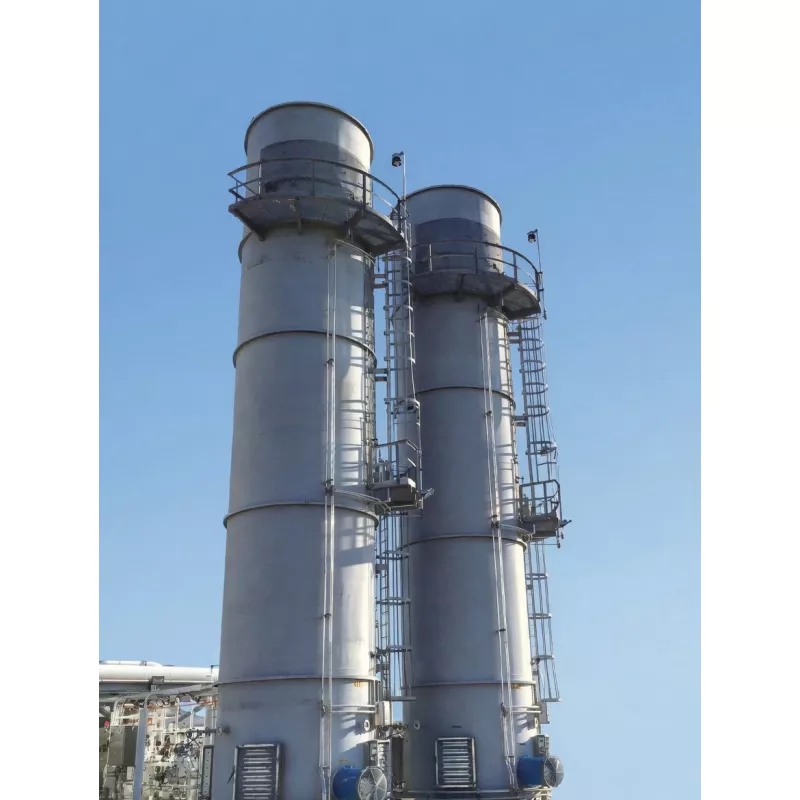

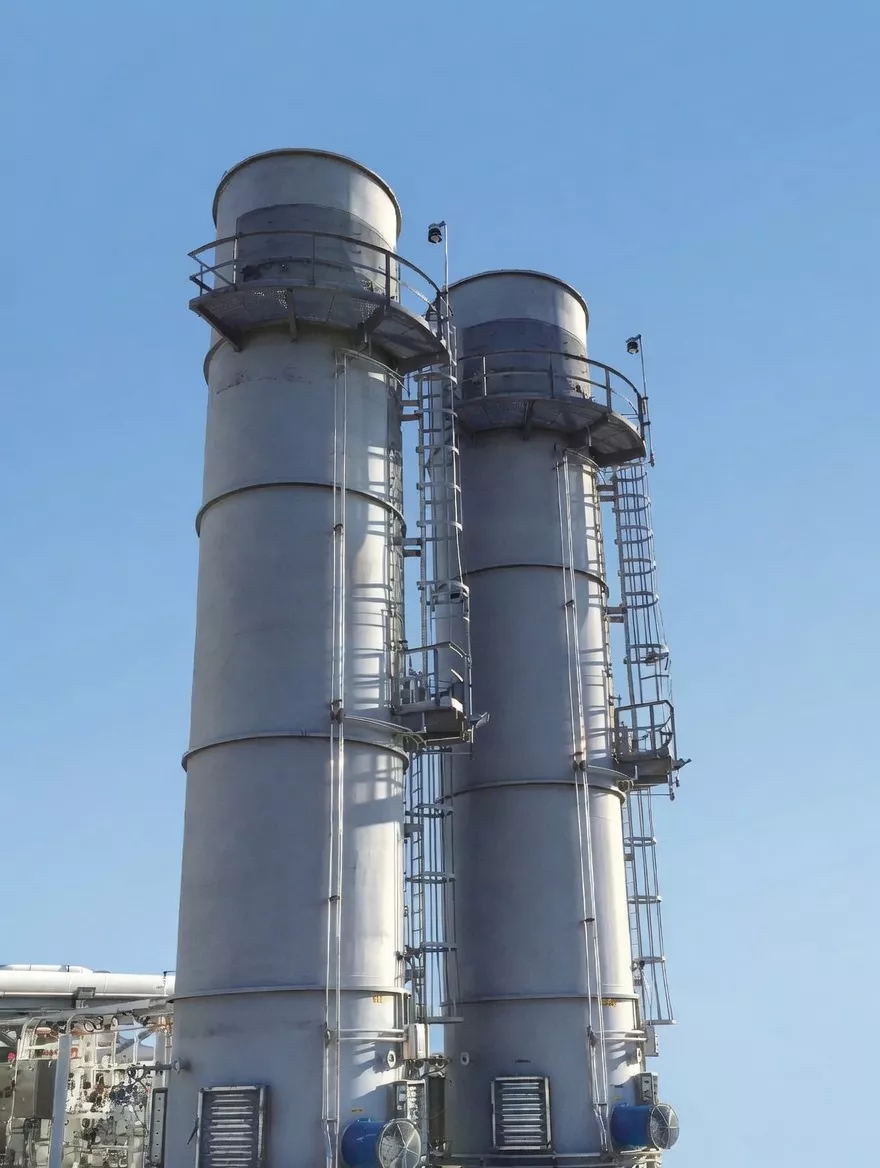
What Is a Vapor Combustion Unit?
A vapour combustion unit (VCU) — sometimes called an enclosed combustion device or low-emission flare — is a purpose-built thermal oxidiser for VOCs and combustible waste gases. Unlike an open flare, the VCU encloses the flame inside a refractory-lined chamber, holds the gas at oxidation temperature for a controlled residence time, and delivers measurable, repeatable destruction efficiency under audit conditions.
Ever-power VCUs are skid-mounted packages that integrate combustion, fuel-gas, vapour-handling, safety and control hardware into a single delivery. They are designed for marine and truck loading terminals, tank-farm vapour control, gasoline distribution depots, ethanol production and any application where regulators require demonstrable VOC destruction.
Core Components Explained
Combustion System
- Anti-flashback main burner
- Continuous-monitored pilot light
- Refractory-lined combustion chamber rated 1,400 °C
- Sized for 0.5–2.0 second residence time at 760–1,100 °C
Gas Supply Unit
- Combustion-air blower with VFD
- Fuel-gas piping with redundant block-and-bleed
- Modulating control dampers
- Inlet flow and pressure transmitters with continuous logging
Safety Control
- Detonation/flame arrestor (FM/UL listed)
- Dual UV/IR flame detection
- Ignition controller with NFPA 86 sequencing
- SIL 2 BMS as standard, SIL 3 available
Waste Gas Handling
- Vapour piping with isolation valving
- Booster blower (where vapour pressure is insufficient)
- Liquid knock-out and demister
- Sample point per AS 4323 for performance verification
Performance & Specifications
| Parameter | Specification |
|---|---|
| VOC destruction efficiency | 99.0% (typical) up to 99.99% (engineered) |
| Outlet hydrocarbon | <10 mg/L (terminal-grade) |
| Operating temperature | 760–1,100 °C in combustion chamber |
| Residence time | ≥0.75 s (per 40 CFR 60 Subpart QQQ) |
| Vapour flow capacity | 100 Nm³/h to 80,000 Nm³/h |
| VOC concentration range | 200 g/Nm³ down to lean cases (with assist fuel) |
| Fuel | Natural gas, propane, fuel gas, LPG |
| Control | Allen-Bradley / Siemens PLC, HMI, remote dial-in |
| Hazardous area | Zone 1 / Zone 2 IECEx / ATEX as required |
| Compliance | AS 3814, AS 1940, NFPA 86, IEC 61511, API 537 |
VCU vs Open Flare vs RTO — Which Fits Your Site?
| Criterion | VCU | Open Flare | RTO |
|---|---|---|---|
| Visible flame | No | Yes | No |
| DRE typical | 99–99.99% | 98–99% | 95–99% |
| Best VOC concentration | Medium-high (with assist fuel possible) | High | Low (<25% LEL) |
| Capital cost | Medium | Low (small) / High (large) | High |
| OPEX | Low (self-sustaining at design VOC) | Medium (assist gas/steam) | Medium-low |
| Audit-ready | Yes — sample port + CEMS option | Indirect | Yes |
Where Australian Operators Deploy VCUs
- Marine loading terminals: petrol, jet fuel, diesel and crude vapour control during ship and barge loading.
- Truck and rail-car loading racks: displaced vapours during top- and bottom-loading captured and oxidised.
- Tank farms & storage terminals: floating-roof emissions, breathing losses, and degassing during tank cleaning.
- Refineries: small to mid-rate continuous vents that should not go to a main flare.
- Petrochemical & specialty chemical: reactor vents, distillation off-gas, batch process emissions.
- Ethanol & bioenergy: fermenter and storage vapour streams under increasingly tight licence conditions.
Why Specifiers Choose Ever-power VCUs
Our combustion engineering history is detailed on the company page. For VCU procurement specifically, here is what changes the conversation:
Audit-Ready Documentation
Each unit ships with a performance-test report aligned with EPA Method 25A / AS 4323, IEC 61511 functional safety dossier, and a complete operations & maintenance manual — the package your environmental manager actually needs.
Engineered for the Worst Day
Anti-flashback main burner, dual flame detection, and SIL 2 BMS as standard. We do not de-rate safety to meet a price target.
Skid Modular Delivery
Pre-piped, pre-wired and FAT-tested in our shop. Site installation reduces from months to weeks, with predictable schedule and cost.
Full Lifecycle Service
Refractory programme, burner refurbishment, instrumentation re-calibration and 24/7 phone support — over the full 20-year asset life.
Australian Project Highlights
Port Botany Marine Loading VCU
Location: Sydney, NSW | Year: 2024
A 24,000 Nm³/h petrol vapour stream from product loading was previously sent to an ageing candlestick flare. Ever-power supplied a twin-chamber VCU package with 99.6% measured destruction efficiency under variable loading rates.
Outcome: EPA NSW emission licence variation approved; VOC fugitive losses reduced by an estimated 320 tonnes/year.
SA Tank Farm Degassing VCU
Location: Port Adelaide, SA | Year: 2025
A relocatable skid VCU was supplied for tank cleaning campaigns across multiple storage terminals. Mobile design with road-transport-compliant skid base and quick-connect vapour piping enabled redeployment within 48 hours per site.
Outcome: Audited 99.4% DRE; six campaigns completed in twelve months with zero unplanned downtime.
Frequently Asked Questions
A VCU encloses the flame in a refractory-lined chamber and operates with controlled residence time and temperature, producing measurable destruction efficiency that an open flare cannot. The VCU is preferred where visible flame is unacceptable or where audit-grade emission documentation is required.
Yes — an assist fuel-gas burner brings the chamber to oxidation temperature, after which the VOC contributes to the heat balance. For very lean streams an RTO may be more economical; we will recommend the right path during sizing.
99% to 99.99% verified by EPA Method 25A or AS 4323 stack testing. The performance-test pack and on-site witnessing are included in our commissioning scope.
Detonation arrestor at vapour inlet, anti-flashback burner geometry, dual UV/IR flame detection, and SIL-rated BMS that isolates vapour in under one second on unsafe condition.
Yes — IECEx/ATEX-certified instrumentation rated for Zone 1 or Zone 2 with hazardous-area junction boxes and intrinsically-safe field wiring.
Standard VCU skids: 22–28 weeks from PO including FAT. Larger custom packages with booster blower and CEMS: 28–36 weeks.
Yes — we frequently configure a VRU as primary recovery with the VCU as backup destruction. This combination maximises product recovery while keeping a compliant fallback for high-rate or off-spec events.
Get an EPA-Ready VCU Specification
Send us your vapour flow profile, composition, site classification and licence conditions. You will receive a sized VCU configuration, performance-test methodology and indicative pricing within five working days.